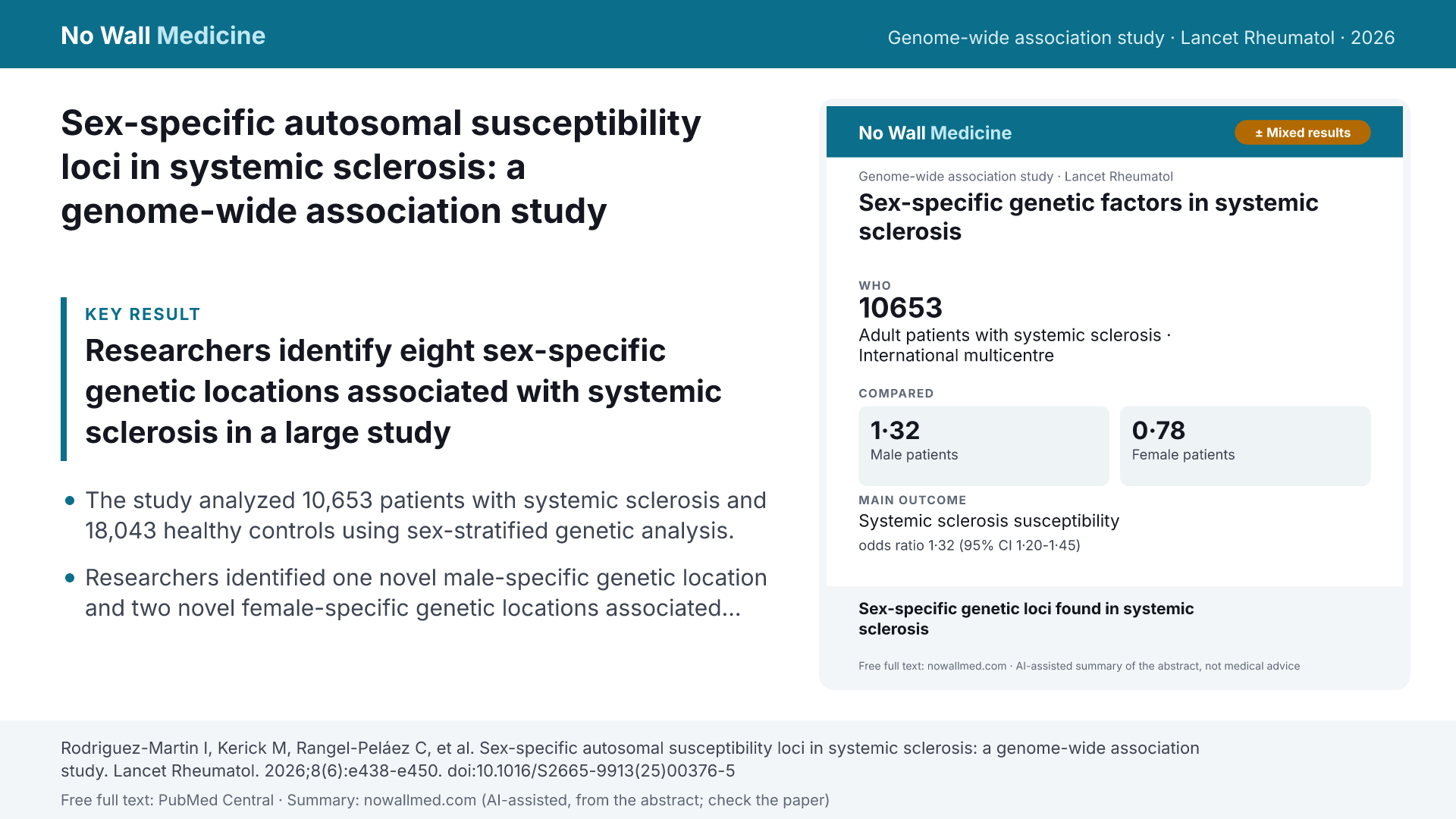
Researchers identify eight sex-specific genetic locations associated with systemic sclerosis in a large study
Sex-specific autosomal susceptibility loci in systemic sclerosis: a genome-wide association study
Genome-wide association studyMixed results
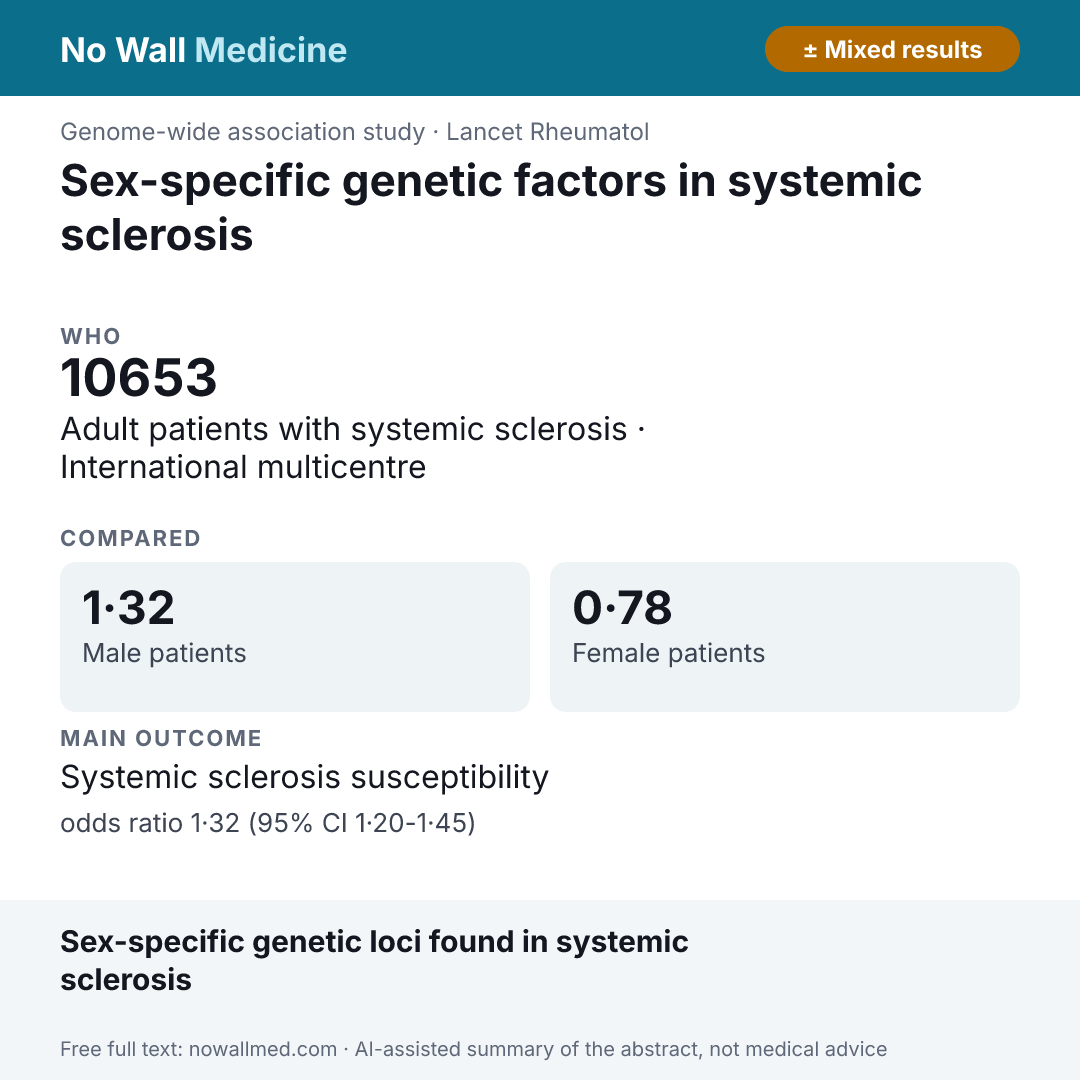
Sex-specific genetic factors in systemic sclerosis
Who
10653
Adult patients with systemic sclerosis · International multicentre
Compared
1·32Male patients (1·20-1·45)
0·78Female patients (0·71-0·85)
Main outcome
Systemic sclerosis susceptibility
Result: odds ratio 1·32 (95% CI 1·20-1·45)
Bottom line: Sex-specific genetic loci found in systemic sclerosis
Funded by: Instituto de Salud Carlos III
Lancet Rheumatol · 2026-04-15 · Save PNG
Why it matters: Systemic sclerosis is an inflammatory disease with differences in prevalence and severity between sexes, but sex-aware genetic research has been scarce.
Key points
- The study analyzed 10,653 patients with systemic sclerosis and 18,043 healthy controls using sex-stratified genetic analysis.
- Researchers identified one novel male-specific genetic location and two novel female-specific genetic locations associated with the disease.
- Functional analysis of the findings implicated 39 candidate genes, including five that showed sex-differential expression in patients.
Headline and key points written with AI from the paper’s abstract, with every number checked against it. Read the paper before relying on them.
Was this summary helpful?
Abstract
Background
Systemic sclerosis is an immune-mediated inflammatory disease with marked sex differences in prevalence and severity. Although genome-wide association studies (GWAS) have advanced the understanding of systemic sclerosis genetics, sex-aware approaches remain scarce. We aimed to address this gap by examining autosomal sex-specific genetic factors in systemic sclerosis. Methods
Based on a chromosomal definition of sex, we conducted a sex-stratified autosomal meta-analysis of GWAS in systemic sclerosis. We retrieved patient-level and control data from a previous GWAS for systemic sclerosis and newly recruited participants from an international multicentre collaboration (data cutoff June 1, 2024). Adult patients (aged ≥18 years) were required to meet the 2013 American College of Rheumatology-European League Against Rheumatism classification criteria or the criteria for early systemic sclerosis proposed by LeRoy and Medsger, 2001. Patients with systemic sclerosis were compared with healthy controls through sex-stratified analyses. Sex-specific loci were functionally annotated and a sex-differential expression analysis was performed to validate the findings. Additionally, we performed a drug repurposing analysis to explore the clinical implications of our findings. People with lived experience of systemic sclerosis were not involved in the study design or conduct. Findings
After quality control filtering, we included 10 653 patients with systemic sclerosis (1556 male and 9097 female) and 18 043 controls (6990 male and 11 053 female). We identified eight sex-specific loci associated with systemic sclerosis: one novel male-specific locus (BCL11A odds ratio [OR] 1·32 [95% CI 1·20-1·45], p=8·39 × 10-9), two novel female-specific loci (IRF4 OR 0·78 [0·71-0·85], p=2·36 × 10-8RPL3-PDGFB OR 1·19 [1·12-1·26], p=3·18 × 10-8), and five previously known loci now characterised as female-specific. Functional analyses implicated 39 candidate genes, of which five (IL12RB2, ARHGAP31, UBL7, CSK, and MPI) showed sex-differential expression in patients with systemic sclerosis. Two approved drugs, fostamatinib and dasatinib, were identified as potential repurposing candidates for systemic sclerosis sex-aware treatment. Interpretation
We report the first evidence of sex-specific genetic architecture in systemic sclerosis. These findings offer insight into the molecular basis of sex differences in the disease, highlighting both IL12RB2 gene and interferon signalling. These results also support the development of sex-aware precision medicine approaches. Funding
Instituto de Salud Carlos III, EU's Seventh Framework Program, and European Federation of Pharmaceutical Industries and Associations companies.
Abstract reproduced under the article’s CC BY NC ND licence.
Subject terms
Headline, design, result, key points, caveat and citation as plain text.
Cite this article
Rodriguez-Martin I, Kerick M, Rangel-Peláez C, et al. Sex-specific autosomal susceptibility loci in systemic sclerosis: a genome-wide association study. Lancet Rheumatol. 2026;8(6):e438-e450. doi:10.1016/S2665-9913(25)00376-5
Spotted a mistake? Suggest a correction