Sex-specific analysis shows similar risks for women and men after coronary stent procedures
Sex-Specific Differences in Clinical Outcomes After Percutaneous Coronary Intervention: Insights from the TAILOR-PCI Trial
Randomized trialNo clear difference
Sex differences after coronary intervention
Who
5276
Patients after coronary intervention
Compared
Women
Men
Main outcome
Major adverse cardiac events
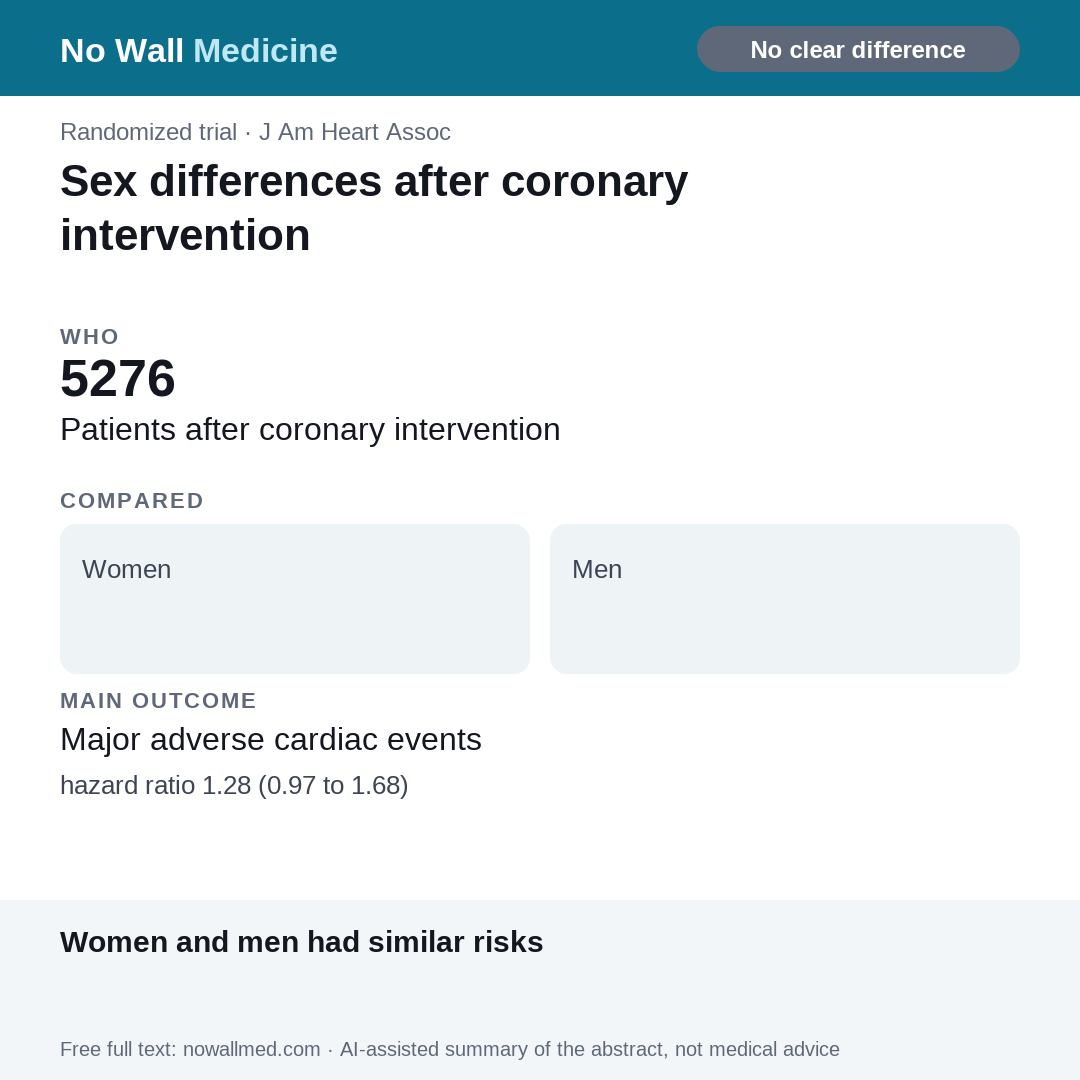
Result: hazard ratio 1.28 (0.97 to 1.68)
Bottom line: Women and men had similar risks
J Am Heart Assoc · 2022-06-14Download image
Why it matters: It was unknown if sex influences the relationship between genetic variations in the CYP2C19 gene and clinical outcomes after coronary stent procedures.
Key points
- Researchers analyzed 5276 randomized patients to compare cardiovascular events and bleeding risks between men and women after percutaneous coronary intervention, which is a procedure to open blocked heart arteries.
- At 12 months, the risks for major adverse cardiac events (hazard ratio 1.28 [0.97 to 1.68]) and bleeding (hazard ratio 1.36 [0.91 to 2.05]) were comparable between women and men.
- Genotype-guided therapy did not significantly reduce the risk of major adverse cardiac events or bleeding compared to conventional therapy for either sex.
Headline and key points written with AI from the paper’s abstract, with every number checked against it. Read the paper before relying on them.
Was this summary helpful?
Subject terms
Cite this article
Madan M, Abbott JD, Lennon R, So DYF, MacDougall AM, McLaughlin MA. Sex-Specific Differences in Clinical Outcomes After Percutaneous Coronary Intervention: Insights from the TAILOR-PCI Trial. J Am Heart Assoc. 2022. doi:10.1161/JAHA.121.024709
Spotted a mistake? Suggest a correction
Top studies every Monday
The week’s key trials and guidelines in your specialties, plus any topics you follow. By email, free.
Get the weekly digest