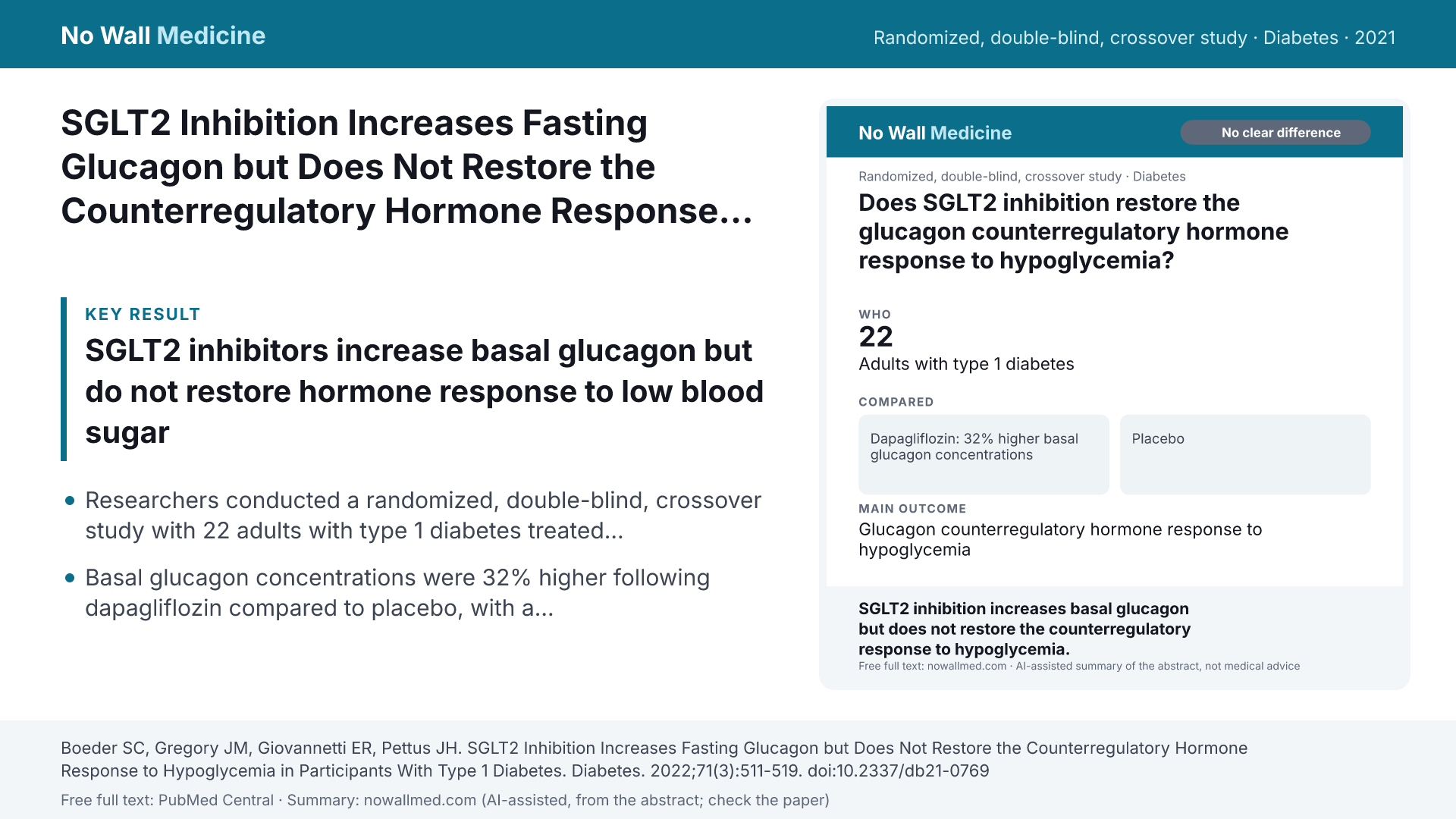
SGLT2 Inhibition Increases Fasting Glucagon but Does Not Restore the Counterregulatory Hormone Response to Hypoglycemia in Participants With Type 1 Diabetes
Key result: SGLT2 inhibitors increase basal glucagon but do not restore hormone response to low blood sugar
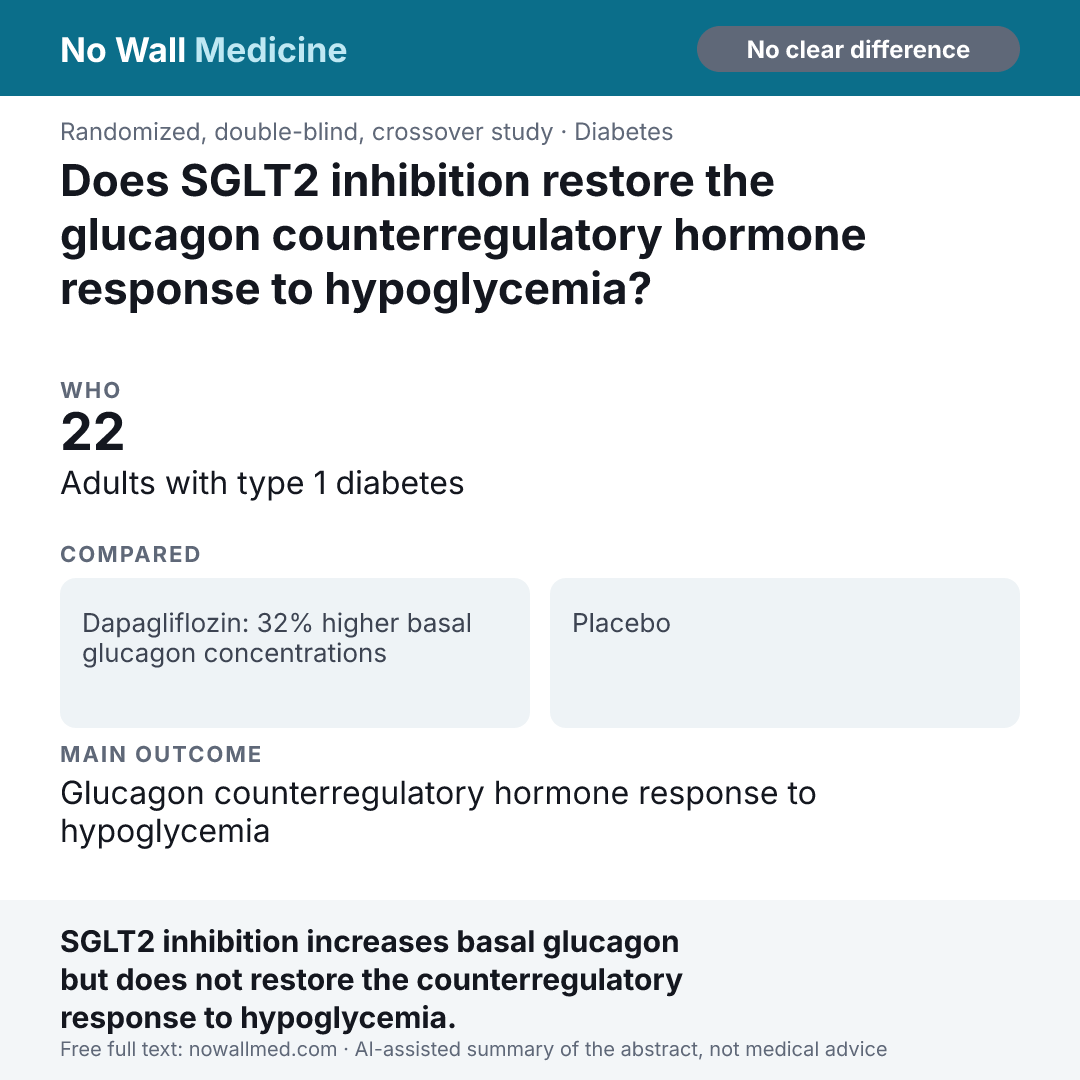
Randomized, double-blind, crossover studyNo clear difference
Does SGLT2 inhibition restore the glucagon counterregulatory hormone response to hypoglycemia?
Who
22
Adults with type 1 diabetes
Compared
Dapagliflozin: 32% higher basal glucagon concentrations
Placebo
Main outcome
Glucagon counterregulatory hormone response to hypoglycemia
Bottom line: SGLT2 inhibition increases basal glucagon but does not restore the counterregulatory response to hypoglycemia.
Diabetes · 2021-12-04 · Save PNG
Key points
- Researchers conducted a randomized, double-blind, crossover study with 22 adults with type 1 diabetes treated with dapagliflozin or a placebo for 4 weeks.
- Basal glucagon concentrations were 32% higher following dapagliflozin compared to placebo, with a median within-participant difference of 2.75 pg/mL (95% CI 1.38-12.6).
- SGLT2 inhibition did not change counterregulatory hormone concentrations, time to recovery from hypoglycemia, hypoglycemia symptoms, or cognitive function during a hypoglycemic clamp.
Discussion prompts
- Would these patients look like yours? Who was left out?
- Is the main outcome one that matters to patients?
- Is the difference large enough to change what you do?
Cite: Boeder SC, Gregory JM, Giovannetti ER, Pettus JH. SGLT2 Inhibition Increases Fasting Glucagon but Does Not Restore the Counterregulatory Hormone Response to Hypoglycemia in Participants With Type 1 Diabetes. Diabetes. 2022;71(3):511-519. doi:10.2337/db21-0769
Free full text: PubMed Central · Summary and visual abstract: nowallmed.com/a/sglt2-inhibition-increases-fasting-glucagon-but-does-not-restore-the-1x50n2a/ (AI-assisted from the abstract; check the paper before relying on it).