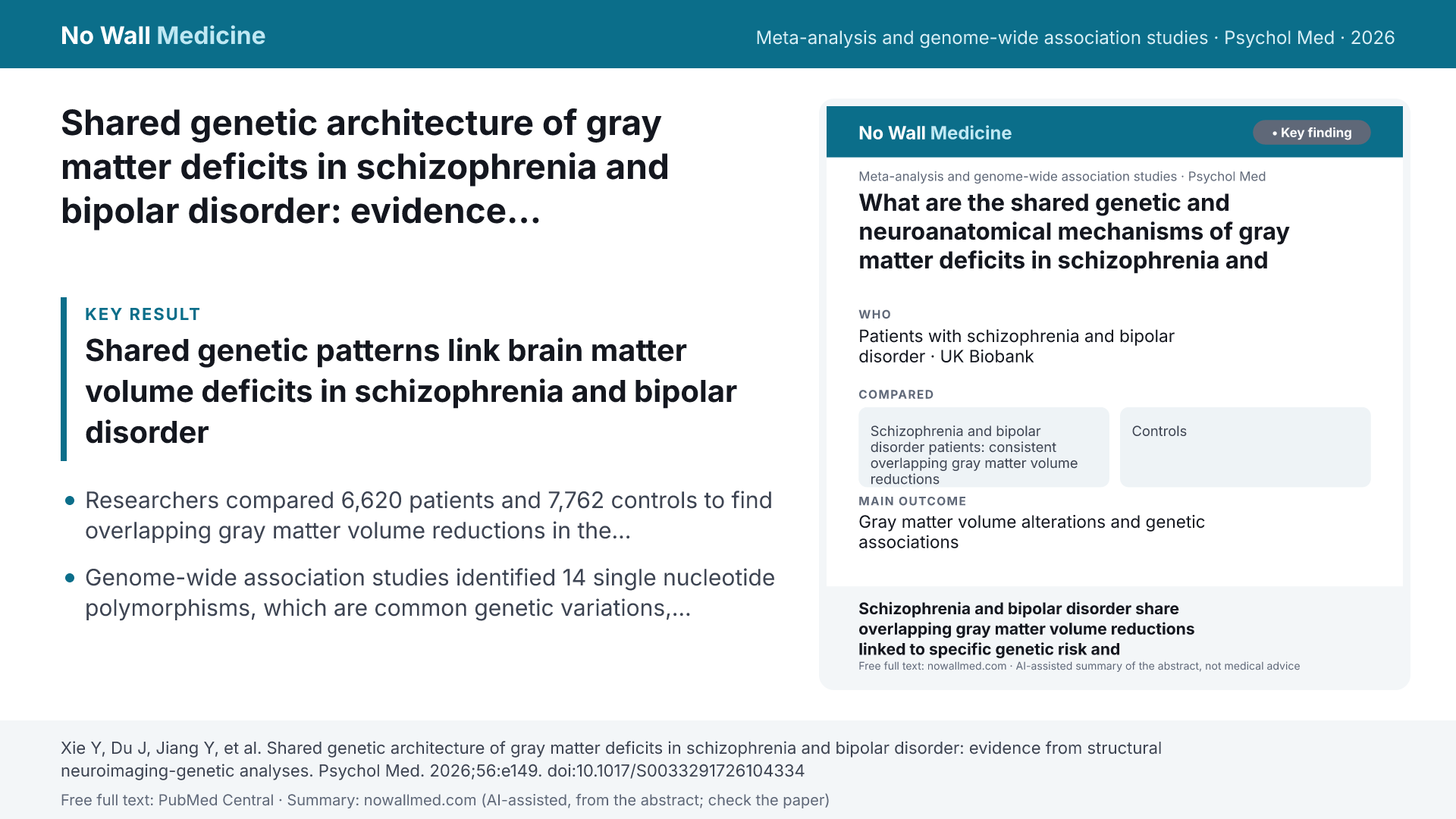
Shared genetic architecture of gray matter deficits in schizophrenia and bipolar disorder: evidence from structural neuroimaging-genetic analyses
Key result: Shared genetic patterns link brain matter volume deficits in schizophrenia and bipolar disorder
Meta-analysis and genome-wide association studiesKey finding
What are the shared genetic and neuroanatomical mechanisms of gray matter deficits in schizophrenia and bipolar disorder?
Who
Patients with schizophrenia and bipolar disorder · UK Biobank
Compared
Schizophrenia and bipolar disorder patients: consistent overlapping gray matter volume reductions
Controls
Main outcome
Gray matter volume alterations and genetic associations
Bottom line: Schizophrenia and bipolar disorder share overlapping gray matter volume reductions linked to specific genetic risk and pleiotropic single nucleotide polymorphisms.
Psychol Med · 2026-05-14
Key points
- Researchers compared 6,620 patients and 7,762 controls to find overlapping gray matter volume reductions in the frontal, temporal, and insular brain regions.
- Genome-wide association studies identified 14 single nucleotide polymorphisms, which are common genetic variations, associated with these shared brain volume deficits.
- Two specific genetic variations were linked to both schizophrenia, bipolar disorder, and the shared reductions in gray matter volume.
Discussion prompts
- Would these patients look like yours? Who was left out?
- Is the main outcome one that matters to patients?
- Is the difference large enough to change what you do?
Cite: Xie Y, Du J, Jiang Y, et al. Shared genetic architecture of gray matter deficits in schizophrenia and bipolar disorder: evidence from structural neuroimaging-genetic analyses. Psychol Med. 2026;56:e149. doi:10.1017/S0033291726104334
Free full text: PubMed Central · Summary and visual abstract: nowallmed.com/a/shared-genetic-architecture-of-gray-matter-deficits-in-schizophrenia-1pjabsd/ (AI-assisted from the abstract; check the paper before relying on it).