Shared local oncology care after stem cell transplant shows similar mortality and varying quality of life
Shared Local Oncology Care After Allogeneic Hematopoietic Cell Transplantation: A Randomized Clinical Trial
Multicenter collaborative randomized clinical trialBenefit found
Is shared follow-up care after hematopoietic cell transplantation safe and effective?
Who
302
Patients undergoing allogeneic hematopoietic cell transplantation · Massachusetts, Rhode Island, New Hampshire, New York, and Maine
Compared
2.6%Shared care (95% CI, 0.7% to 6.6%)
2.7%Usual care (95% CI, 0.7% to 6.7%)
Main outcome
Nonrelapse mortality and quality of life
Result: noninferior NRM at day 100
Bottom line: Shared care is safe and improves early quality of life compared to usual care after transplantation.
JAMA Oncol · 2025-01-09Download image
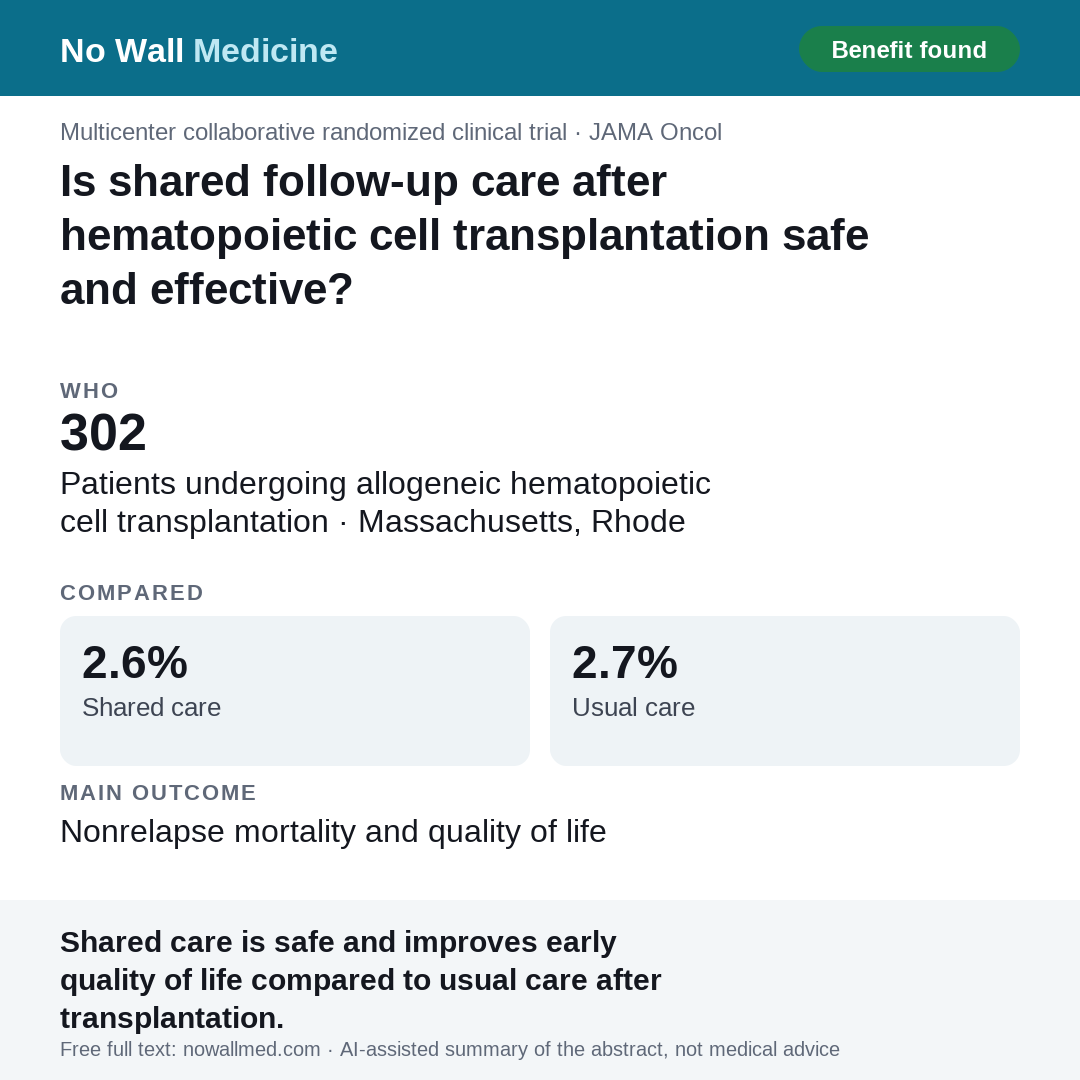
Clinical question: Is shared follow-up care after hematopoietic cell transplantation safe and effective?
Why it matters: It is unknown if sharing follow-up care between a transplant center and local oncologists is safe or improves quality of life for patients living far from transplant centers.
In absolute numbers
Shared care: 2.6% · Usual care: 2.7% → a difference of 0.1 percentage points, so about 1000 people would need the treatment for 1 more to benefit (number needed to treat) over the trial’s follow-up.
Worked out by us from the two group results above, not reported by the authors. Check the paper for the exact outcome and timing.
Key points
- Researchers randomized 302 patients undergoing allogeneic hematopoietic cell transplantation (stem cell transplant) to either shared care with local oncologists or usual care at a specialty center.
- Nonrelapse mortality at day 100 was 2.6% for shared care versus 2.7% for usual care, showing no significant difference in safety.
- Shared care was associated with better quality of life scores at day 100, but no differences were found in quality of life scores at day 180.
Headline and key points written with AI from the paper’s abstract, with every number checked against it. Read the paper before relying on them.
Topics
Cite this article
Abel GA, Kim HT, Zackon I, Alyea ET, Bailey AS, Winters JP. Shared Local Oncology Care After Allogeneic Hematopoietic Cell Transplantation: A Randomized Clinical Trial. JAMA Oncol. 2025. doi:10.1001/jamaoncol.2024.5786
Spotted a mistake? Suggest a correction
Top studies every Monday
The week’s key trials and guidelines in your specialties, by email. Free.
Get the weekly digest