Shift Schedule With Fewer Short Daily Rest Periods and Sickness Absence Among Health Care Workers: A Cluster Randomized Clinical Trial
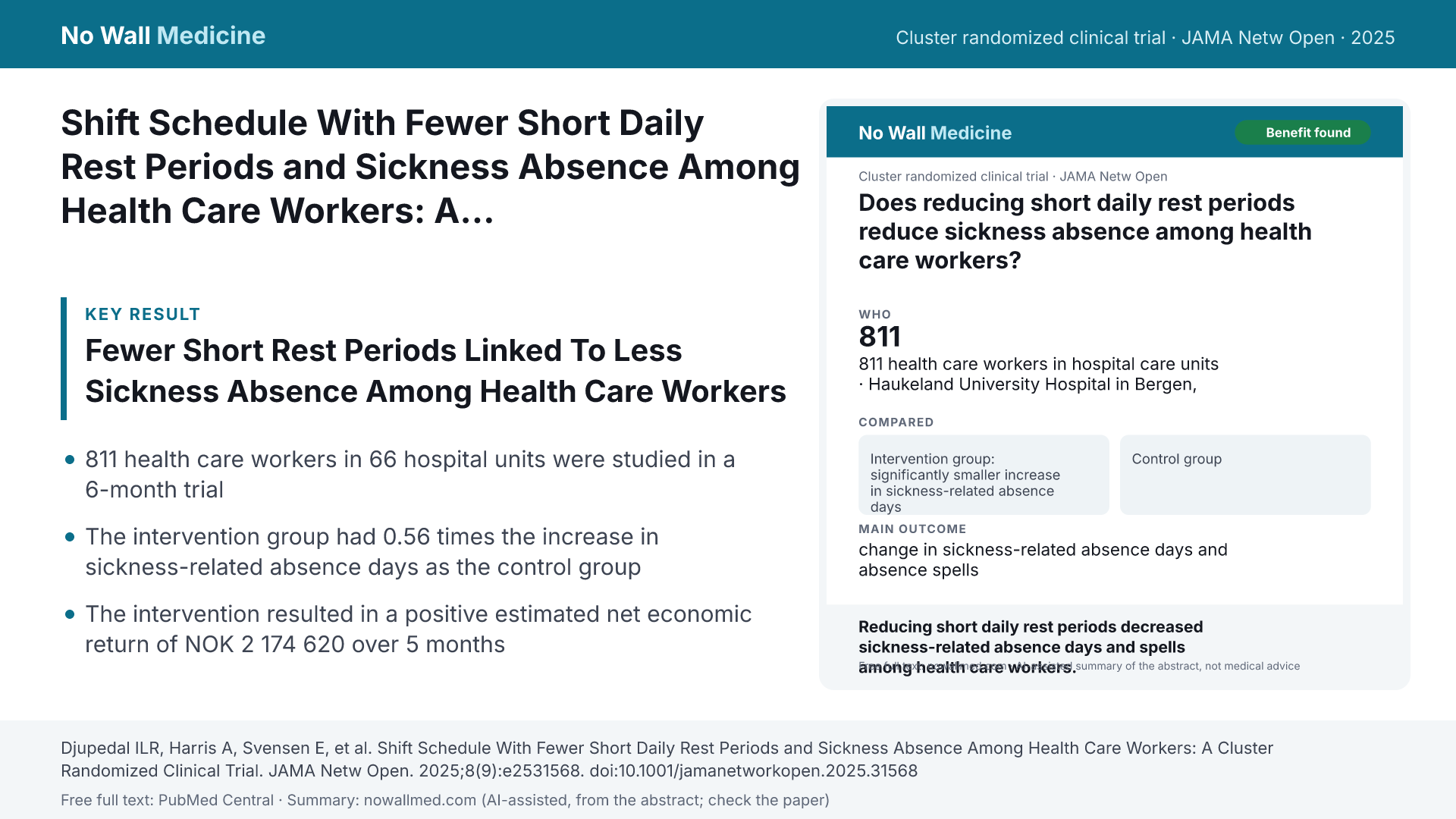
Key result: Fewer Short Rest Periods Linked To Less Sickness Absence Among Health Care Workers
Cluster randomized clinical trialBenefit found
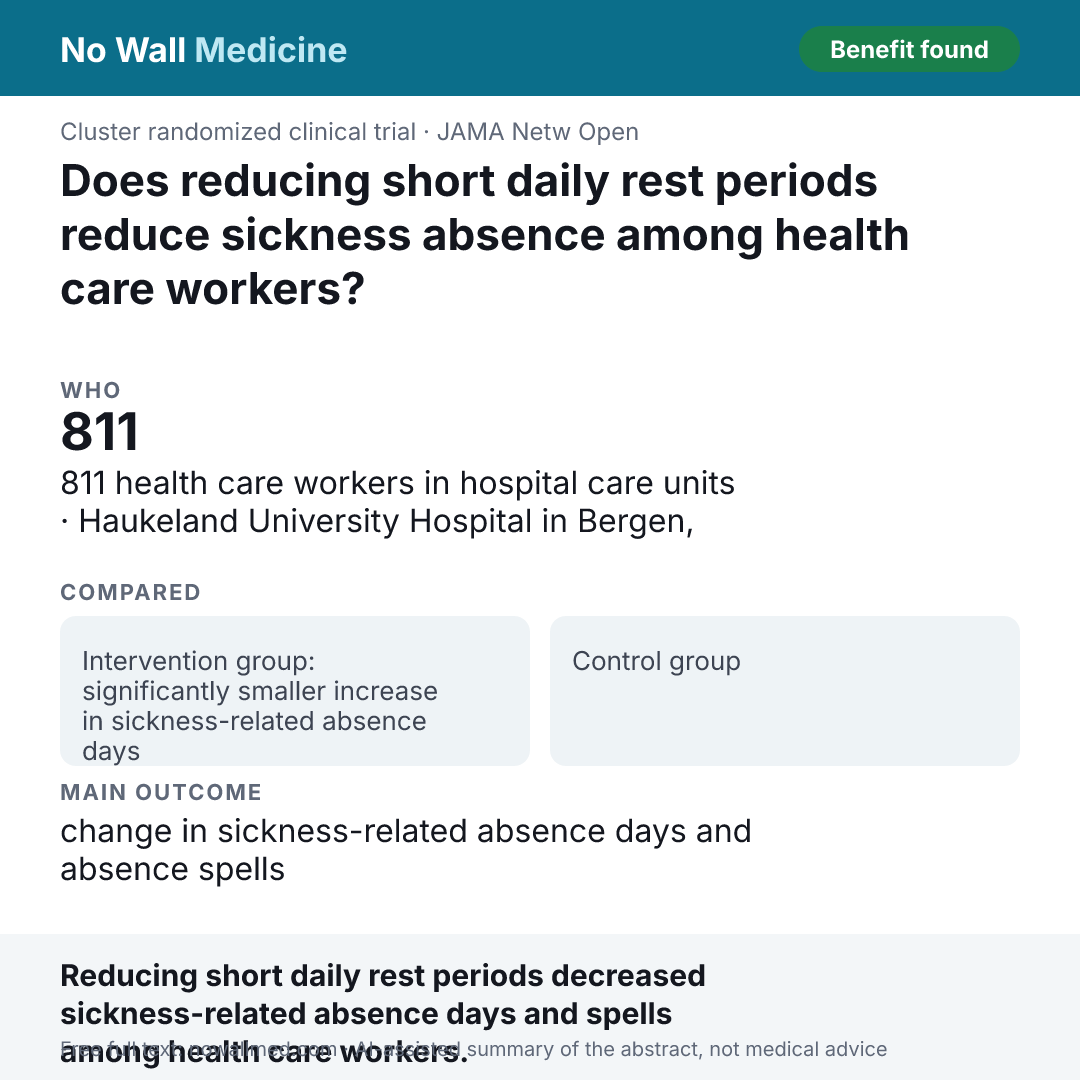
Does reducing short daily rest periods reduce sickness absence among health care workers?
Who
811
811 health care workers in hospital care units · Haukeland University Hospital in Bergen, Norway
Compared
Intervention group: significantly smaller increase in sickness-related absence days
Control group
Main outcome
change in sickness-related absence days and absence spells
Result: incidence rate ratio 0.56 (95% CI 0.41-0.79) for absence days
Bottom line: Reducing short daily rest periods decreased sickness-related absence days and spells among health care workers.
JAMA Netw Open · 2025-09-02 · Save PNG
Key points
- 811 health care workers in 66 hospital units were studied in a 6-month trial.
- The intervention group had 0.56 times the increase in sickness-related absence days as the control group.
- The intervention resulted in a positive estimated net economic return of NOK 2 174 620 over 5 months.
Limitation the authors note: None stated in the abstract
Discussion prompts
- Would these patients look like yours? Who was left out?
- Is the main outcome one that matters to patients?
- Is the difference large enough to change what you do?
Cite: Djupedal ILR, Harris A, Svensen E, et al. Shift Schedule With Fewer Short Daily Rest Periods and Sickness Absence Among Health Care Workers: A Cluster Randomized Clinical Trial. JAMA Netw Open. 2025;8(9):e2531568. doi:10.1001/jamanetworkopen.2025.31568
Free full text: PubMed Central · Summary and visual abstract: nowallmed.com/a/shift-schedule-with-fewer-short-daily-rest-periods-and-sickness-dtdsya/ (AI-assisted from the abstract; check the paper before relying on it).