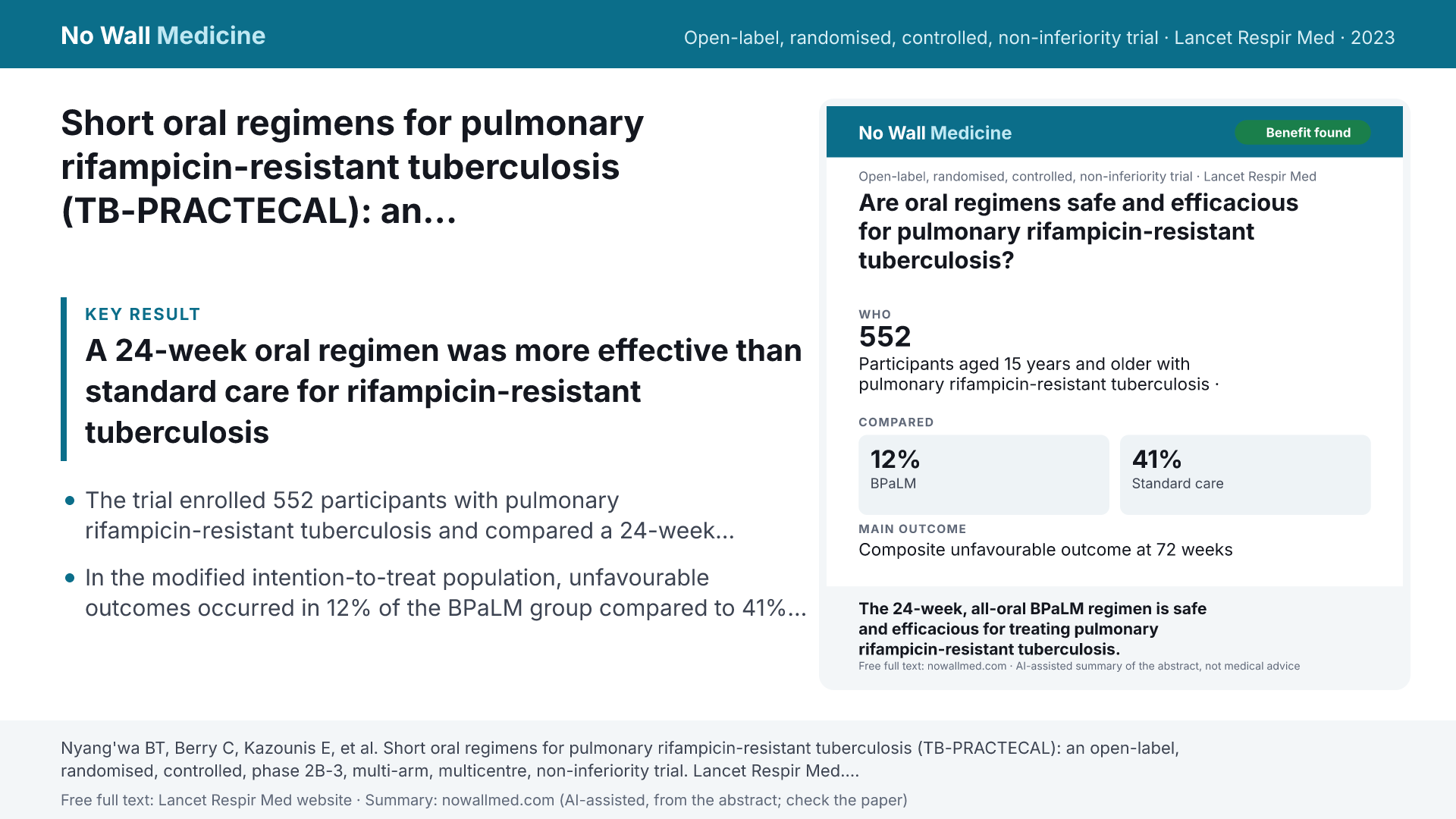
A 24-week oral regimen was more effective than standard care for rifampicin-resistant tuberculosis
Short oral regimens for pulmonary rifampicin-resistant tuberculosis (TB-PRACTECAL): an open-label, randomised, controlled, phase 2B-3, multi-arm, multicentre, non-inferiority trial
Open-label, randomised, controlled, non-inferiority trialBenefit found
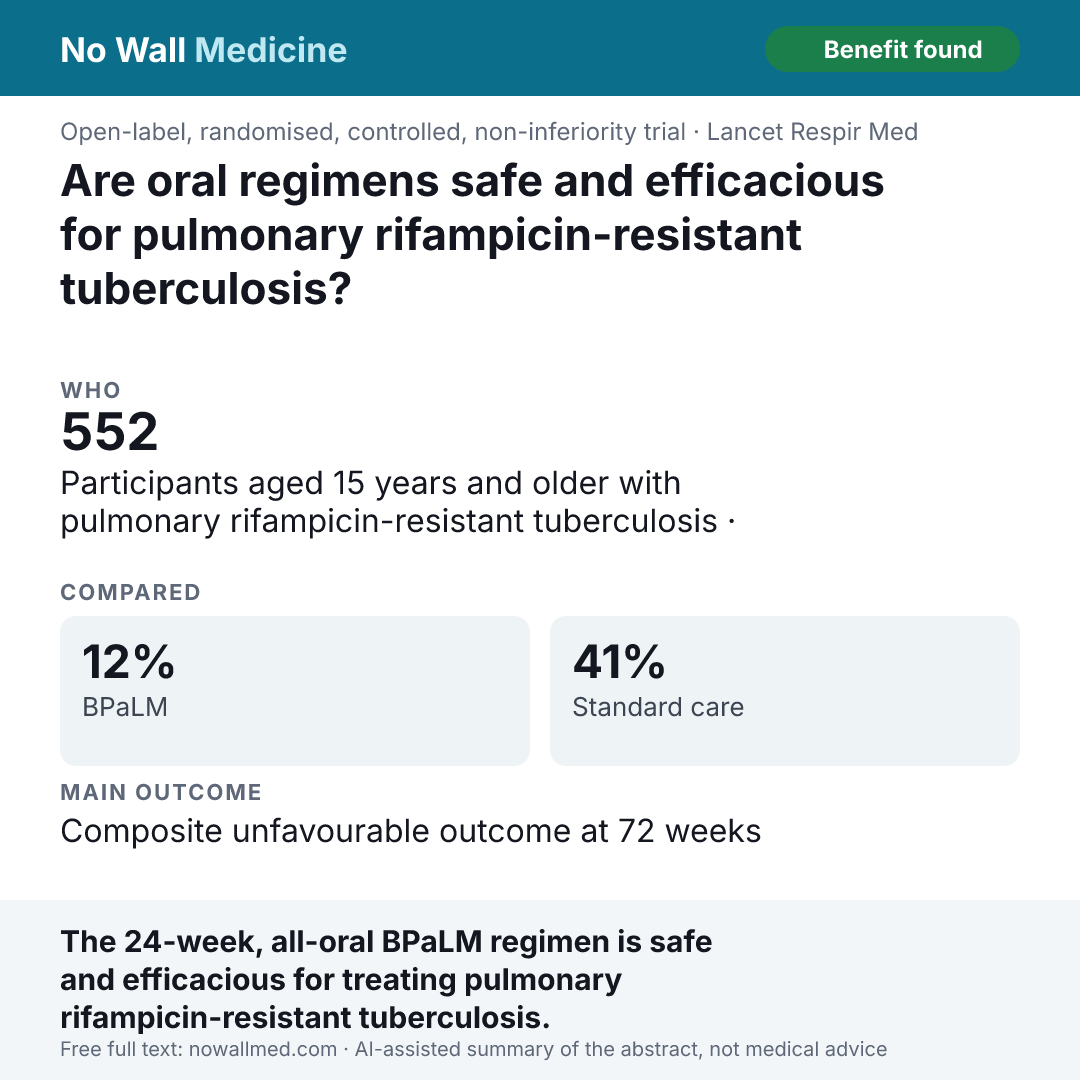
Are oral regimens safe and efficacious for pulmonary rifampicin-resistant tuberculosis?
Who
552
Participants aged 15 years and older with pulmonary rifampicin-resistant tuberculosis · Seven sites in Uzbekistan, Belarus, and South Africa
Compared
12%BPaLM
41%Standard care
Main outcome
Composite unfavourable outcome at 72 weeks
Result: risk difference -29·2 percentage points (96·6% CI -39·8 to -18·6)
In absolute numbers · Composite unfavourable outcome at 72 weeks
BPaLM
Standard care
About 4 people would need the treatment for 1 more to benefit over the trial’s follow-up (number needed to treat).
Worked out by us from the two group results, not reported by the authors.
Bottom line: The 24-week, all-oral BPaLM regimen is safe and efficacious for treating pulmonary rifampicin-resistant tuberculosis.
Lancet Respir Med · 2023-11-16 · Funded by Médecins Sans Frontières · NCT02589782
Why it matters: Successful treatment outcomes for people with rifampicin-resistant tuberculosis remain low and new treatment options are needed.
Headline and visual abstract written with AI from the paper’s abstract, with every number checked against it. Read the paper before relying on them.
Was this summary helpful?
Abstract
Background
Around 500 000 people worldwide develop rifampicin-resistant tuberculosis each year. The proportion of successful treatment outcomes remains low and new treatments are needed. Following an interim analysis, we report the final safety and efficacy outcomes of the TB-PRACTECAL trial, evaluating the safety and efficacy of oral regimens for the treatment of rifampicin-resistant tuberculosis. Methods
This open-label, randomised, controlled, multi-arm, multicentre, non-inferiority trial was conducted at seven hospital and community sites in Uzbekistan, Belarus, and South Africa, and enrolled participants aged 15 years and older with pulmonary rifampicin-resistant tuberculosis. Participants were randomly assigned, in a 1:1:1:1 ratio using variable block randomisation and stratified by trial site, to receive 36-80 week standard care; 24-week oral bedaquiline, pretomanid, and linezolid (BPaL); BPaL plus clofazimine (BPaLC); or BPaL plus moxifloxacin (BPaLM) in stage one of the trial, and in a 1:1 ratio to receive standard care or BPaLM in stage two of the trial, the results of which are described here. Laboratory staff and trial sponsors were masked to group assignment and outcomes were assessed by unmasked investigators. The primary outcome was the percentage of participants with a composite unfavourable outcome (treatment failure, death, treatment discontinuation, disease recurrence, or loss to follow-up) at 72 weeks after randomisation in the modified intention-to-treat population (all participants with rifampicin-resistant disease who received at least one dose of study medication) and the per-protocol population (a subset of the modified intention-to-treat population excluding participants who did not complete a protocol-adherent course of treatment (other than because of treatment failure or death) and those who discontinued treatment early because they violated at least one of the inclusion or exclusion criteria). Safety was measured in the safety population. The non-inferiority margin was 12%. This trial is registered with ClinicalTrials.gov, NCT02589782, and is complete. Findings
Between Jan 16, 2017, and March 18, 2021, 680 patients were screened for eligibility, of whom 552 were enrolled and randomly assigned (152 to the standard care group, 151 to the BPaLM group, 126 to the BPaLC group, and 123 to the BPaL group). The standard care and BPaLM groups proceeded to stage two and are reported here, post-hoc analyses of the BPaLC and BPaL groups are also reported. 151 participants in the BPaLM group and 151 in the standard care group were included in the safety population, with 138 in the BPaLM group and 137 in the standard care group in the modified intention-to-treat population. In the modified intention-to-treat population, unfavourable outcomes were reported in 16 (12%) of 137 participants for whom outcome was assessable in the BPaLM group and 56 (41%) of 137 participants in the standard care group (risk difference -29·2 percentage points [96·6% CI -39·8 to -18·6]; non-inferiority and superiority p<0·0001). 34 (23%) of 151 participants receiving BPaLM had adverse events of grade 3 or higher or serious adverse events, compared with 72 (48%) of 151 participants receiving standard care (risk difference -25·2 percentage points [96·6% CI -36·4 to -13·9]). Five deaths were reported in the standard care group by week 72, of which one (COVID-19 pneumonia) was unrelated to treatment and four (acute pancreatitis, suicide, sudden death, and sudden cardiac death) were judged to be treatment-related. Interpretation
The 24-week, all-oral BPaLM regimen is safe and efficacious for the treatment of pulmonary rifampicin-resistant tuberculosis, and was added to the WHO guidance for treatment of this condition in 2022. These findings will be key to BPaLM becoming the preferred regimen for adolescents and adults with pulmonary rifampicin-resistant tuberculosis. Funding
Médecins Sans Frontières.
Abstract reproduced under the article’s CC BY licence.
Subject terms
Cite this article
Nyang'wa BT, Berry C, Kazounis E, et al. Short oral regimens for pulmonary rifampicin-resistant tuberculosis (TB-PRACTECAL): an open-label, randomised, controlled, phase 2B-3, multi-arm, multicentre, non-inferiority trial. Lancet Respir Med. 2024;12(2):117-128. doi:10.1016/S2213-2600(23)00389-2
Spotted a mistake? Suggest a correction