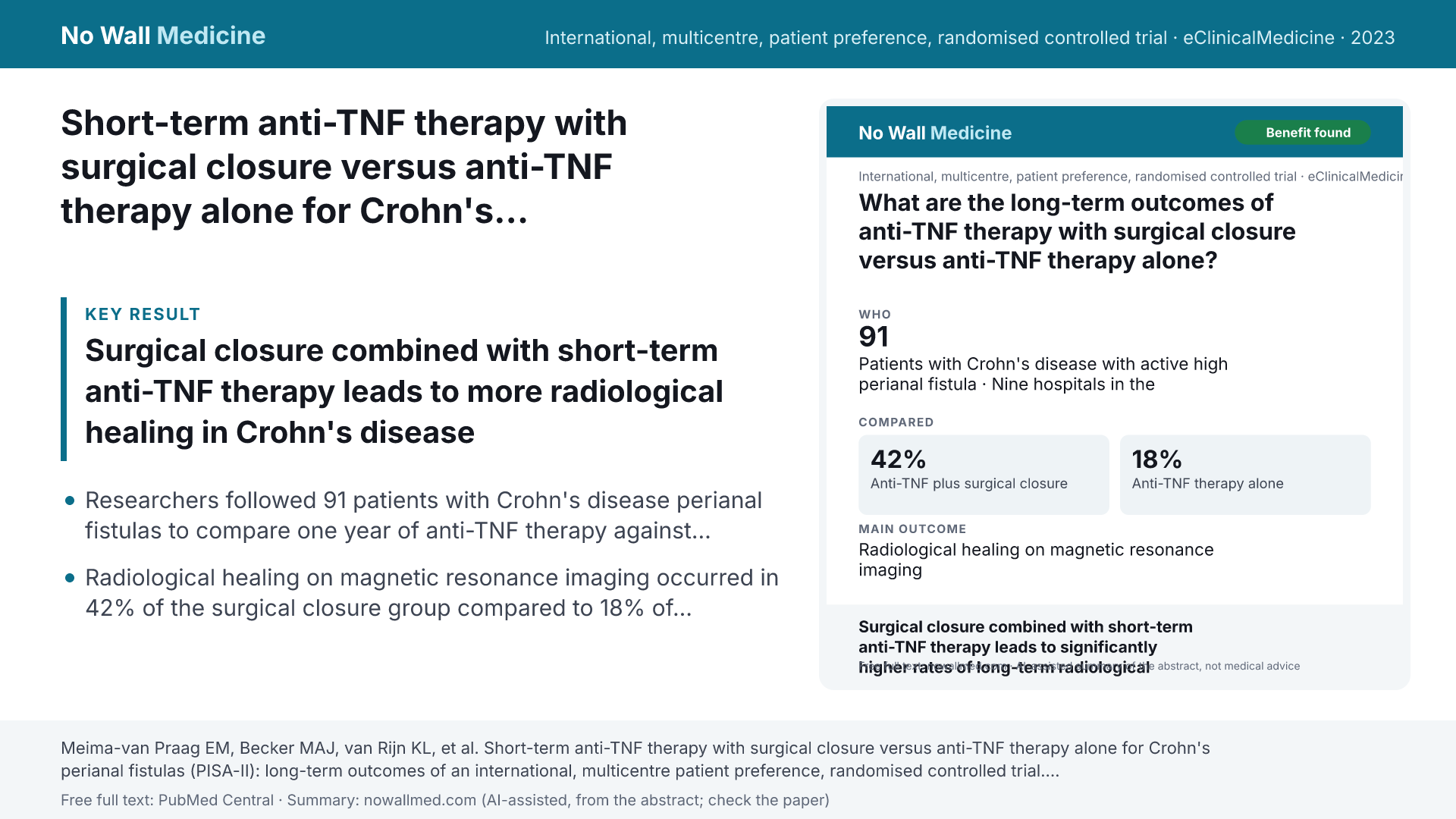
Surgical closure combined with short-term anti-TNF therapy leads to more radiological healing in Crohn's disease
Short-term anti-TNF therapy with surgical closure versus anti-TNF therapy alone for Crohn's perianal fistulas (PISA-II): long-term outcomes of an international, multicentre patient preference, randomised controlled trial
International, multicentre, patient preference, randomised controlled trialBenefit found
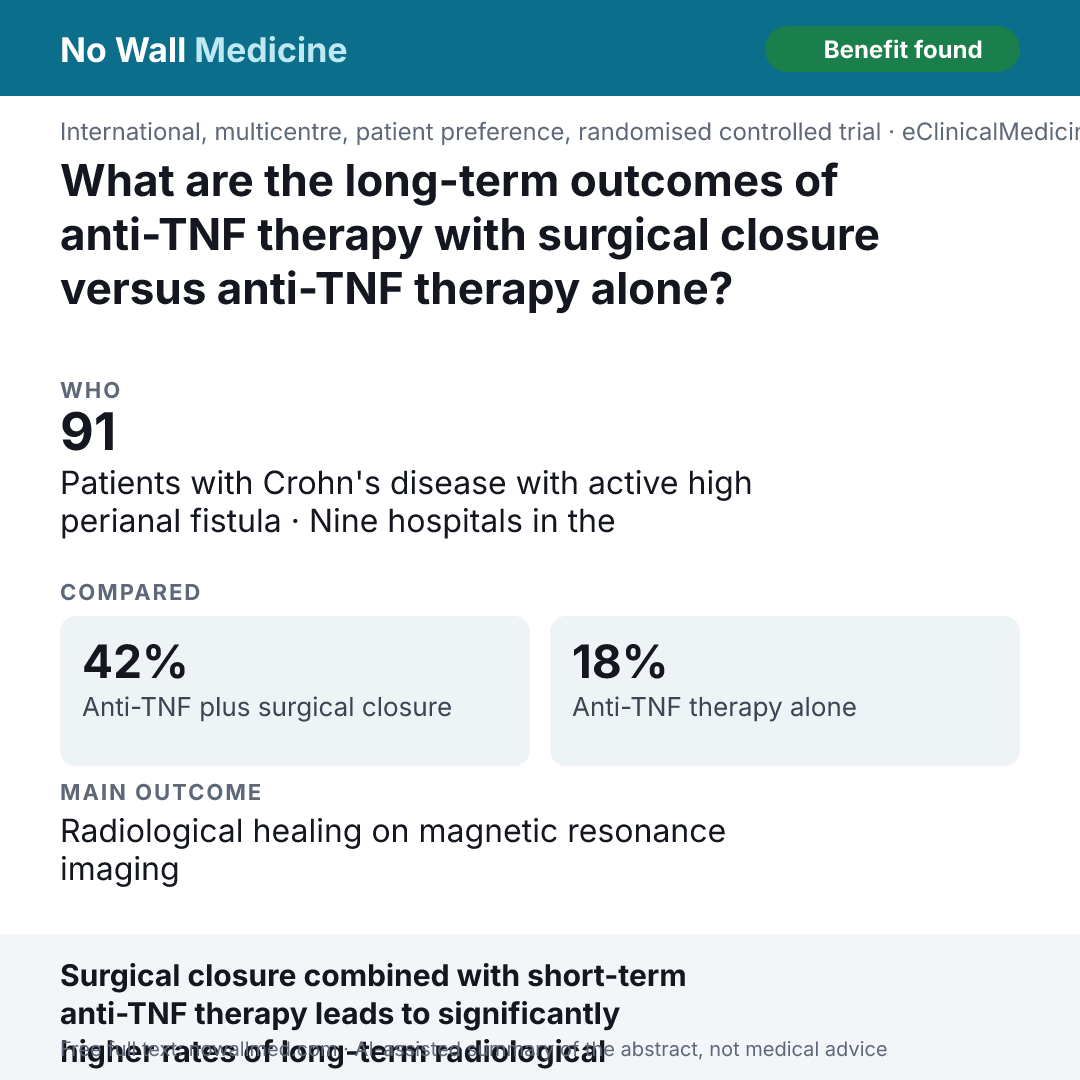
What are the long-term outcomes of anti-TNF therapy with surgical closure versus anti-TNF therapy alone?
Who
91
Patients with Crohn's disease with active high perianal fistula · Nine hospitals in the Netherlands and one hospital in Italy
Compared
42%Anti-TNF plus surgical closure
18%Anti-TNF therapy alone
Main outcome
Radiological healing on magnetic resonance imaging
Result: 15/36 = 42% versus 10/55 = 18%; P = 0.014
Bottom line: Surgical closure combined with short-term anti-TNF therapy leads to significantly higher rates of long-term radiological healing.
Limitation: Analysis was based on observed data.
eClinicalMedicine · 2023-07-05 · Save PNG
Clinical question: What are the long-term outcomes of anti-TNF therapy with surgical closure versus anti-TNF therapy alone?
Key points
- Researchers followed 91 patients with Crohn's disease perianal fistulas to compare one year of anti-TNF therapy against four months of anti-TNF therapy plus surgical closure.
- Radiological healing on magnetic resonance imaging occurred in 42% of the surgical closure group compared to 18% of the anti-TNF therapy group.
- While clinical closure was similar between groups, the surgical group required fewer re-interventions at 15% compared to 53% in the anti-TNF group.
Headline and key points written with AI from the paper’s abstract, with every number checked against it. Read the paper before relying on them.
Was this summary helpful?
Headline, design, result, key points, caveat and citation as plain text.
Cite this article
Meima-van Praag EM, Becker MAJ, van Rijn KL, et al. Short-term anti-TNF therapy with surgical closure versus anti-TNF therapy alone for Crohn's perianal fistulas (PISA-II): long-term outcomes of an international, multicentre patient preference, randomised controlled trial. EClinicalMedicine. 2023;61:102045. doi:10.1016/j.eclinm.2023.102045
Spotted a mistake? Suggest a correction