Ferric carboxymaltose was associated with improved heart muscle strain in patients with heart failure
Short-Term Changes in Left and Right Ventricular Cardiac Magnetic Resonance Feature Tracking Strain Following Ferric Carboxymaltose in Patients With Heart Failure: A Substudy of the Myocardial-IRON Trial
Post hoc subanalysis of a randomized, double-blind, placebo-controlled trialBenefit found
Does ferric carboxymaltose affect left and right ventricular cardiac magnetic resonance feature tracking strain?
Who
53
Ambulatory patients with heart failure, ejection fraction <50%, and iron deficiency
Compared
Ferric carboxymaltose: 30-day left ventricular circumferential strain difference: -2.5%
Placebo
Main outcome
Left and right ventricular cardiac magnetic resonance feature tracking strain
Bottom line: Ferric carboxymaltose was associated with short-term improvements in left and right ventricular function in heart failure patients.
J Am Heart Assoc · 2022-03-18Download image
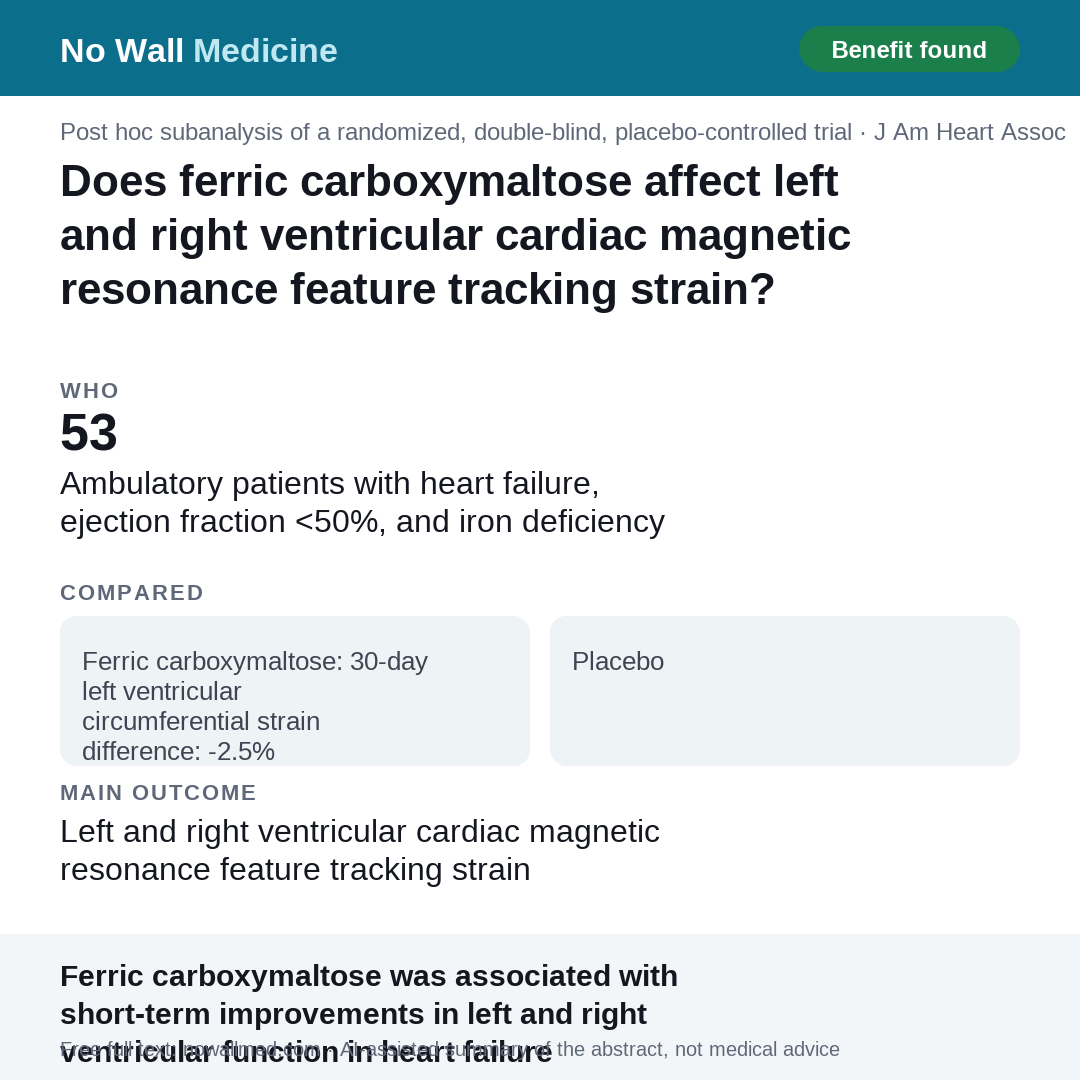
Clinical question: Does ferric carboxymaltose affect left and right ventricular cardiac magnetic resonance feature tracking strain?
Why it matters: The mechanisms explaining how ferric carboxymaltose provides clinical benefits to patients with heart failure and iron deficiency are not fully clarified.
Key points
- Researchers analyzed 53 ambulatory patients with heart failure and iron deficiency in a randomized, placebo-controlled trial.
- At 30 days, ferric carboxymaltose was associated with higher left ventricular strain, including longitudinal (difference: -2.3%, P<0.001), circumferential (difference: -2.5%, P<0.001), and radial (difference: 4.2%, P=0.002) parameters.
- The treatment was also associated with higher right ventricular strain at 30 days, including longitudinal (difference: -3.3%, P=0.010), circumferential (difference: -4.5%, P<0.001), and radial (difference: 4.5%, P=0.027) measurements.
Headline and key points written with AI from the paper’s abstract, with every number checked against it. Read the paper before relying on them.
Was this summary helpful?
Subject terms
Cite this article
Del Canto I, Santas E, Cardells I, Miñana G, Palau P, Llàcer P. Short-Term Changes in Left and Right Ventricular Cardiac Magnetic Resonance Feature Tracking Strain Following Ferric Carboxymaltose in Patients With Heart Failure: A Substudy of the Myocardial-IRON Trial. J Am Heart Assoc. 2022. doi:10.1161/JAHA.121.022214
Spotted a mistake? Suggest a correction
Top studies every Monday
The week’s key trials and guidelines in your specialties, plus any topics you follow. By email, free.
Get the weekly digest