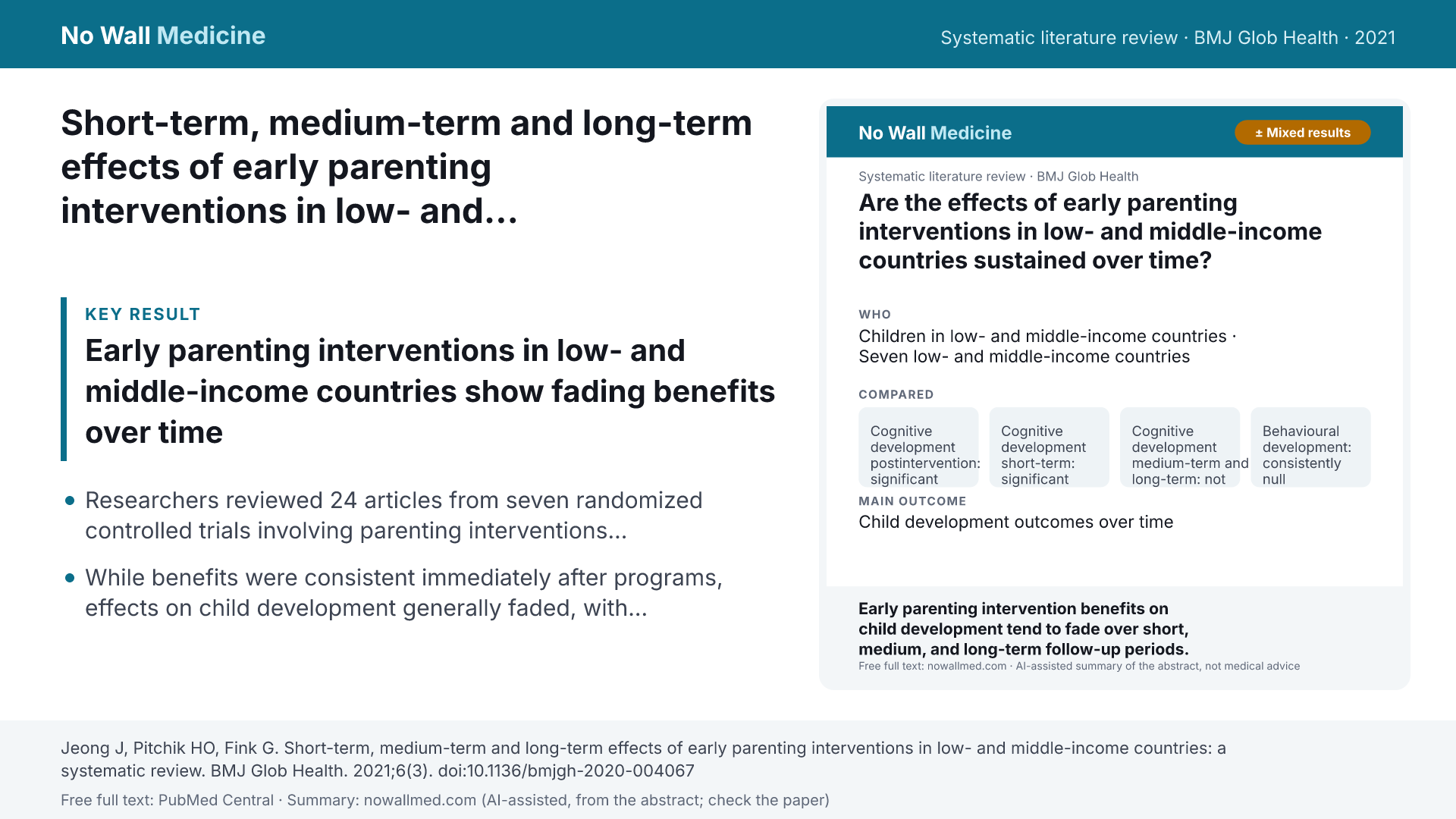
Early parenting interventions in low- and middle-income countries show fading benefits over time
Short-term, medium-term and long-term effects of early parenting interventions in low- and middle-income countries: a systematic review
Systematic literature reviewMixed results
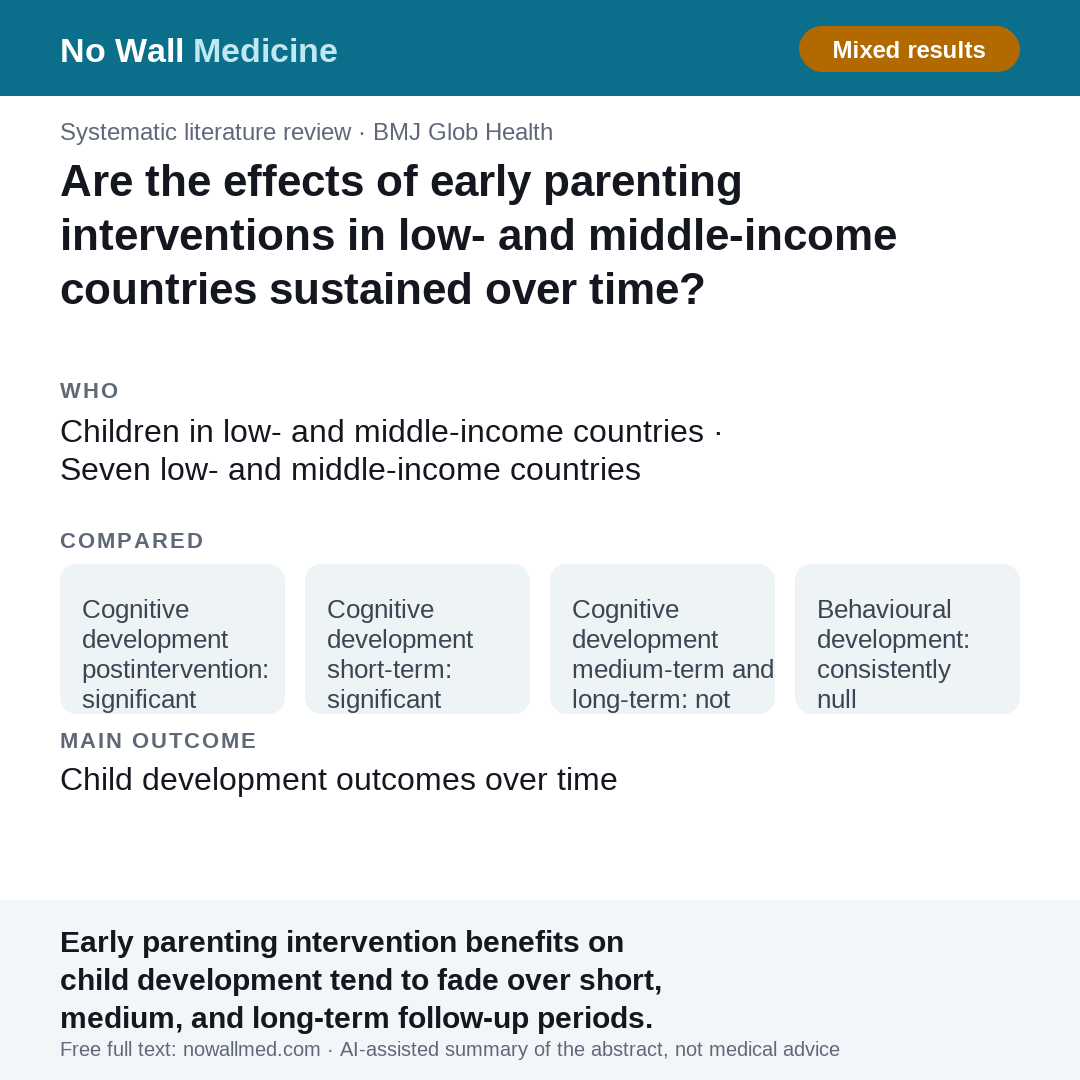
Are the effects of early parenting interventions in low- and middle-income countries sustained over time?
Who
Children in low- and middle-income countries · Seven low- and middle-income countries
Compared
Cognitive development postintervention: significant
Cognitive development short-term: significant
Cognitive development medium-term and long-term: not significant
Behavioural development: consistently null
Main outcome
Child development outcomes over time
Bottom line: Early parenting intervention benefits on child development tend to fade over short, medium, and long-term follow-up periods.
Limitation: Few longer-term follow-up studies were available in the identified trials.
BMJ Glob Health · 2021-03-06Download image
Clinical question: Are the effects of early parenting interventions in low- and middle-income countries sustained over time?
Key points
- Researchers reviewed 24 articles from seven randomized controlled trials involving parenting interventions delivered during the first 3 years of life in low- and middle-income countries.
- While benefits were consistent immediately after programs, effects on child development generally faded, with medium-term and long-term results being largely inconclusive.
- A meta-analysis showed significant cognitive development effects at postintervention and in the short-term, but these were not significant in the medium-term or long-term.
Limitation the authors note: The majority of follow-up studies were in the short-term, with only two trials conducting long-term follow-up evaluations.
Headline and key points written with AI from the paper’s abstract, with every number checked against it. Read the paper before relying on them.
Was this summary helpful?
Abstract
Introduction
Parenting interventions during early childhood are known to improve various child development outcomes immediately following programme implementation. However, less is known about whether these initial benefits are sustained over time. Methods
We conducted a systematic literature review of parenting interventions in low- and middle-income countries (LMICs) that were delivered during the first 3 years of life and had completed a follow-up evaluation of the intervention cohort at least 1 year after the primary postintervention endpoint. We summarized intervention effects over time by child-level and parent-level outcomes as well as by timing of follow-up rounds in the short-term (1-3 years after programme completion), medium-term (4-9 years), and long-term (10+ years). We also conducted exploratory meta-analyses to compare effects on children's cognitive and behavioral development by these subgroups of follow-up rounds. Results
We identified 24 articles reporting on seven randomised controlled trials of parenting interventions delivered during early childhood that had at least one follow-up study in seven LMICs. The majority of follow-up studies were in the short-term. Three trials conducted a medium-term follow-up evaluation, and only two trials conducted a long-term follow-up evaluation. Although trials consistently supported wide-ranging benefits on early child development outcomes immediately after programme completion, results revealed a general fading of effects on children's outcomes over time. Short-term effects were mixed, and medium-term and long-term effects were largely inconclusive. The exploratory meta-analysis on cognitive development found that pooled effects were significant at postintervention and in the short-term (albeit smaller in magnitude), but the effects were not significant in the medium-term and long-term. For behavioural development, the effects were consistently null over time. Conclusions
There have been few longer-term follow-up studies of early parenting interventions in LMICs. Greater investments in longitudinal intervention cohorts are needed in order to gain a more comprehensive understanding of the effectiveness of parenting interventions over the life course and to improve the design of future interventions so they can have greater potential for achieving and sustaining programme benefits over time.
Abstract reproduced under the article’s CC BY NC licence.
Subject terms
Headline, design, result, key points, caveat and citation as plain text.
Cite this article
Jeong J, Pitchik HO, Fink G. Short-term, medium-term and long-term effects of early parenting interventions in low- and middle-income countries: a systematic review. BMJ Glob Health. 2021;6(3). doi:10.1136/bmjgh-2020-004067
Spotted a mistake? Suggest a correction