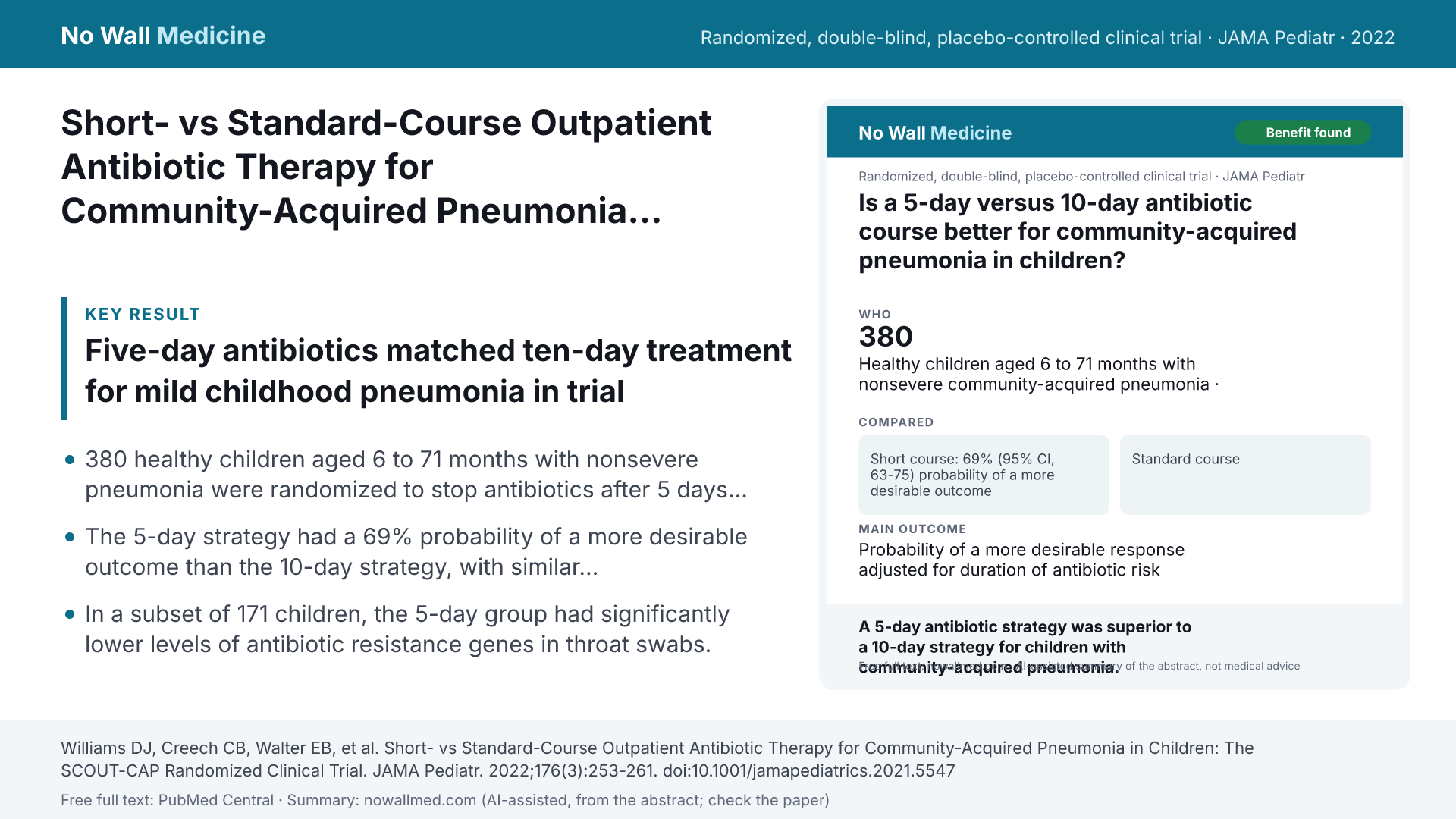
Short- vs Standard-Course Outpatient Antibiotic Therapy for Community-Acquired Pneumonia in Children: The SCOUT-CAP Randomized Clinical Trial
Key result: Five-day antibiotics matched ten-day treatment for mild childhood pneumonia in trial
Key points
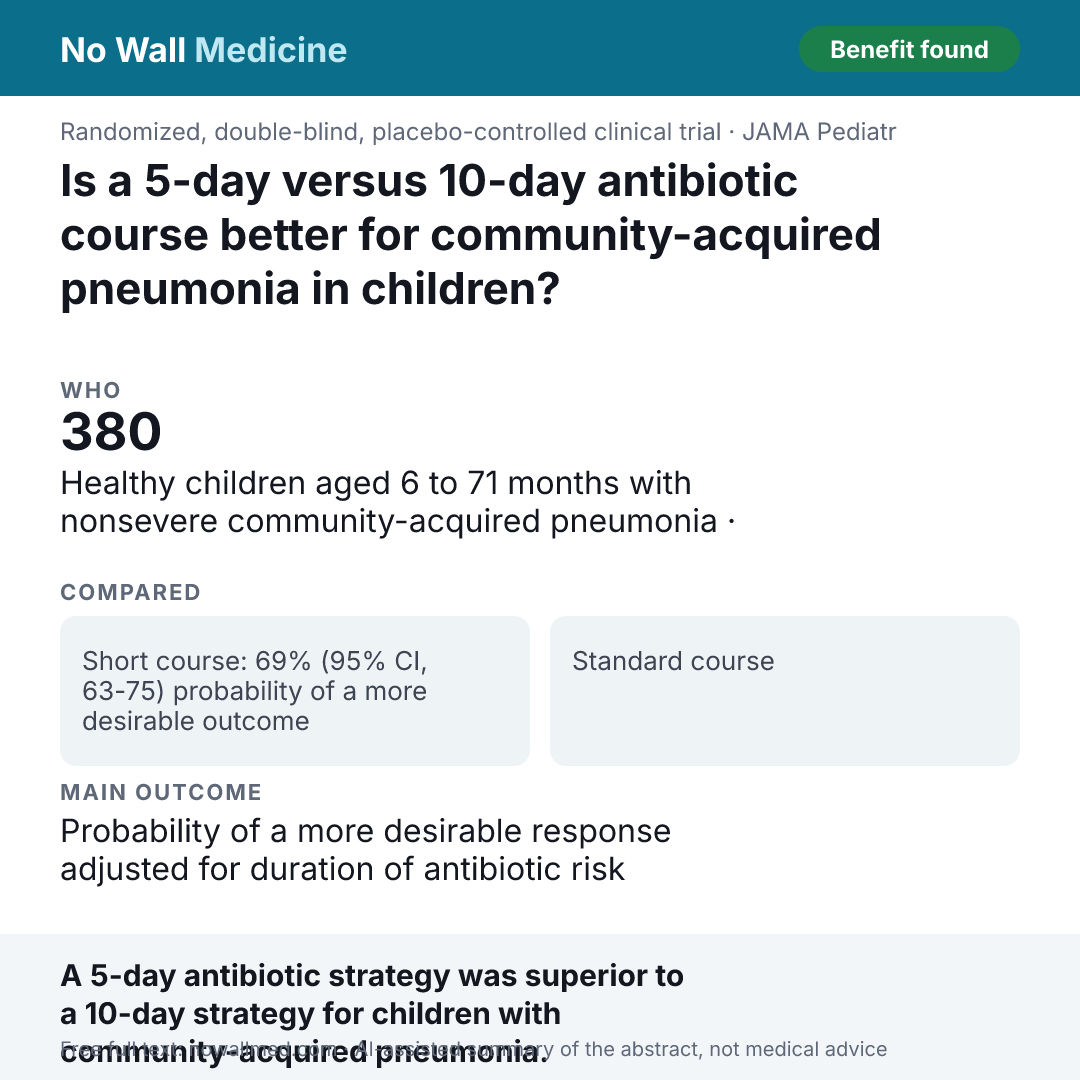
- 380 healthy children aged 6 to 71 months with nonsevere pneumonia were randomized to stop antibiotics after 5 days or continue for 10 days.
- The 5-day strategy had a 69% probability of a more desirable outcome than the 10-day strategy, with similar clinical response and adverse effects.
- In a subset of 171 children, the 5-day group had significantly lower levels of antibiotic resistance genes in throat swabs.
Why it matters: Standard treatment for childhood pneumonia is 10 days, but shorter courses might reduce antibiotic exposure and resistance without harming recovery.
Limitation the authors note: The antibiotic resistance gene analysis was performed in a subset of 171 children, not the entire study population.
Discussion prompts
- Would these patients look like yours? Who was left out?
- Is the main outcome one that matters to patients?
- Is the difference large enough to change what you do?
Cite: Williams DJ, Creech CB, Walter EB, et al. Short- vs Standard-Course Outpatient Antibiotic Therapy for Community-Acquired Pneumonia in Children: The SCOUT-CAP Randomized Clinical Trial. JAMA Pediatr. 2022;176(3):253-261. doi:10.1001/jamapediatrics.2021.5547
Free full text: PubMed Central · Summary and visual abstract: nowallmed.com/a/short-vs-standard-course-outpatient-antibiotic-therapy-for-community-7to6ti/ (AI-assisted from the abstract; check the paper before relying on it).