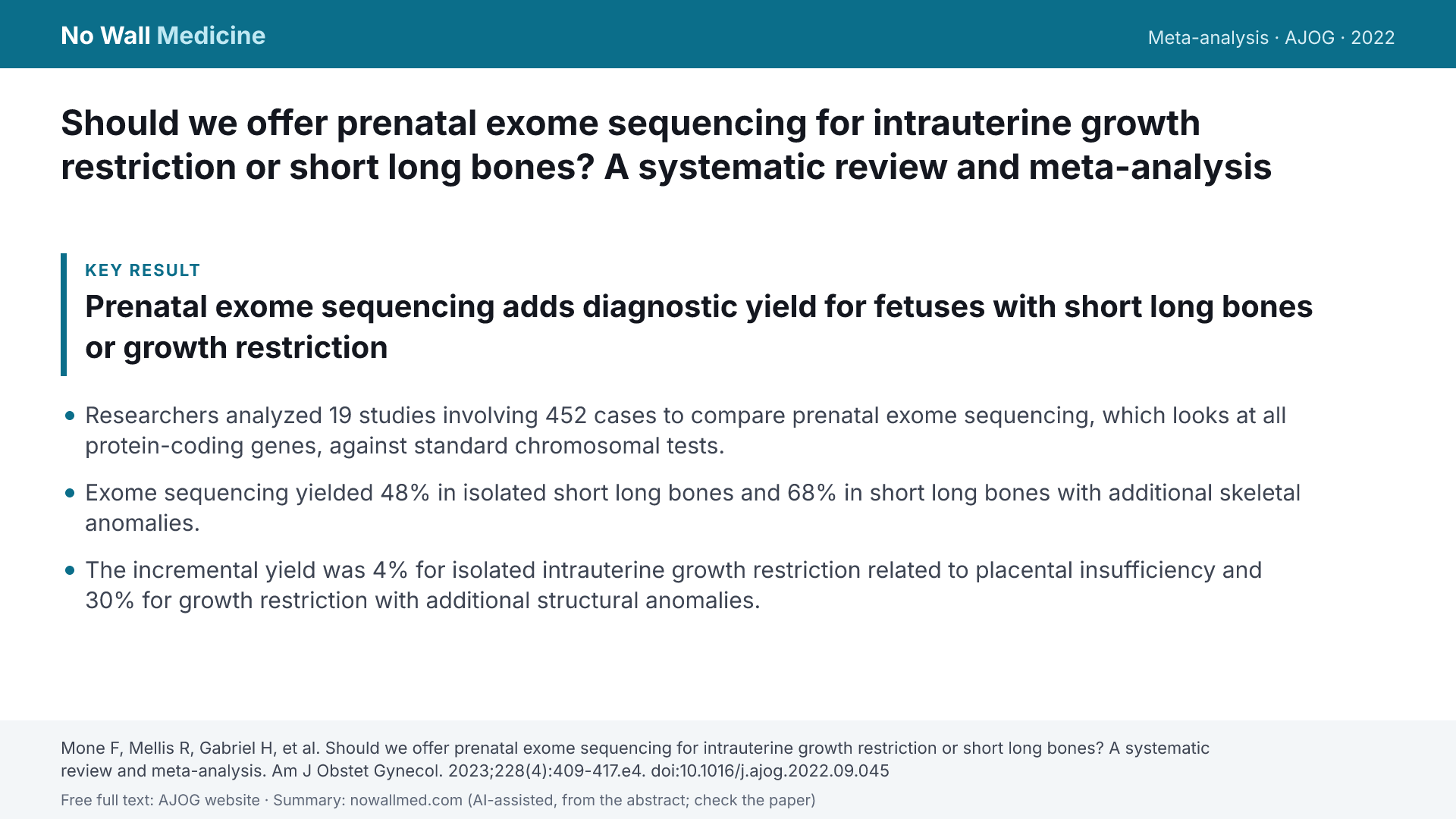
Prenatal exome sequencing adds diagnostic yield for fetuses with short long bones or growth restriction
Should we offer prenatal exome sequencing for intrauterine growth restriction or short long bones? A systematic review and meta-analysis
Key points
- Researchers analyzed 19 studies involving 452 cases to compare prenatal exome sequencing, which looks at all protein-coding genes, against standard chromosomal tests.
- Exome sequencing yielded 48% in isolated short long bones and 68% in short long bones with additional skeletal anomalies.
- The incremental yield was 4% for isolated intrauterine growth restriction related to placental insufficiency and 30% for growth restriction with additional structural anomalies.
Headline and key points written with AI from the paper’s abstract, with every number checked against it. Read the paper before relying on them.
Was this summary helpful?
Subject terms
Headline, design, result, key points, caveat and citation as plain text.
Cite this article
Mone F, Mellis R, Gabriel H, et al. Should we offer prenatal exome sequencing for intrauterine growth restriction or short long bones? A systematic review and meta-analysis. Am J Obstet Gynecol. 2023;228(4):409-417.e4. doi:10.1016/j.ajog.2022.09.045
Spotted a mistake? Suggest a correction