Visual abstractsVisuals
Randomized trialCritical Care · Aug 17, 2026

Adding sigh breaths to protective ventilation improved oxygenation in patients undergoing cardiac surgery

Sigh ventilation versus conventional protective ventilation in cardiac surgery: a proof-of-concept randomized controlled trial

Wang Z, Chen H, Chen T, Cheng Q, Huang S, Zha Z, et al
Critical CareAdult
Randomized, assessor-blinded, phase 2 proof-of-concept trialBenefit found
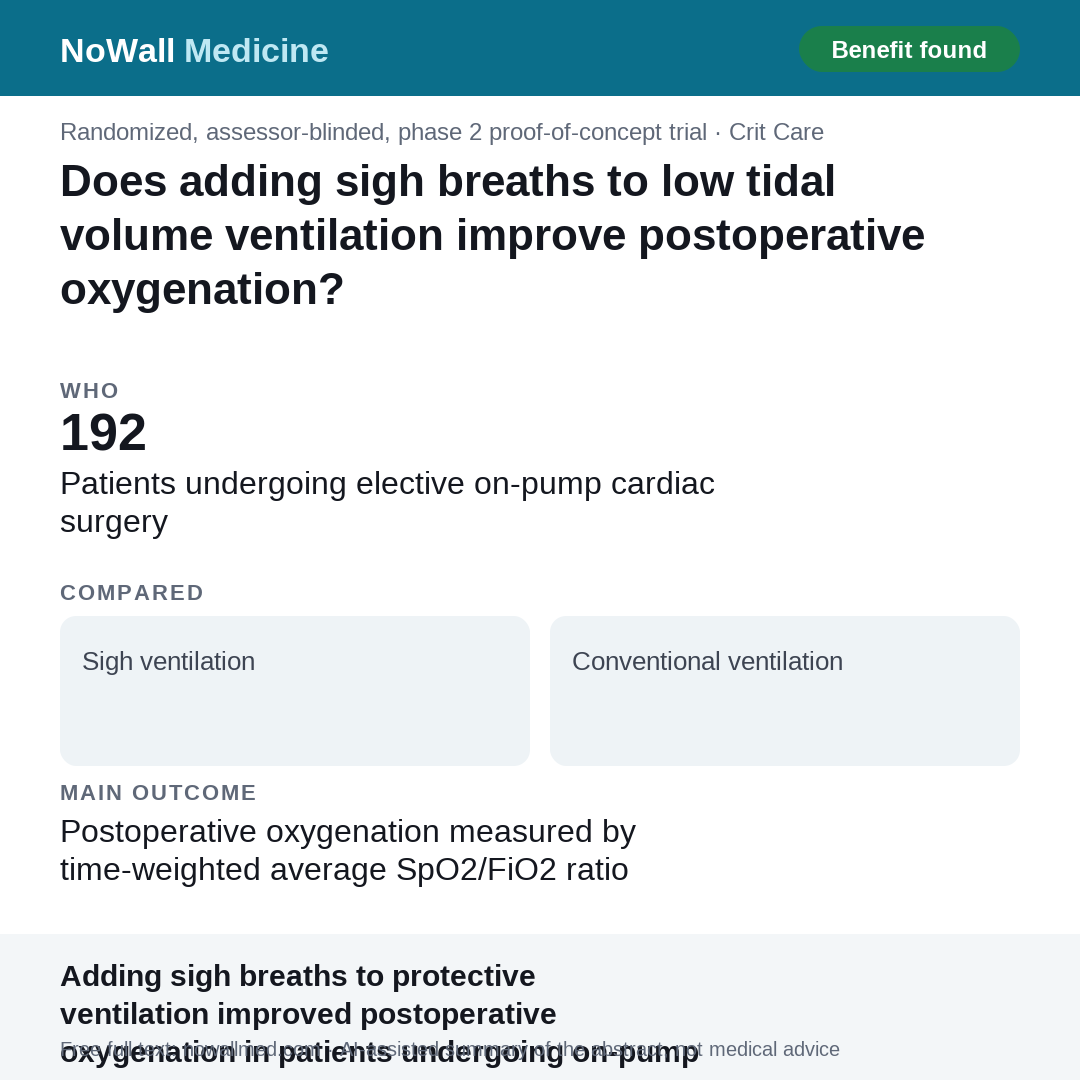
Does adding sigh breaths to low tidal volume ventilation improve postoperative oxygenation?
Who
192
Patients undergoing elective on-pump cardiac surgery
Compared
Sigh ventilation
Conventional ventilation
Main outcome
Postoperative oxygenation measured by time-weighted average SpO2/FiO2 ratio
Bottom line: Adding sigh breaths to protective ventilation improved postoperative oxygenation in patients undergoing on-pump cardiac surgery.
Crit Care · 2026-08-17Download image

Clinical question: Does adding sigh breaths to low tidal volume ventilation improve postoperative oxygenation?

Why it matters: It is uncertain whether adding lung recruitment to low tidal volume ventilation provides additional protection against ventilator-induced lung injury during cardiac surgery.

Key points

Headline and key points written with AI from the paper’s abstract, with every number checked against it. Read the paper before relying on them.
Read the full paper free at PubMed Central ↗

Topics

Humans; Cardiac Surgical Procedures; Respiration, Artificial; Female; Aged; Male; Middle Aged; Tidal Volume; Ventilator-Induced Lung Injury; Proof of Concept Study

DOI: 10.1186/s13054-026-06251-y · PubMed: 43015817 · Registered: NCT06248320

Spotted a mistake? Suggest a correction

More in Critical Care

Meta-analysisCrit Care · Nov 19, 2026 · Critical Care

Corticosteroids in sepsis have conflicting mortality conclusions in reviews

Discordant evidence on corticosteroids in sepsis: a meta-research study

ResearchPediatricResuscitation · Nov 17, 2026 · Critical Care

Eighty-nine percent of infants survived 28 days after chest compressions at birth in 2024

Survival after neonatal chest compressions at birth: Temporal trends and prognostic factors in a population-based cohort, Queensland, Australia

ResearchResuscitation · Nov 17, 2026 · Critical Care

Bystanders attaching AEDs had highest 30-day survival rate of 28 percent

Survival after out of hospital cardiac arrest in relation to AED usage in a multi response system including AED equipped drones

ResearchResuscitation · Nov 17, 2026 · Critical Care

Foreign body airway obstruction caused 1.1% of out-of-hospital cardiac arrests

Out-of-hospital cardiac arrests due to foreign body airway obstruction: A CanROC registry, retrospective cohort study

ResearchResuscitation · Nov 17, 2026 · Critical Care

Commercially available multimodal LLMs for EEG-based prognostication after cardiac arrest