Simlukafusp alfa combined with atezolizumab and bevacizumab showed higher response rates in metastatic kidney cancer
Simlukafusp alfa (FAP-IL2v) plus atezolizumab with or without bevacizumab in unresectable, metastatic renal cell carcinoma: a randomized, open-label phase Ib study
Randomized, open-label phase Ib studyBenefit found
What is the efficacy and safety of Simlukafusp alfa plus atezolizumab with or without bevacizumab?
Who
66
Patients with unresectable, metastatic renal cell carcinoma
Compared
Doublet (Simlukafusp alfa and atezolizumab): 25% objective response rate
Triplet (Simlukafusp alfa, atezolizumab, and bevacizumab): 47% objective response rate
Main outcome
Objective response rate and progression-free survival
Bottom line: The triplet therapy showed a higher objective response rate than the doublet therapy in metastatic renal cell carcinoma.
J Immunother Cancer · 2026-04-09Download image
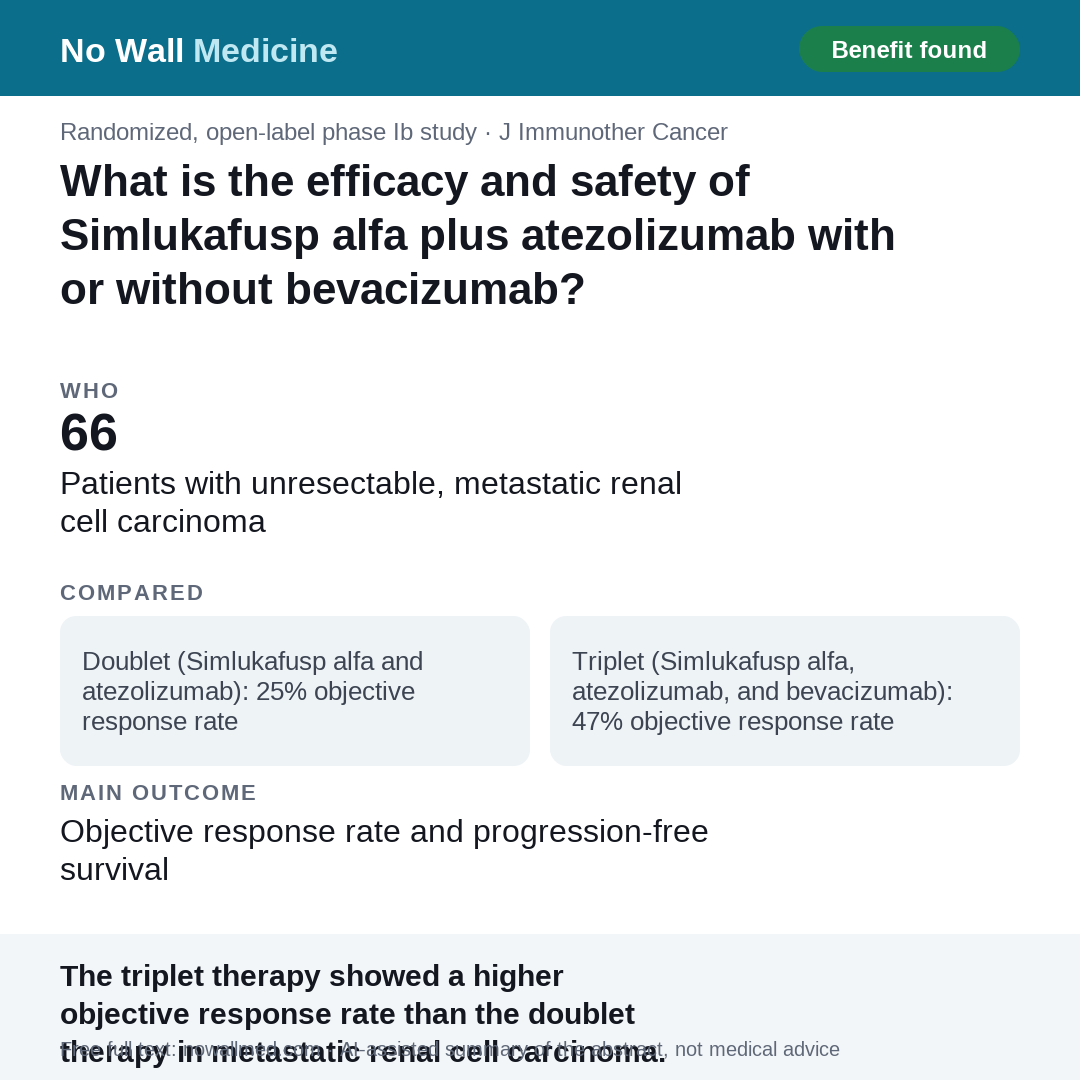
Clinical question: What is the efficacy and safety of Simlukafusp alfa plus atezolizumab with or without bevacizumab?
Why it matters: Doctors need to explore new ways to activate immune cells in the tumor microenvironment for patients with metastatic renal cell carcinoma.
Key points
- Researchers studied 66 patients with unresectable or metastatic renal cell carcinoma using combinations of simlukafusp alfa, atezolizumab, and bevacizumab.
- The triplet therapy group had an objective response rate of 47% and median progression-free survival of 18.3 months compared to 25% and 6.3 months for the doublet.
- Two deaths occurred due to treatment-related adverse events, specifically one case of acute kidney injury and one case of pancytopenia.
Headline and key points written with AI from the paper’s abstract, with every number checked against it. Read the paper before relying on them.
Abstract
Background
Simlukafusp alfa (FAP-IL2v) was engineered to preferentially activate CD8+ T and natural killer (NK) cells in tumor microenvironments overexpressing fibroblast activation protein (FAP). Checkpoint inhibitors combined with antiangiogenic agents are standard therapy for metastatic renal cell carcinoma (mRCC), which overexpresses FAP. Here, we explored the efficacy, safety, and pharmacodynamic effects of FAP-IL2v in combination with atezolizumab with or without bevacizumab in patients with mRCC. Methods
Patients with treatment-naïve or pretreated clear cell and/or sarcomatoid mRCC were eligible. Dose escalation explored FAP-IL2v every 2 weeks (Q2W) with atezolizumab Q2W (doublet, arm A), and with atezolizumab and bevacizumab Q2W (triplet, arm B) in patients treated with up to one prior systemic therapy. Dose extension explored in untreated patients the recommended FAP-IL2v dose administered Q2W (doublet, arm A; and triplet, arm B) or 3-weekly (doublet, arm C; and triplet, arm D). Primary objectives were the recommended FAP-IL2v dose and antitumor activity. Secondary objectives included safety, pharmacodynamics, and exploratory biomarkers in peripheral blood and paired biopsies. Results
By the data cut-off date (31 August, 2021), 66 patients were enrolled. The median duration of treatment was 11.0 months. Objective response rates (ORRs) were 25% for the doublet and 47% for the triplet, and median progression-free survival was 6.3 and 18.3 months, respectively. Safety profiles were consistent with the individual drugs, including expected interleukin-2 (IL-2) class-specific adverse events (AEs). Two deaths were recorded caused by AEs related to study treatment (acute kidney injury, n=1; pancytopenia, n=1). Expansion and activation of NK and T cells, but not regulatory T cells, was observed in peripheral blood, leading to increased tumor infiltration and inflammation in paired biopsies. The addition of bevacizumab led to a reduced angiogenesis signature score and reduced vessel density. Conclusion
The combination of FAP-IL2v plus atezolizumab with or without bevacizumab was consistent with the known safety profile of the individual drugs. The maximum tolerated dose was not reached, with a recommended FAP-IL2v dose of 10 mg. ORR was higher among patients receiving the triplet therapy compared with the doublet. Pharmacodynamic results were consistent with the mechanism of action of IL-2, supporting further research in this field.
Abstract reproduced under the article’s CC BY NC licence.
Topics
Cite this article
Perez-Gracia JL, Mellado B, Hansen AR, Alonso-Gordoa T, Gomez-Roca C, Løvendahl Eefsen R. Simlukafusp alfa (FAP-IL2v) plus atezolizumab with or without bevacizumab in unresectable, metastatic renal cell carcinoma: a randomized, open-label phase Ib study. J Immunother Cancer. 2026. doi:10.1136/jitc-2025-012466
Spotted a mistake? Suggest a correction