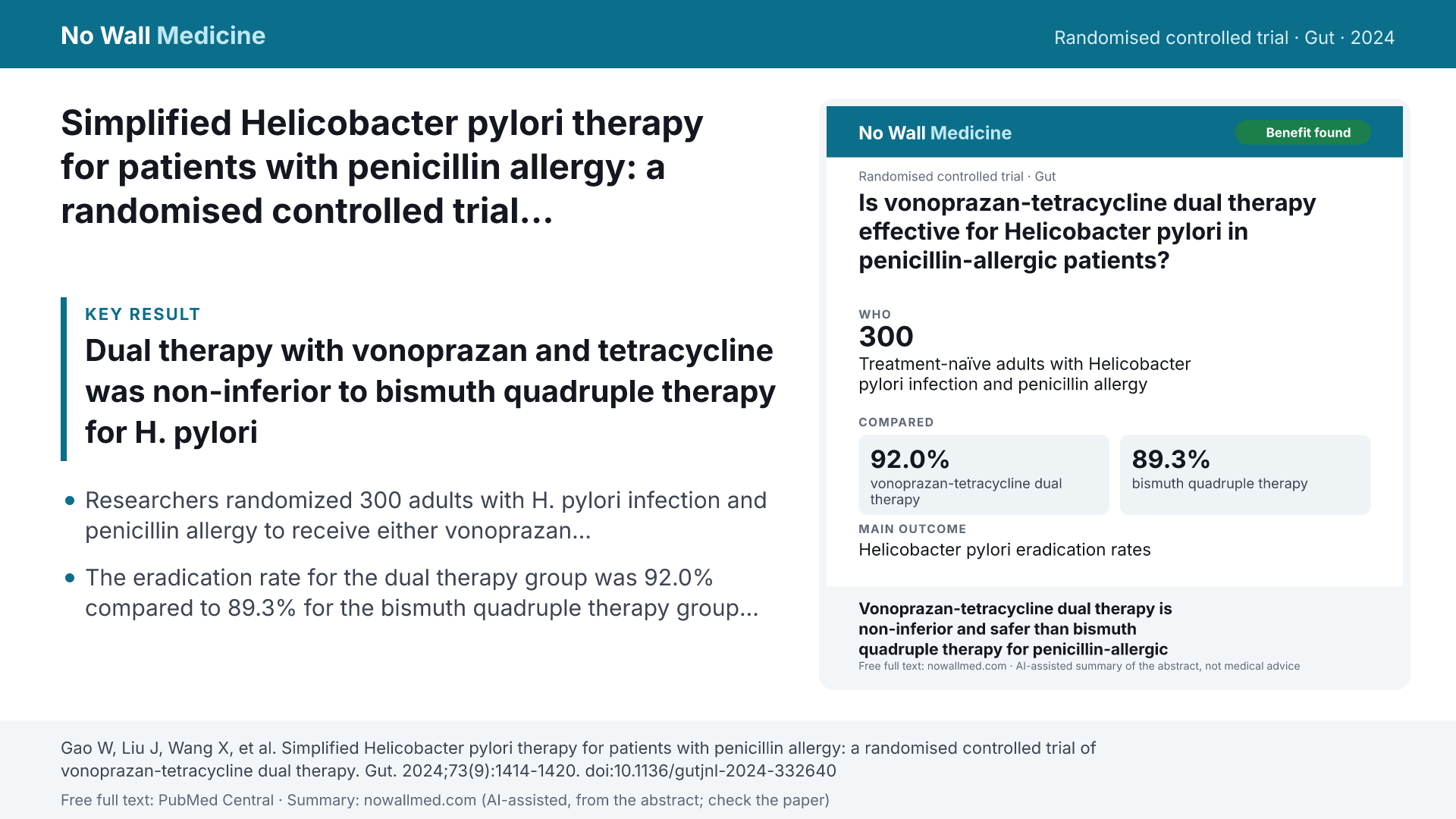
Dual therapy with vonoprazan and tetracycline was non-inferior to bismuth quadruple therapy for H. pylori
Simplified Helicobacter pylori therapy for patients with penicillin allergy: a randomised controlled trial of vonoprazan-tetracycline dual therapy
Randomised controlled trialBenefit found
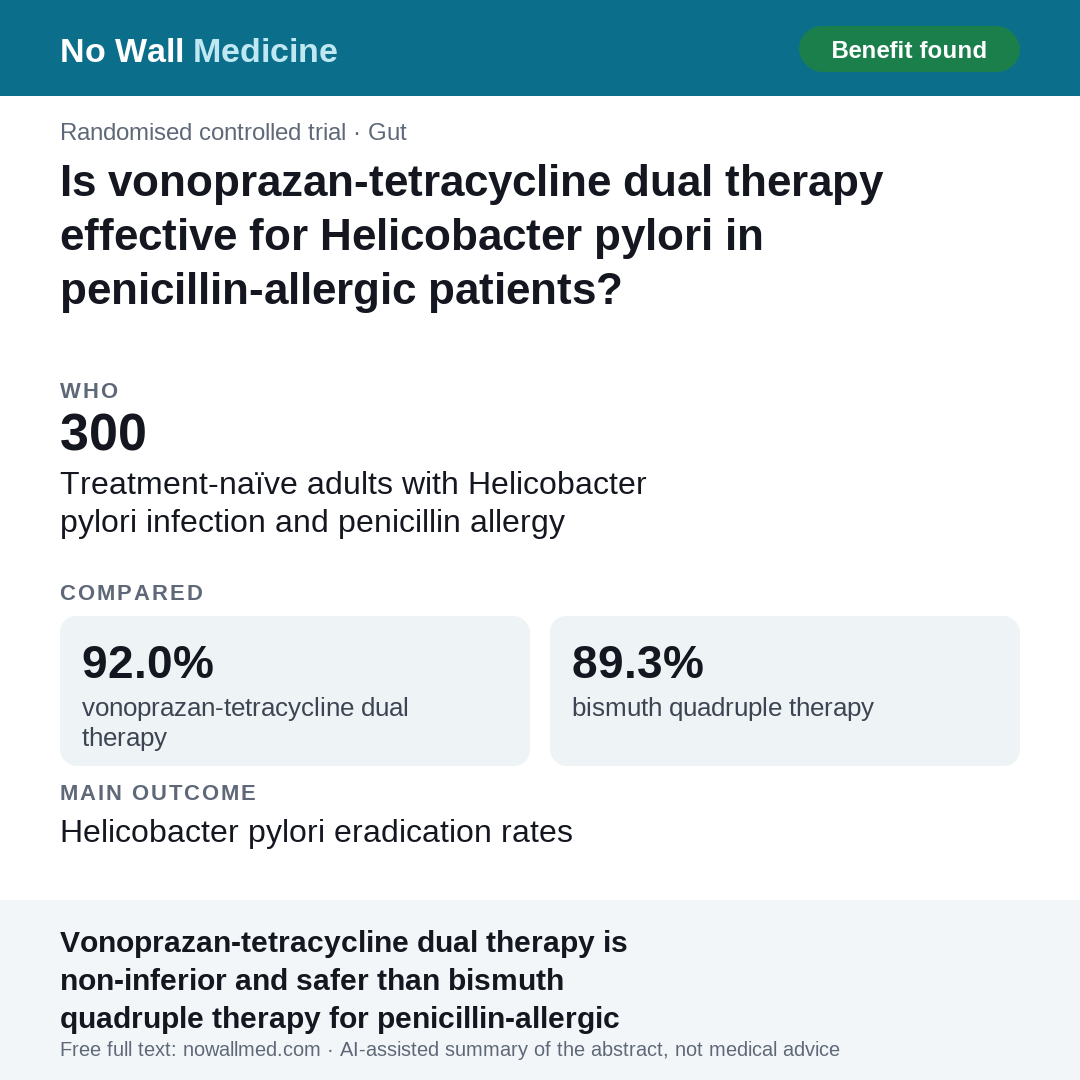
Is vonoprazan-tetracycline dual therapy effective for Helicobacter pylori in penicillin-allergic patients?
Who
300
Treatment-naïve adults with Helicobacter pylori infection and penicillin allergy
Compared
92.0%vonoprazan-tetracycline dual therapy (138/150)
89.3%bismuth quadruple therapy (134/150)
Main outcome
Helicobacter pylori eradication rates
Result: difference 2.7%; 95% CI -4.6% to 10.0%
Bottom line: Vonoprazan-tetracycline dual therapy is non-inferior and safer than bismuth quadruple therapy for penicillin-allergic patients.
Gut · 2024-08-08Download image
Clinical question: Is vonoprazan-tetracycline dual therapy effective for Helicobacter pylori in penicillin-allergic patients?
Why it matters: Effective first-line treatment options for Helicobacter pylori infection in patients with penicillin allergies are needed.
Key points
- Researchers randomized 300 adults with H. pylori infection and penicillin allergy to receive either vonoprazan and tetracycline dual therapy or bismuth quadruple therapy for 14 days.
- The eradication rate for the dual therapy group was 92.0% compared to 89.3% for the bismuth quadruple therapy group in the intention-to-treat analysis.
- Treatment-emergent adverse events were significantly lower in the dual therapy group at 14.0% compared to 48.0% in the bismuth quadruple therapy group.
Headline and key points written with AI from the paper’s abstract, with every number checked against it. Read the paper before relying on them.
Was this summary helpful?
Abstract
Background and aims
This study aimed to evaluate the efficacy and safety of vonoprazan and tetracycline (VT) dual therapy as first-line treatment for Helicobacter pylori infection in patients with penicillin allergy. Methods
In this randomised controlled trial, treatment-naïve adults with H. pylori infection and penicillin allergy were randomised 1:1 to receive either open-label VT dual therapy (vonoprazan 20 mg two times per day+tetracycline 500 mg three times a day) or bismuth quadruple therapy (BQT; lansoprazole 30 mg two times per day+colloidal bismuth 150 mg three times a day+tetracycline 500 mg three times a day+metronidazole 400 mg three times a day) for 14 days. The primary outcome was non-inferiority in eradication rates in the VT dual group compared with the BQT group. Secondary outcomes included assessing adverse effects. Results
300 patients were randomised. The eradication rates in the VT group and the BQT group were: 92.0% (138/150, 95% CI 86.1% to 95.6%) and 89.3% (134/150, 95% CI 83.0% to 93.6%) in intention-to-treat analysis (difference 2.7%; 95% CI -4.6% to 10.0%; non-inferiority p=0.000); 94.5% (138/146, 95% CI 89.1% to 97.4%) and 93.1% (134/144, 95% CI 87.3% to 96.4%) in modified intention-to-treat analysis (difference 1.5%; 95% CI -4.9% to 8.0%; non-inferiority p=0.001); 95.1% (135/142, 95% CI 89.7% to 97.8%) and 97.7% (128/131, 95% CI 92.9% to 99.4%) in per-protocol analysis (difference 2.6%; 95% CI -2.9% to 8.3%; non-inferiority p=0.000). The treatment-emergent adverse events (TEAEs) were significantly lower in the VT group (14.0% vs 48.0%, p=0.000), with fewer treatment discontinuations due to TEAEs (2.0% vs 8.7%, p=0.010). Conclusions
VT dual therapy demonstrated efficacy and safety as a first-line treatment for H. pylori infection in the penicillin-allergic population, with comparable efficacy and a lower incidence of TEAEs compared with traditional BQT. Trial registration number
ChiCTR2300074693.
Abstract reproduced under the article’s CC BY NC licence.
Subject terms
Cite this article
Gao W, Liu J, Wang X, et al. Simplified Helicobacter pylori therapy for patients with penicillin allergy: a randomised controlled trial of vonoprazan-tetracycline dual therapy. Gut. 2024. doi:10.1136/gutjnl-2024-332640
Spotted a mistake? Suggest a correction