Integrated malnutrition treatment with decreasing food doses was superior to standard protocols in children
Simplifying and optimising the management of uncomplicated acute malnutrition in children aged 6-59 months in the Democratic Republic of the Congo (OptiMA-DRC): a non-inferiority, randomised controlled trial
Open-label, non-inferiority, randomised controlled trialBenefit found
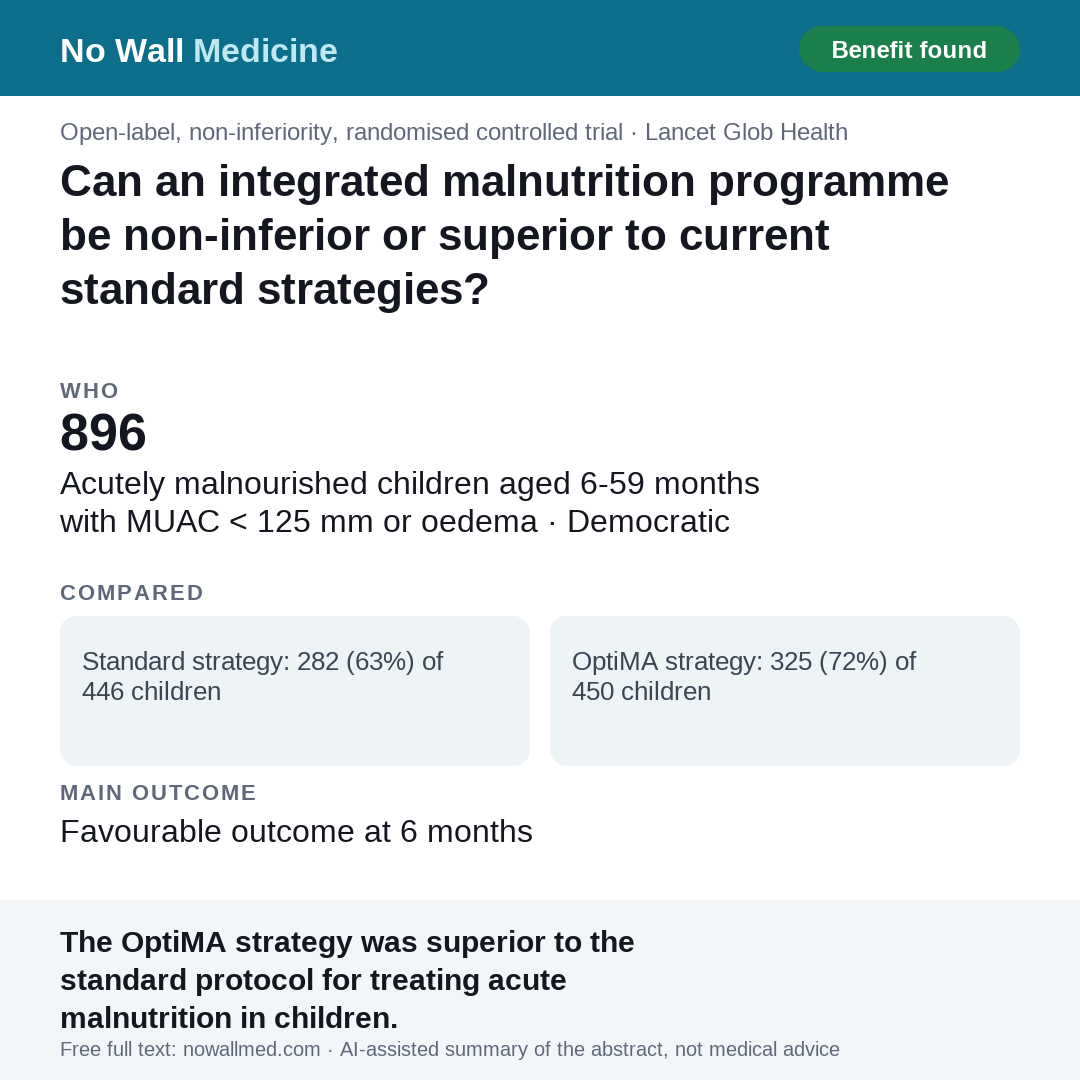
Can an integrated malnutrition programme be non-inferior or superior to current standard strategies?
Who
896
Acutely malnourished children aged 6-59 months with MUAC < 125 mm or oedema · Democratic Republic of the Congo
Compared
Standard strategy: 282 (63%) of 446 children
OptiMA strategy: 325 (72%) of 450 children
Main outcome
Favourable outcome at 6 months
Result: difference -9·0%, 95% CI -15·9 to -2·0
Bottom line: The OptiMA strategy was superior to the standard protocol for treating acute malnutrition in children.
Funded by: Innocent Foundation and European Civil Protection and Humanitarian Aid Operations
Lancet Glob Health · 2022-03-19Download image
Clinical question: Can an integrated malnutrition programme be non-inferior or superior to current standard strategies?
Why it matters: It is unknown if integrating severe and moderate acute malnutrition treatments into one programme using a single nutritional product and decreasing doses is as effective as current separate programmes.
Key points
- Researchers studied 896 children aged 6-59 months in the Democratic Republic of the Congo assigned to either standard care or an integrated strategy.
- In the per-protocol analysis, 74% of children in the OptiMA group had a favourable outcome compared to 61% in the standard group.
- In the intention-to-treat analysis, 72% of children in the OptiMA group achieved a favourable outcome compared to 63% in the standard group.
Headline and key points written with AI from the paper’s abstract, with every number checked against it. Read the paper before relying on them.
Was this summary helpful?
Abstract
Background
Global access to acute malnutrition treatment is low. Different programmes using different nutritional products manage cases of severe acute malnutrition and moderate acute malnutrition separately. We aimed to assess whether integrating severe acute malnutrition and moderate acute malnutrition treatment into one programme, using a single nutritional product and reducing the dose as the child improves, could achieve similar or higher individual efficacy, increase coverage, and minimise costs compared with the current programmes. Methods
We conducted an open-label, non-inferiority, randomised controlled trial in the Democratic Republic of the Congo. Acutely malnourished children aged 6-59 months with a mid-upper-arm circumference (MUAC) of less than 125 mm or oedema were randomly assigned (1:1), using specially developed software and random blocks (size was kept confidential), to either the current standard strategy (one programme for severe acute malnutrition using ready-to-use therapeutic food [RUTF] at an increasing dose as weight increased, another for moderate acute malnutrition using a fixed dose of ready-to-use supplementary food [RUSF]) or the OptiMA strategy (a single programme for both severe acute malnutrition and moderate acute malnutrition using RUTF at a decreasing dose as MUAC and weight increased). The primary endpoint was a favourable outcome at 6 months, defined as being alive, not acutely malnourished as per the definition applied at inclusion, and with no further episodes of acute malnutrition throughout the 6-month observation period; the endpoint was analysed in the intention-to-treat (all children) and per-protocol populations (participants who had a minimum prescription of 4 weeks' RUTF, received at least 90% of the total amount of RUTF they were supposed to receive as per the protocol, or were prescribed RUSF rations for a minimum of 4 weeks [ie, minimum of 28 RUSF sachets], and had a maximum interval of 6 weeks between any two visits in the 6-month follow-up). The non-inferiority analysis (margin 10%) was to be followed by a superiority analysis (margin 0%) if non-inferiority was concluded. This trial is registered at ClinicalTrials.gov, NCT03751475, and is now closed. Findings
Between July 22 and Dec 6, 2019, 912 children were randomly assigned; after 16 were excluded, 896 were analysed (446 in the standard group and 450 in the OptiMA group). In the intention-to-treat analysis, 282 (63%) of 446 children in the standard group and 325 (72%) of 450 children in the OptiMA group had a favourable outcome (difference -9·0%, 95% CI -15·9 to -2·0). In the per protocol analysis, 161 (61%) of 264 children in the standard group and 291 (74%) of 392 children in the OptiMA group had a favourable outcome (-13·2%, -21·6 to -4·9). Interpretation
In this non-inferiority trial treating children with MUAC of less than 125 mm or oedema, decreasing RUTF dose according to MUAC and weight increase proved to be a superior strategy to the standard protocol in the Democratic Republic of the Congo. These results demonstrate the safety and benefits of an approach that could substantially increase access to treatment for millions of children with acute malnutrition in sub-Saharan Africa. Funding
Innocent Foundation and European Civil Protection and Humanitarian Aid Operations. Translation
For the French translation of the abstract see Supplementary Materials section.
Abstract reproduced under the article’s CC BY NC ND licence.
Subject terms
Cite this article
Cazes C, Phelan K, Hubert V, Boubacar H, Bozama LI, Sakubu GT. Simplifying and optimising the management of uncomplicated acute malnutrition in children aged 6-59 months in the Democratic Republic of the Congo (OptiMA-DRC): a non-inferiority, randomised controlled trial. Lancet Glob Health. 2022. doi:10.1016/S2214-109X(22)00041-9
Spotted a mistake? Suggest a correction
Top studies every Monday
The week’s key trials and guidelines in your specialties, plus any topics you follow. By email, free.
Get the weekly digest