Simplifying Survivorship Care Planning: A Randomized Controlled Trial Comparing 3 Care Plan Delivery Approaches
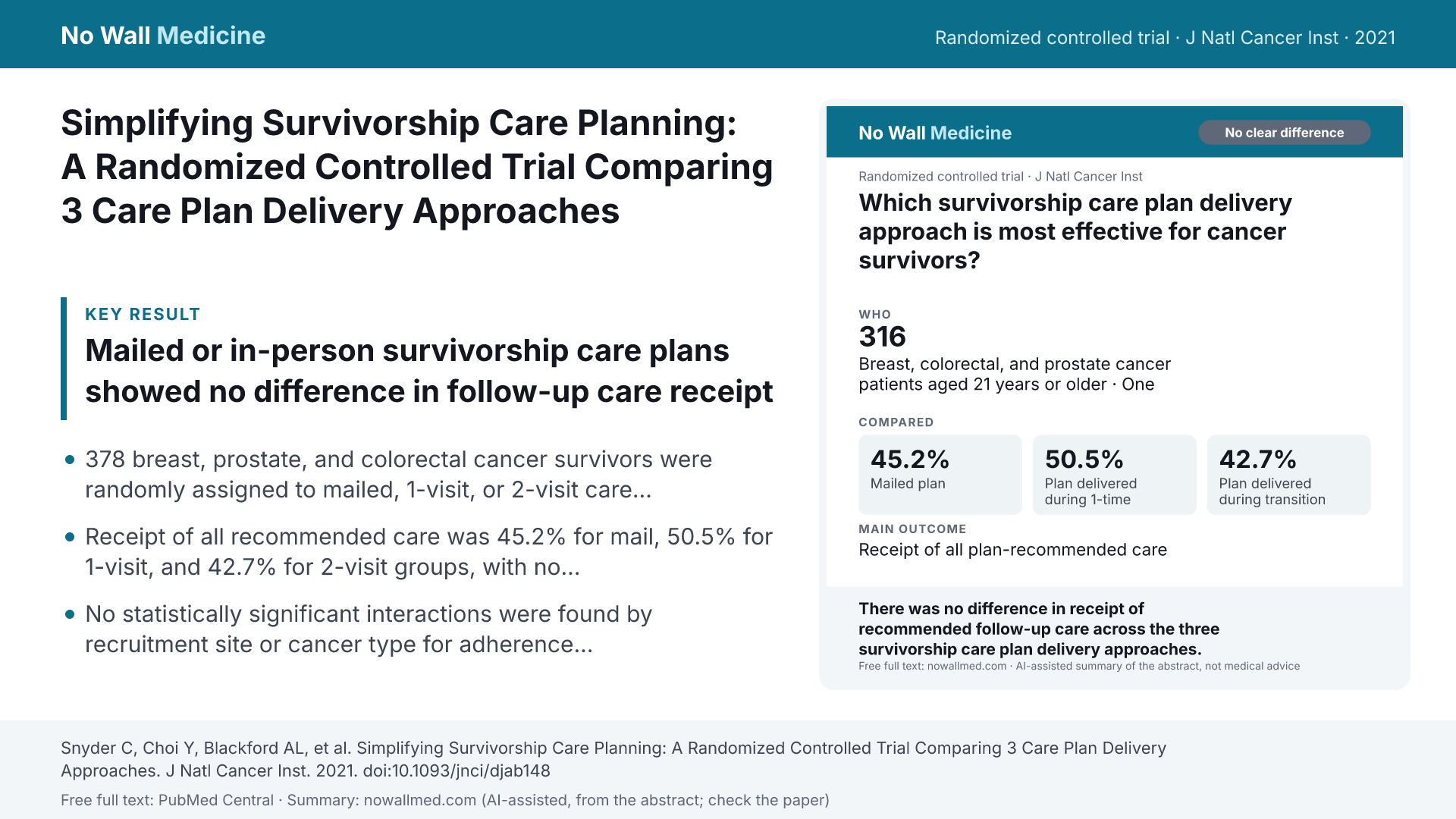
Key result: Mailed or in-person survivorship care plans showed no difference in follow-up care receipt
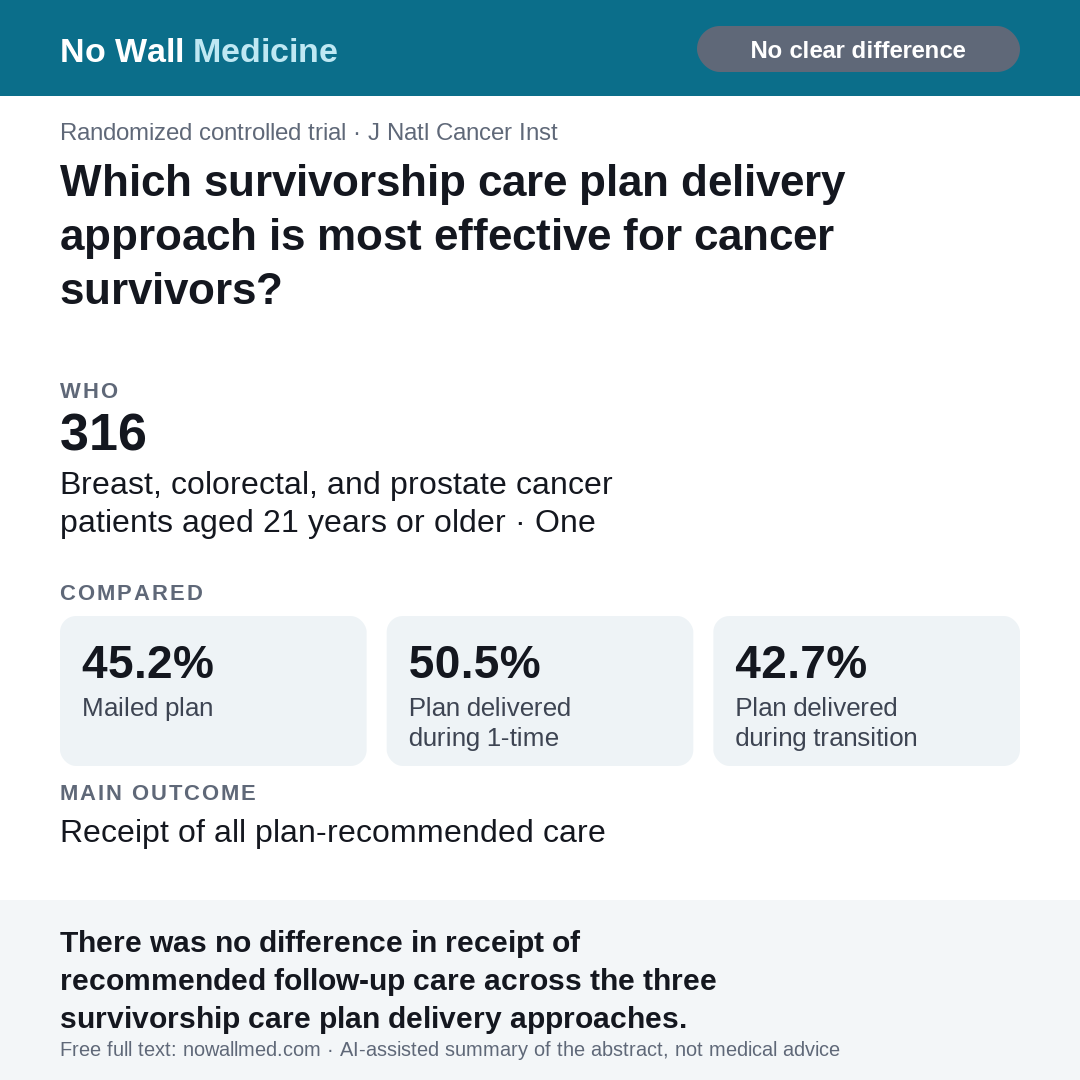
Randomized controlled trialNo clear difference
Which survivorship care plan delivery approach is most effective for cancer survivors?
Who
316
Breast, colorectal, and prostate cancer patients aged 21 years or older · One urban-academic and one rural-community cancer center
Compared
45.2%Mailed plan
50.5%Plan delivered during 1-time transition visit
42.7%Plan delivered during transition visit plus 6-month follow-up
Main outcome
Receipt of all plan-recommended care
Bottom line: There was no difference in receipt of recommended follow-up care across the three survivorship care plan delivery approaches.
J Natl Cancer Inst · 2021-07-25Download image
Key points
- 378 breast, prostate, and colorectal cancer survivors were randomly assigned to mailed, 1-visit, or 2-visit care plan delivery.
- Receipt of all recommended care was 45.2% for mail, 50.5% for 1-visit, and 42.7% for 2-visit groups, with no significant difference.
- No statistically significant interactions were found by recruitment site or cancer type for adherence to plan-recommended care.
Why it matters: Survivorship care plans face implementation barriers, and it was unclear which delivery approach was simplest and most effective.
Discussion prompts
- Would these patients look like yours? Who was left out?
- Is the main outcome one that matters to patients?
- Is the difference large enough to change what you do?
Cite: Snyder C, Choi Y, Blackford AL, et al. Simplifying Survivorship Care Planning: A Randomized Controlled Trial Comparing 3 Care Plan Delivery Approaches. J Natl Cancer Inst. 2021. doi:10.1093/jnci/djab148
Free full text: PubMed Central · Summary and visual abstract: nowallmed.com/a/simplifying-survivorship-care-planning-a-randomized-controlled-trial-1rd3h1b/ (AI-assisted from the abstract; check the paper before relying on it).