Anti-gravity treadmill technology was associated with improvements in gait and balance for neurological patients
Simulating space walking: a systematic review on anti-gravity technology in neurorehabilitation
Systematic reviewBenefit found
Does anti-gravity technology improve gait and balance in neurological patients?
Who
Patients with Parkinson's disease, multiple sclerosis, cerebral palsy and stroke
Compared
Anti-gravity technology
Control
Main outcome
Gait and balance outcomes
Bottom line: Anti-gravity technology shows promising results for improving gait and balance in neurological patients.
Limitation: Lack of robust high-quality randomized controlled trials and large samples.
J Neuroeng Rehabil · 2024-09-13Download image
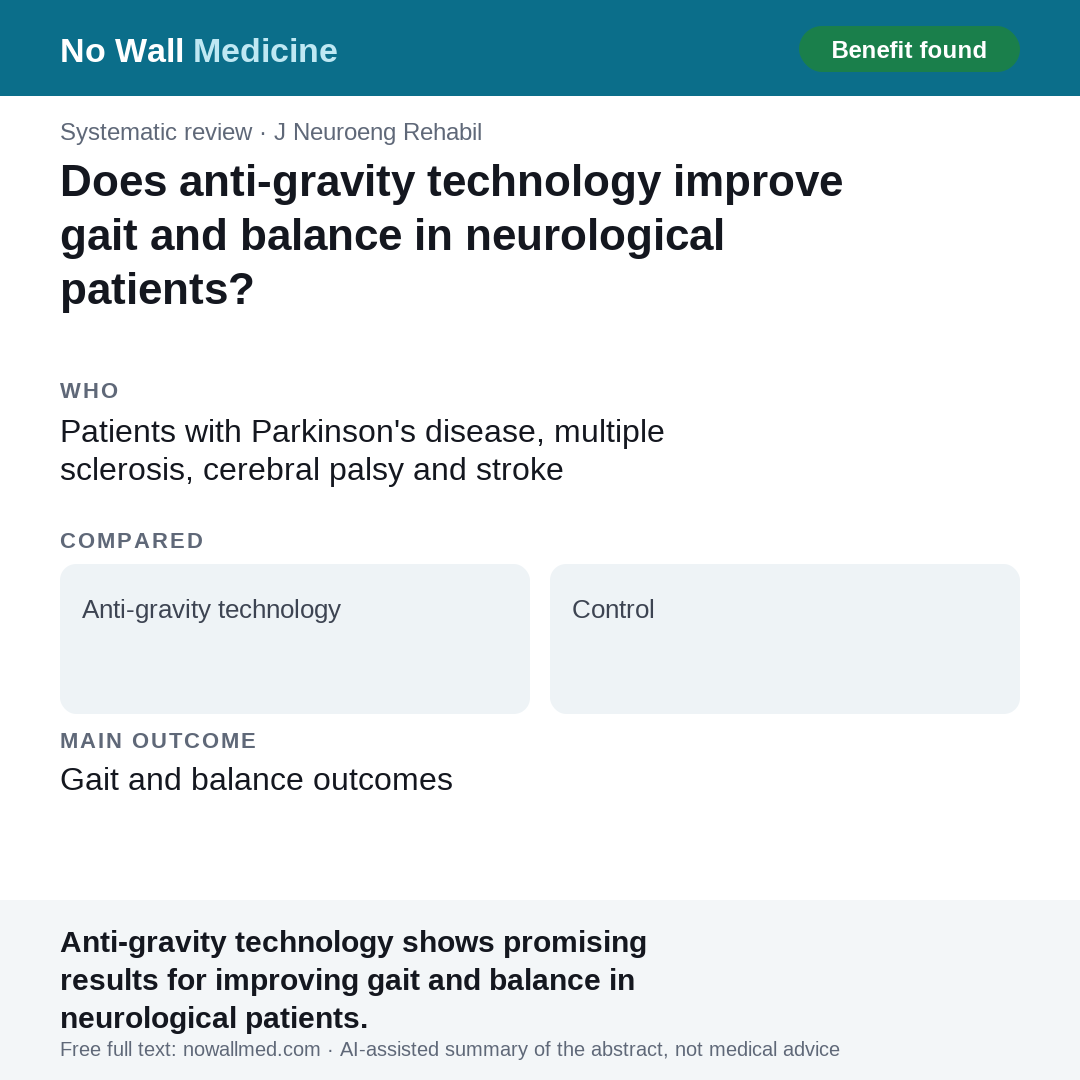
Clinical question: Does anti-gravity technology improve gait and balance in neurological patients?
Why it matters: It is unknown what specific dose and parameters of anti-gravity treadmill training are most effective for neurological rehabilitation.
Key points
- Researchers reviewed 16 studies published between January 2010 and September 2023, including 5 randomized controlled trials and 7 pilot studies.
- The review found that anti-gravity technology was associated with improvements in gait and balance outcomes for people with neurological disorders.
- The findings included patients with conditions such as Parkinson's disease, multiple sclerosis, cerebral palsy, and stroke.
Headline and key points written with AI from the paper’s abstract, with every number checked against it. Read the paper before relying on them.
Topics
Cite this article
Bonanno M, Maggio MG, Quartarone A, De Nunzio AM, Calabrò RS. Simulating space walking: a systematic review on anti-gravity technology in neurorehabilitation. J Neuroeng Rehabil. 2024. doi:10.1186/s12984-024-01449-z
Spotted a mistake? Suggest a correction
Top studies every Monday
The week’s key trials and guidelines in your specialties, plus any topics you follow. By email, free.
Get the weekly digest