Simulation-based randomized trial of medical emergency cognitive aids
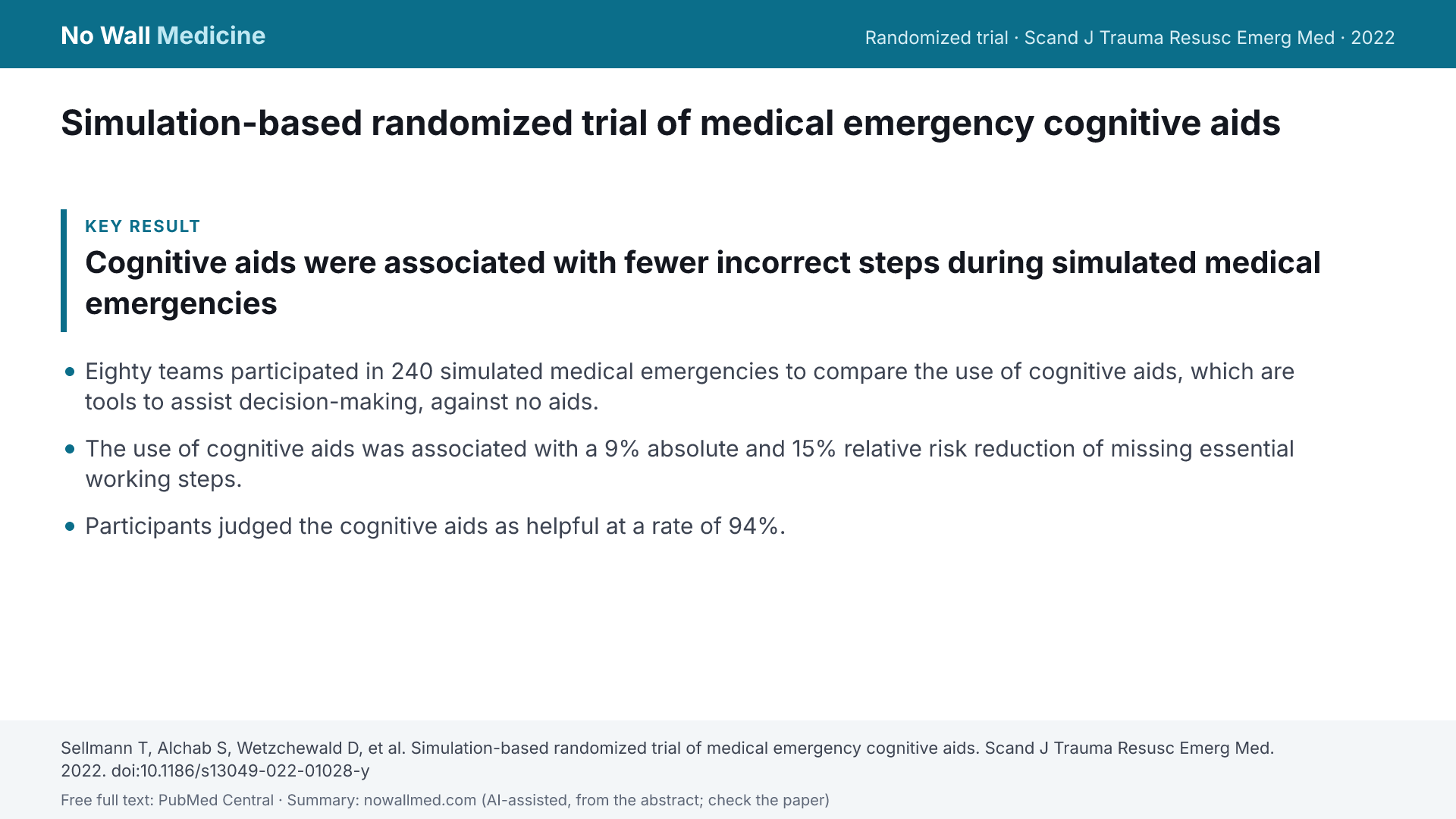
Key result: Cognitive aids were associated with fewer incorrect steps during simulated medical emergencies
Key points
- Eighty teams participated in 240 simulated medical emergencies to compare the use of cognitive aids, which are tools to assist decision-making, against no aids.
- The use of cognitive aids was associated with a 9% absolute and 15% relative risk reduction of missing essential working steps.
- Participants judged the cognitive aids as helpful at a rate of 94%.
Discussion prompts
- Would these patients look like yours? Who was left out?
- Is the main outcome one that matters to patients?
- Is the difference large enough to change what you do?
Cite: Sellmann T, Alchab S, Wetzchewald D, et al. Simulation-based randomized trial of medical emergency cognitive aids. Scand J Trauma Resusc Emerg Med. 2022. doi:10.1186/s13049-022-01028-y
Free full text: PubMed Central · Summary and visual abstract: nowallmed.com/a/simulation-based-randomized-trial-of-medical-emergency-cognitive-1dxil4a/ (AI-assisted from the abstract; check the paper before relying on it).