Online singing sessions improved physical quality of life for people with chronic obstructive pulmonary disease
Singing for lung health in COPD: a multicentre randomised controlled trial of online delivery
Assessor-blind randomised controlled trialMixed results
Does online singing for lung health improve quality of life in COPD?
Who
115
People with stable chronic obstructive pulmonary disease · Multicentre
Compared
Online singing for lung health: 32% responder rate for physical health component
Usual care: 12.7% responder rate for physical health component
Main outcome
RAND 36-Item Short Form Health Survey quality of life scores
Result: regression coefficient 1.77 (95% CI 0.11 to 3.44)
Bottom line: Online singing for lung health improved physical health quality of life but not mental health in people with COPD.
Limitation: The overall effect is relatively modest compared with face-to-face group sessions.
BMJ Open Respir Res · 2024-05-02Download image
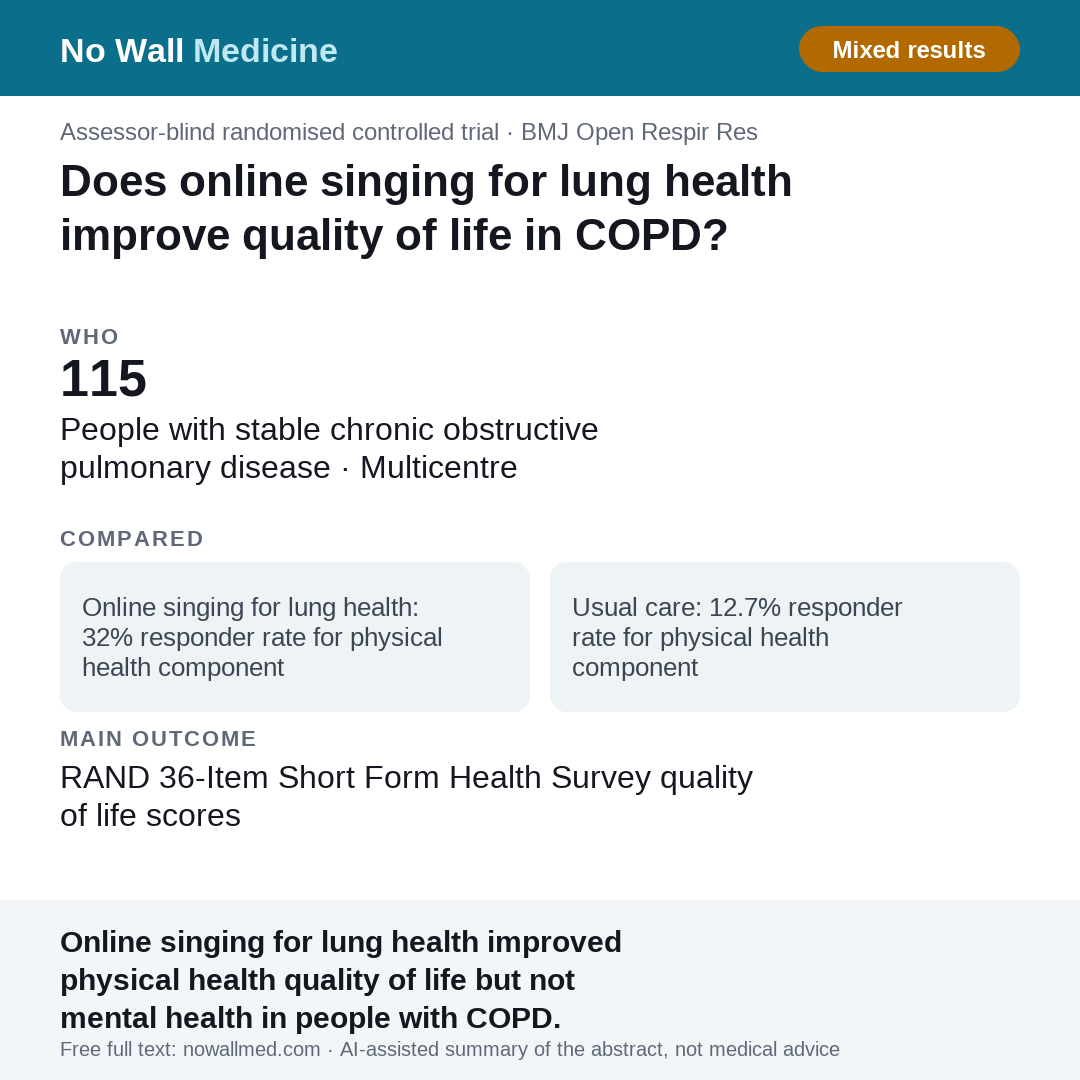
Clinical question: Does online singing for lung health improve quality of life in COPD?
Why it matters: It was unknown if remotely delivered singing programs for breathing control and movement could effectively improve symptoms and quality of life for people with respiratory conditions.
Key points
- Researchers conducted a randomized controlled trial with 115 people with stable chronic obstructive pulmonary disease, comparing 12 weeks of weekly online singing sessions to usual care.
- The singing intervention was associated with improved physical health scores (regression coefficient 1.77; 95% CI 0.11 to 3.44; p=0.037) but not mental health scores (p=0.504).
- A responder analysis showed a 32% response rate for physical health in the singing group compared to 12.7% for usual care (p=0.024).
Headline and key points written with AI from the paper’s abstract, with every number checked against it. Read the paper before relying on them.
Was this summary helpful?
Abstract
Background
Singing for lung health (SLH) is an arts-based breathing control and movement intervention for people with long-term respiratory conditions, intended to improve symptoms and quality of life. Online, remotely delivered programmes might improve accessibility; however, no previous studies have assessed the effectiveness of this approach. Methods
We conducted an assessor-blind randomised controlled trial comparing the impact of 12 weeks of once-weekly online SLH sessions against usual care on health-related quality of life, assessed using the RAND 36-Item Short Form Health Survey (SF-36) Mental Health Composite (MHC) and Physical Health Composite (PHC) scores. Results
We enrolled 115 people with stable chronic obstructive pulmonary disease (COPD), median (IQR) age 69 (62-74), 56.5% females, 80% prior pulmonary rehabilitation, Medical Research Council dyspnoea scale 4 (3-4), forced expiratory volume in 1 s % predicted 49 (35-63). 50 participants in each arm completed the study. The intervention arm experienced improvements in physical but not mental health components of RAND SF-36; PHC (regression coefficient (95% CI): 1.77 (95% CI 0.11 to 3.44); p=0.037), but not MHC (0.86 (95% CI -1.68 to 3.40); p=0.504). A prespecified responder analysis based on achieving a 10% improvement from baseline demonstrated a response rate for PHC of 32% in the SLH arm and 12.7% for usual care (p=0.024). A between-group difference in responder rate was not found in relation to the MHC (19.3% vs 25.9%; p=0.403). Discussion and conclusion
A 12-week online SLH programme can improve the physical component of quality of life for people with COPD, but the overall effect is relatively modest compared with the impact seen in research using face-to-face group sessions. Further work on the content, duration and dose of online interventions may be useful. Trial registration number
NCT04034212.
Abstract reproduced under the article’s CC BY licence.
Subject terms
Cite this article
Philip KEJ, Buttery SC, Bowen S, Lewis A, Jeffery E, Alghamdi SM. Singing for lung health in COPD: a multicentre randomised controlled trial of online delivery. BMJ Open Respir Res. 2024. doi:10.1136/bmjresp-2024-002365
Spotted a mistake? Suggest a correction
Top studies every Monday
The week’s key trials and guidelines in your specialties, plus any topics you follow. By email, free.
Get the weekly digest