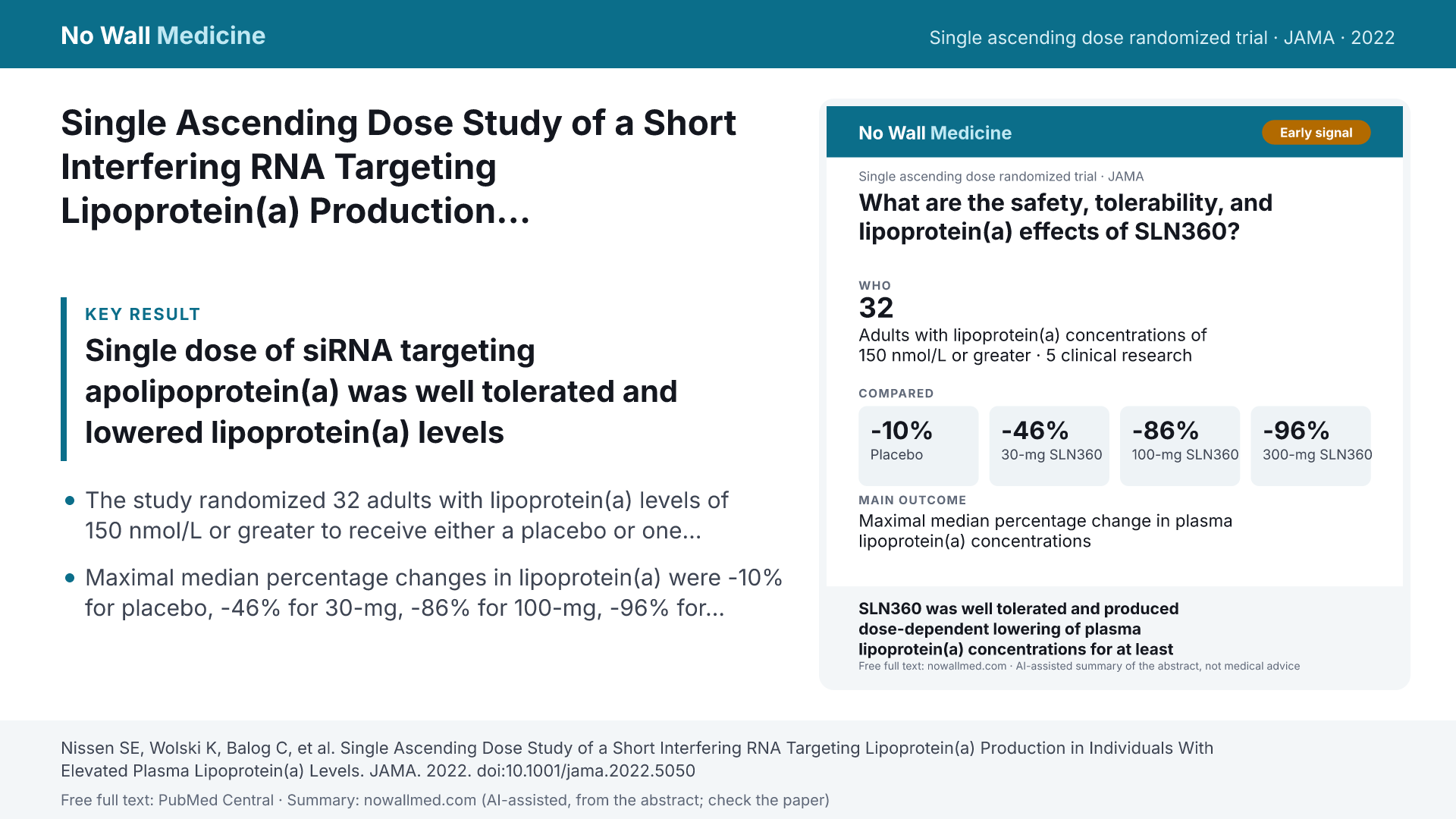
Single dose of siRNA targeting apolipoprotein(a) was well tolerated and lowered lipoprotein(a) levels
Single Ascending Dose Study of a Short Interfering RNA Targeting Lipoprotein(a) Production in Individuals With Elevated Plasma Lipoprotein(a) Levels
Single ascending dose randomized trialEarly signal
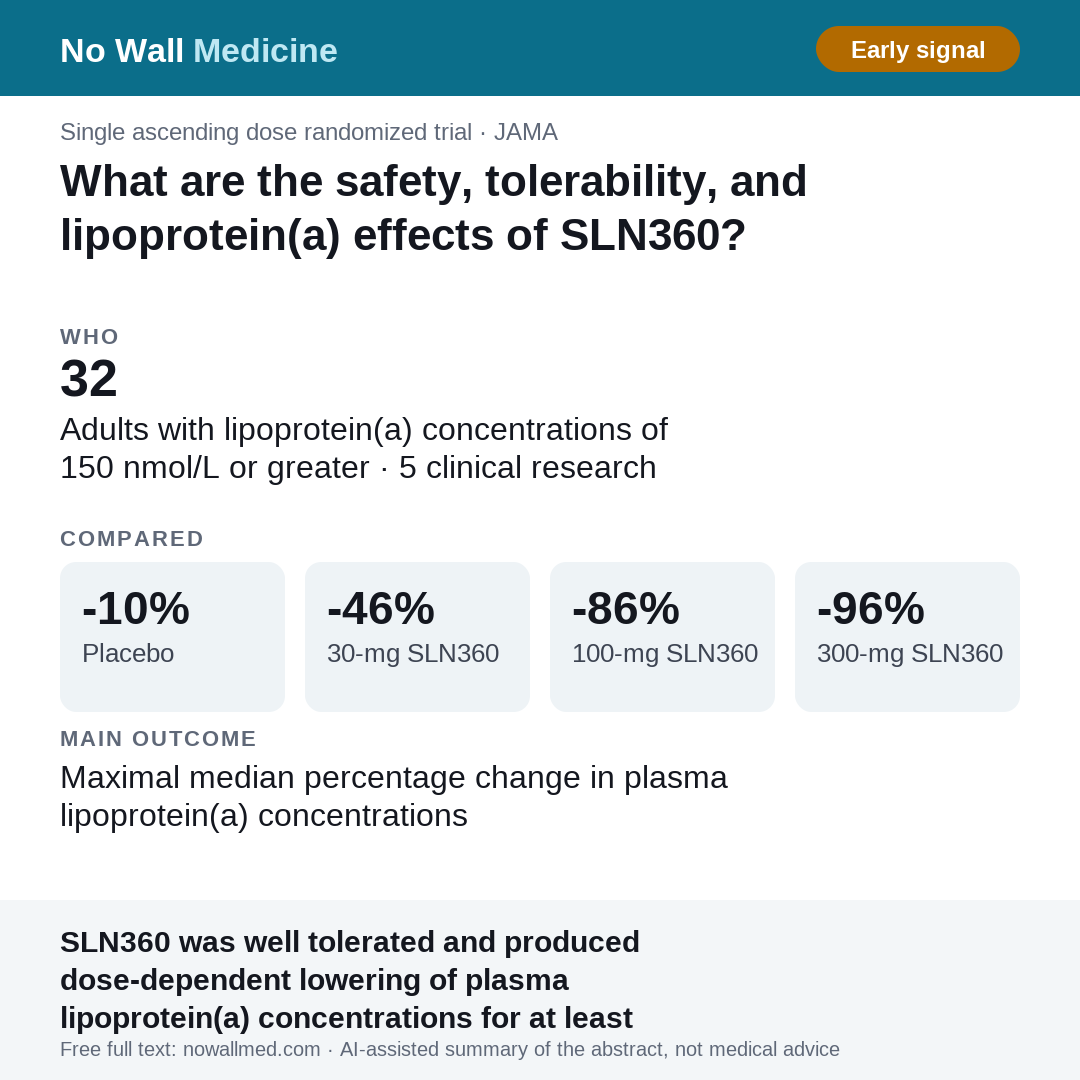
What are the safety, tolerability, and lipoprotein(a) effects of SLN360?
Who
32
Adults with lipoprotein(a) concentrations of 150 nmol/L or greater · 5 clinical research unit sites in US, UK, and Australia
Compared
-10%Placebo (IQR, -16% to 1%)
-46%30-mg SLN360 (IQR, -64% to -40%)
-86%100-mg SLN360 (IQR, -92% to -82%)
-96%300-mg SLN360 (IQR, -98% to -89%)
Main outcome
Maximal median percentage change in plasma lipoprotein(a) concentrations
Bottom line: SLN360 was well tolerated and produced dose-dependent lowering of plasma lipoprotein(a) concentrations for at least 150 days.
JAMA · 2022-04-04Download image
Clinical question: What are the safety, tolerability, and lipoprotein(a) effects of SLN360?
Why it matters: There are currently no approved treatments for cardiovascular disease or aortic stenosis caused by elevated lipoprotein(a) levels.
Key points
- The study randomized 32 adults with lipoprotein(a) levels of 150 nmol/L or greater to receive either a placebo or one of four doses of SLN360, a short interfering RNA.
- Maximal median percentage changes in lipoprotein(a) were -10% for placebo, -46% for 30-mg, -86% for 100-mg, -96% for 300-mg, and -98% for 600-mg doses.
- The reduction in lipoprotein(a) was dose dependent and lasted for at least 150 days after the single subcutaneous injection.
Headline and key points written with AI from the paper’s abstract, with every number checked against it. Read the paper before relying on them.
Was this summary helpful?
Subject terms
Cite this article
Nissen SE, Wolski K, Balog C, et al. Single Ascending Dose Study of a Short Interfering RNA Targeting Lipoprotein(a) Production in Individuals With Elevated Plasma Lipoprotein(a) Levels. JAMA. 2022. doi:10.1001/jama.2022.5050
Spotted a mistake? Suggest a correction