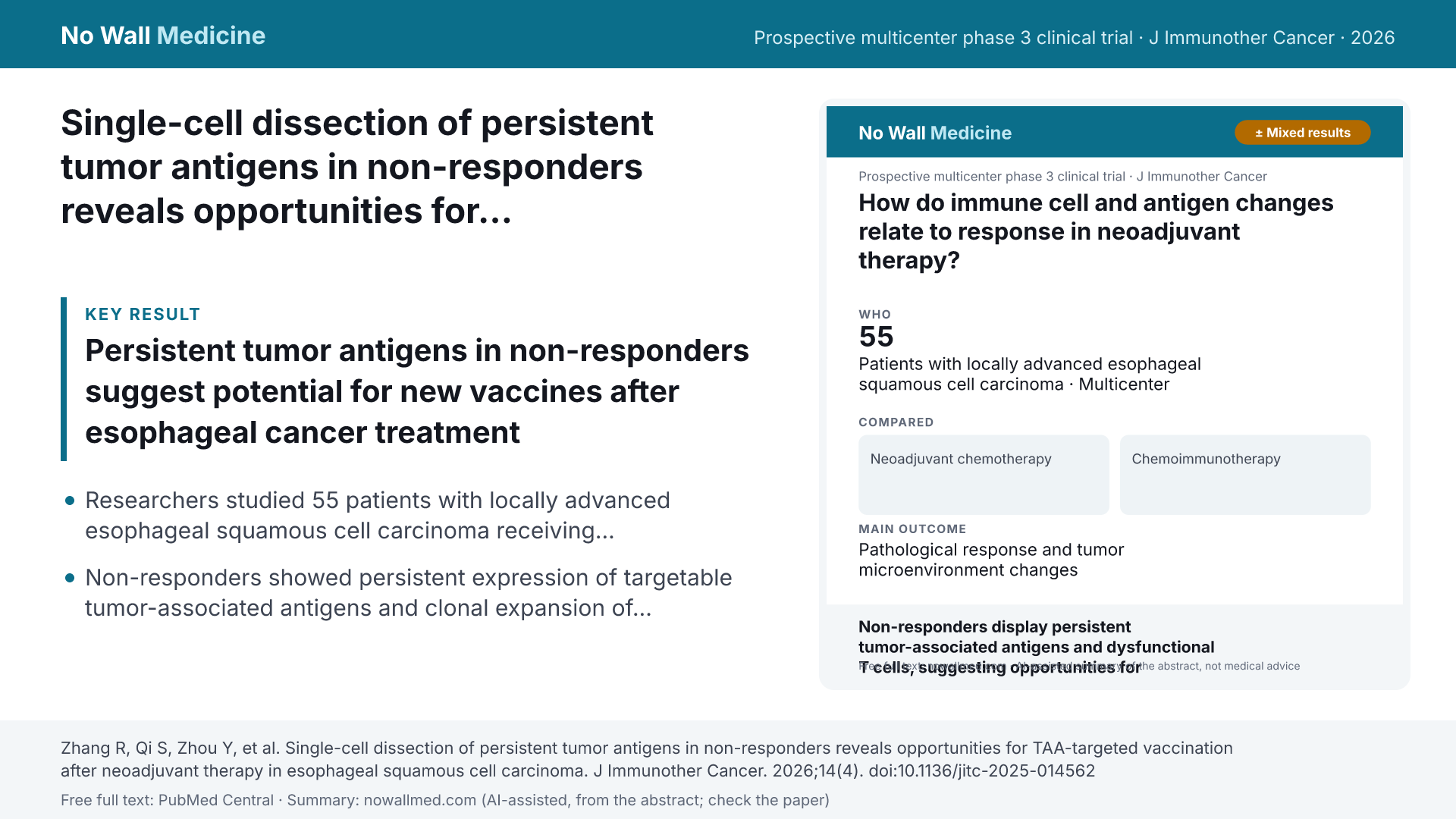
Persistent tumor antigens in non-responders suggest potential for new vaccines after esophageal cancer treatment
Single-cell dissection of persistent tumor antigens in non-responders reveals opportunities for TAA-targeted vaccination after neoadjuvant therapy in esophageal squamous cell carcinoma
Prospective multicenter phase 3 clinical trialMixed results
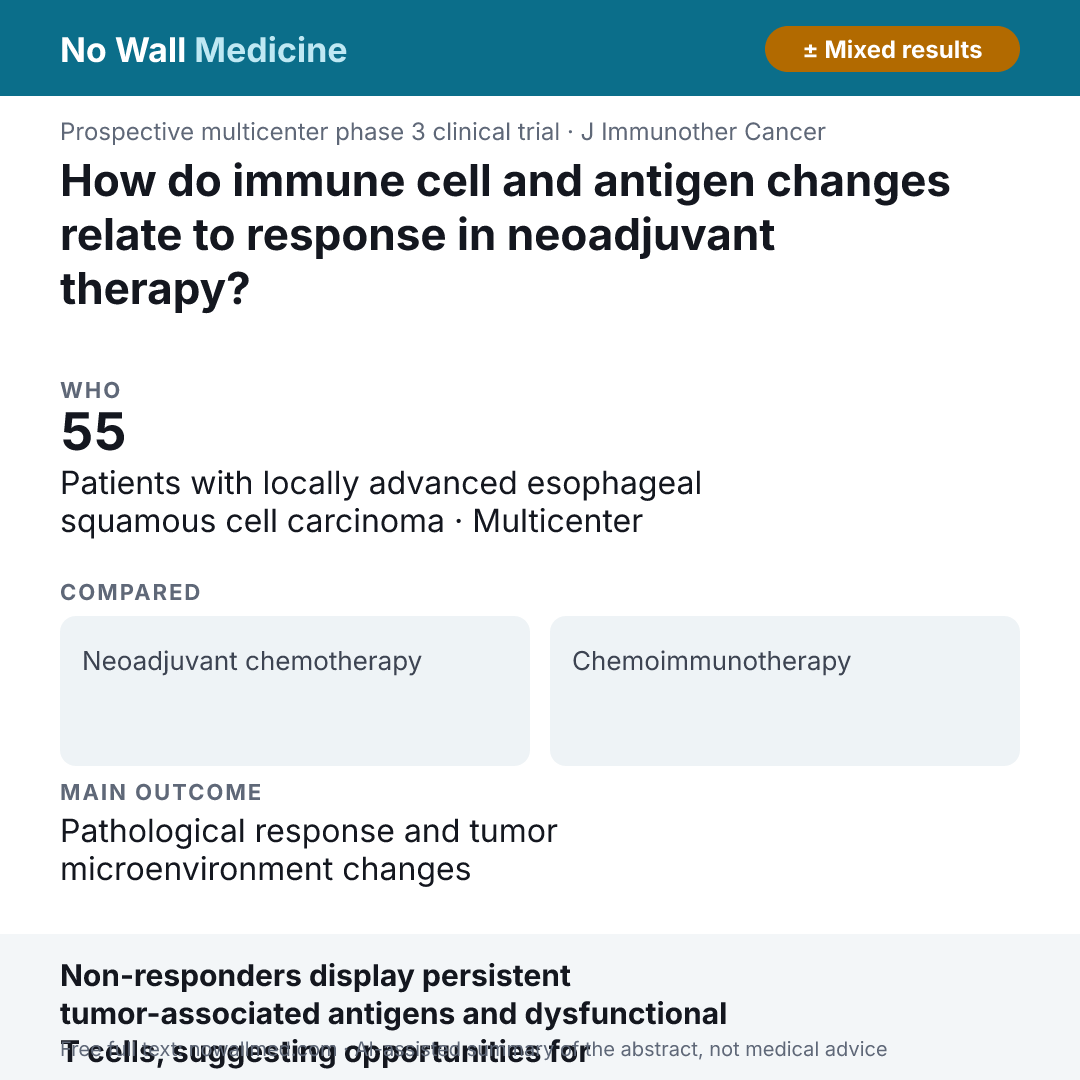
How do immune cell and antigen changes relate to response in neoadjuvant therapy?
Who
55
Patients with locally advanced esophageal squamous cell carcinoma · Multicenter
Compared
Neoadjuvant chemotherapy
Chemoimmunotherapy
Main outcome
Pathological response and tumor microenvironment changes
Bottom line: Non-responders display persistent tumor-associated antigens and dysfunctional T cells, suggesting opportunities for targeted vaccination.
J Immunother Cancer · 2026-04-22 · ChiCTR2000040034
Same trial (ChiCTR2000040034)
Papers we list that report this registered trial, oldest first. Read a secondary analysis alongside the main results.
- Main results Benefit found
Adding camrelizumab to chemotherapy increased complete tumor disappearance rates in esophageal cancer patients Nat Med 2024-07 - Related analysis Mixed results
This paper J Immunother Cancer 2026-04
Why it matters: Direct comparisons of tumor microenvironment characteristics between chemotherapy and chemoimmunotherapy remain largely unexplored in esophageal squamous cell carcinoma.
Headline and visual abstract written with AI from the paper’s abstract, with every number checked against it. Read the paper before relying on them.
Was this summary helpful?
Abstract
Background
Neoadjuvant immune checkpoint blockade (ICB) combined with chemotherapy has demonstrated higher response rates than chemotherapy alone in resectable esophageal squamous cell carcinoma (ESCC). Although tumor microenvironment (TME) features associated with treatment response have been studied in the contexts of both chemotherapy and immunotherapy, direct comparisons of these characteristics and their implications for novel therapeutic development remain largely unexplored. Methods
Paired pretreatment and post-treatment tumor samples were prospectively collected from 55 patients with locally advanced ESCC enrolled in a multicenter, phase 3 clinical trial (ChiCTR2000040034). Patients were randomized to receive neoadjuvant chemotherapy (paclitaxel with cisplatin, TP; n=14) or its combination with PD-1 blockade (camrelizumab, albumin-bound paclitaxel and cisplatin/paclitaxel and cisplatin, Cam+nab-TP/TP; n=41), followed by surgical resection. Pathological response was defined based on Mandard's Tumor Regression Grade scoring system. Changes in immune cell populations and tumor-associated antigens (TAAs) within the TME in relation to response were characterized using single-cell RNA and T cell receptor sequencing. Results
Both chemotherapy and chemoimmunotherapy responders exhibited shared temporal dynamics including dendritic cell remodeling, cytotoxic CD8+ T cell contraction, and memory T cell expansion, with chemoimmunotherapy uniquely suppressing the clonal expansion of GZMB+TIGIT+ T cells. In contrast, non-responders failed to elicit effective antitumor immunity and displayed persistent expression of targetable TAAs, fully preserved HLA machinery, and clonal expansion of dysfunctional GZMB+TIGIT+ T cells. Conclusions
Our study identifies key immune contributors correlated with response to neoadjuvant therapies and a panel of TAAs in non-responders. These findings support the development of TAA-targeted therapeutic vaccines and combination strategies incorporating ICB to overcome resistance in non-responders.
Abstract reproduced under the article’s CC BY NC licence.
Subject terms
Cite this article
Zhang R, Qi S, Zhou Y, et al. Single-cell dissection of persistent tumor antigens in non-responders reveals opportunities for TAA-targeted vaccination after neoadjuvant therapy in esophageal squamous cell carcinoma. J Immunother Cancer. 2026;14(4). doi:10.1136/jitc-2025-014562
Spotted a mistake? Suggest a correction