Cefixime and doxycycline combination failed to match ceftriaxone and azithromycin for treating gonorrhoea
Single-dose cefixime 800 mg plus doxycycline 100 mg twice a day for 7 days compared with single-dose ceftriaxone 1 g plus single-dose azithromycin 2 g for treatment of urogenital, rectal, and pharyngeal gonorrhoea: a randomised clinical trial
Noninferiority, open-label, multicentre randomized controlled trialHarm found
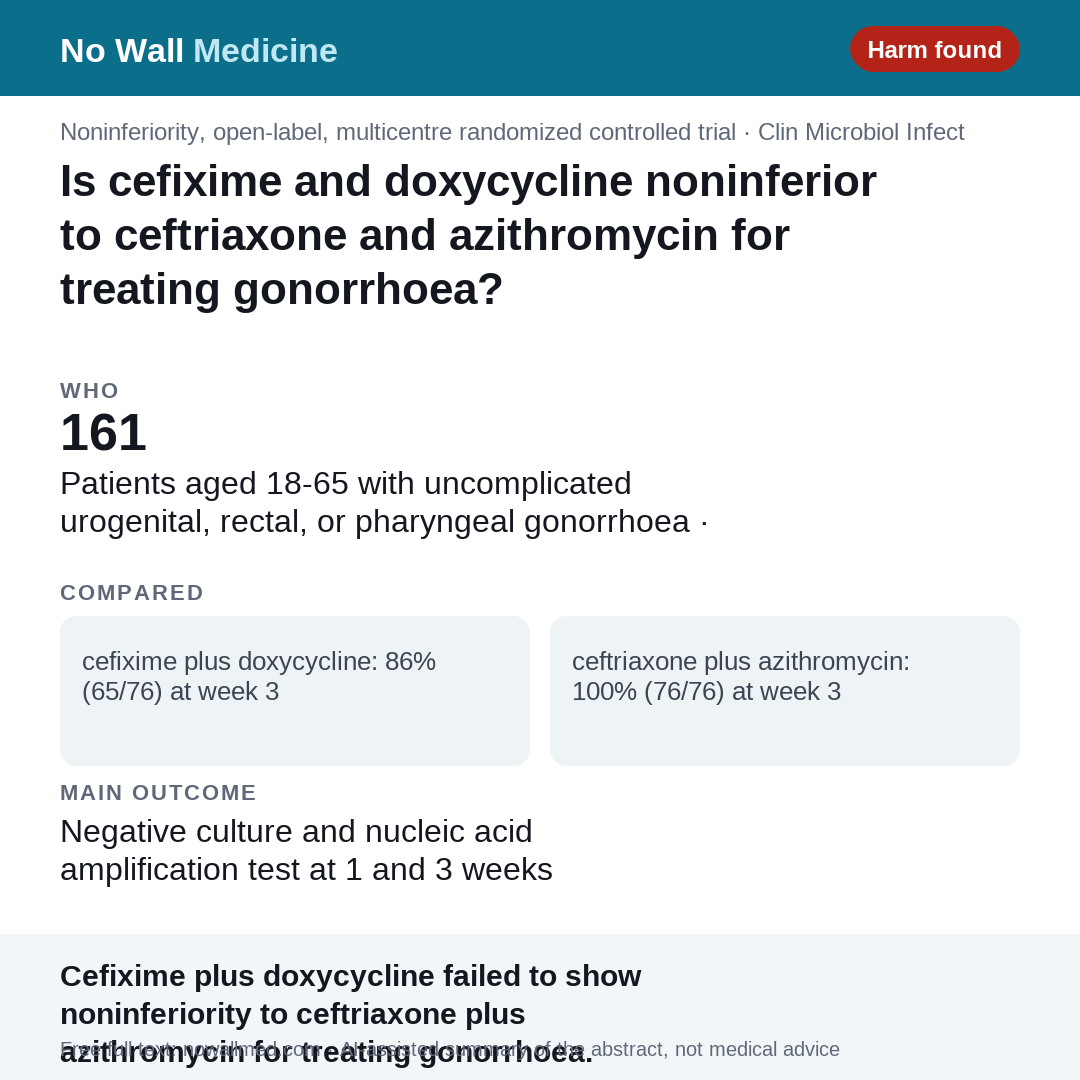
Is cefixime and doxycycline noninferior to ceftriaxone and azithromycin for treating gonorrhoea?
Who
161
Patients aged 18-65 with uncomplicated urogenital, rectal, or pharyngeal gonorrhoea · Prague, Czech Republic
Compared
cefixime plus doxycycline: 86% (65/76) at week 3
ceftriaxone plus azithromycin: 100% (76/76) at week 3
Main outcome
Negative culture and nucleic acid amplification test at 1 and 3 weeks
Result: risk difference 14.5%; 95% CI, 6.56-22.38
Bottom line: Cefixime plus doxycycline failed to show noninferiority to ceftriaxone plus azithromycin for treating gonorrhoea.
Limitation: All treatment failures observed in the cefixime arm were pharyngeal gonorrhoea cases.
Clin Microbiol Infect · 2023-11-18Download image
Clinical question: Is cefixime and doxycycline noninferior to ceftriaxone and azithromycin for treating gonorrhoea?
Why it matters: It is unknown if a combination of oral cefixime and doxycycline is as effective as the recommended ceftriaxone and azithromycin for treating various types of gonorrhoea.
Key points
- Researchers studied 161 patients with urogenital, rectal, or pharyngeal gonorrhoea, comparing oral cefixime and doxycycline to intramuscular ceftriaxone and oral azithromycin.
- While 100% of patients in the ceftriaxone and azithromycin group achieved negative results, only 86% of the cefixime and doxycycline group were negative by culture and nucleic acid amplification test at week 3.
- All treatment failures in the cefixime and doxycycline group occurred in patients with pharyngeal gonorrhoea, which is an infection in the throat.
Headline and key points written with AI from the paper’s abstract, with every number checked against it. Read the paper before relying on them.
Was this summary helpful?
Subject terms
Cite this article
Bížová B, Procházka P, Nyčová E, Bořil P, Kubele J, Poláková A. Single-dose cefixime 800 mg plus doxycycline 100 mg twice a day for 7 days compared with single-dose ceftriaxone 1 g plus single-dose azithromycin 2 g for treatment of urogenital, rectal, and pharyngeal gonorrhoea: a randomised clinical trial. Clin Microbiol Infect. 2023. doi:10.1016/j.cmi.2023.11.006
Spotted a mistake? Suggest a correction
Top studies every Monday
The week’s key trials and guidelines in your specialties, plus any topics you follow. By email, free.
Get the weekly digest