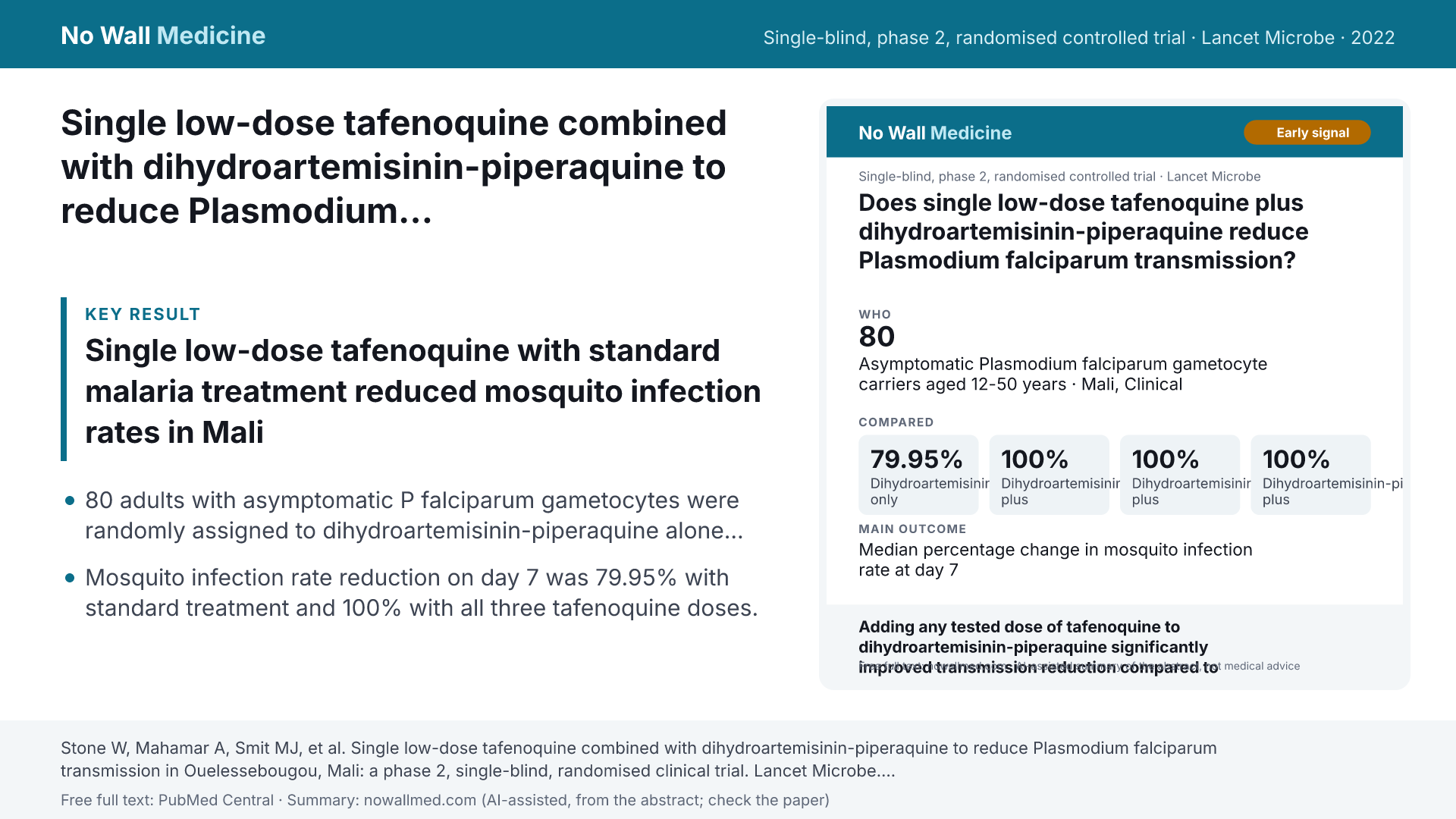
Single low-dose tafenoquine with standard malaria treatment reduced mosquito infection rates in Mali
Single low-dose tafenoquine combined with dihydroartemisinin-piperaquine to reduce Plasmodium falciparum transmission in Ouelessebougou, Mali: a phase 2, single-blind, randomised clinical trial
Single-blind, phase 2, randomised controlled trialEarly signal
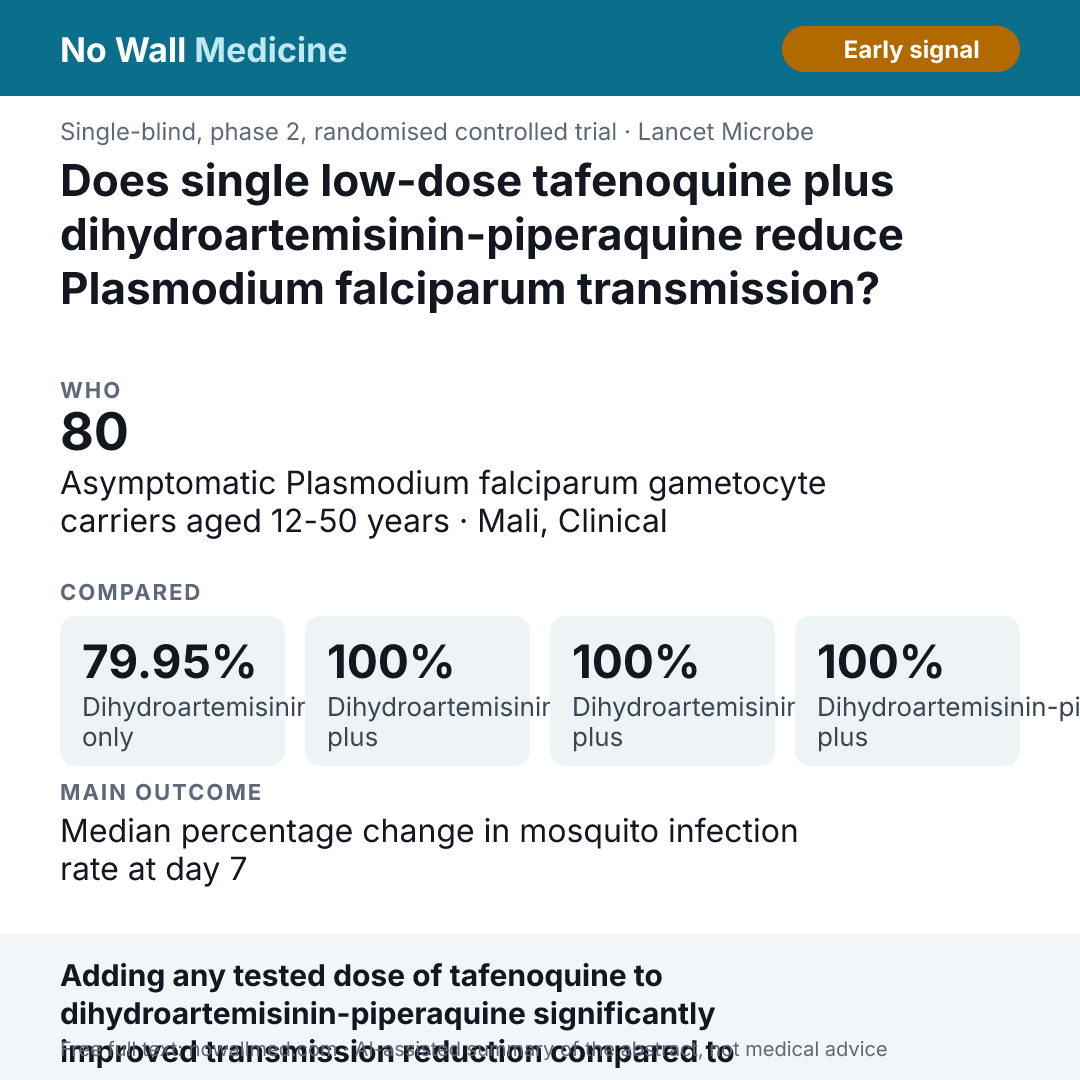
Does single low-dose tafenoquine plus dihydroartemisinin-piperaquine reduce Plasmodium falciparum transmission?
Who
80
Asymptomatic Plasmodium falciparum gametocyte carriers aged 12-50 years · Mali, Clinical Research Unit of the Malaria Research and Training Centre
Compared
79.95%Dihydroartemisinin-piperaquine only (IQR 57.15-100)
100%Dihydroartemisinin-piperaquine plus tafenoquine 0.42 mg/kg (98.36-100)
100%Dihydroartemisinin-piperaquine plus tafenoquine 0.83 mg/kg (100-100)
100%Dihydroartemisinin-piperaquine plus tafenoquine 1.66 mg/kg (100-100)
Main outcome
Median percentage change in mosquito infection rate at day 7
Bottom line: Adding any tested dose of tafenoquine to dihydroartemisinin-piperaquine significantly improved transmission reduction compared to dihydroartemisinin-piperaquine alone.
Funded by: Bill & Melinda Gates Foundation
Lancet Microbe · 2022-03-23 · Save PNG
Clinical question: Does single low-dose tafenoquine plus dihydroartemisinin-piperaquine reduce Plasmodium falciparum transmission?
Why it matters: The transmission-blocking efficacy of tafenoquine against P falciparum was unclear despite its approval for P vivax.
Key points
- 80 adults with asymptomatic P falciparum gametocytes were randomly assigned to dihydroartemisinin-piperaquine alone or plus three tafenoquine doses.
- Mosquito infection rate reduction on day 7 was 79.95% with standard treatment and 100% with all three tafenoquine doses.
- No serious adverse events occurred, and adverse event rates were not significantly different between treatment groups.
Headline and key points written with AI from the paper’s abstract, with every number checked against it. Read the paper before relying on them.
Was this summary helpful?
Abstract
Background
Tafenoquine was recently approved as a prophylaxis and radical cure for Plasmodium vivax infection, but its Plasmodium falciparum transmission-blocking efficacy is unclear. We aimed to establish the efficacy and safety of three single low doses of tafenoquine in combination with dihydroartemisinin-piperaquine for reducing gametocyte density and transmission to mosquitoes. Methods
In this four-arm, single-blind, phase 2, randomised controlled trial, participants were recruited at the Clinical Research Unit of the Malaria Research and Training Centre of the University of Bamako in Mali. Eligible participants were aged 12-50 years, with asymptomatic P falciparum microscopy-detected gametocyte carriage, had a bodyweight of 80 kg or less, and had no clinical signs of malaria defined by fever. Participants were randomly assigned (1:1:1:1) to standard treatment with dihydroartemisinin-piperaquine, or dihydroartemisinin-piperaquine plus a single dose of tafenoquine (in solution) at a final dosage of 0·42 mg/kg, 0·83 mg/kg, or 1·66 mg/kg. Randomisation was done with a computer-generated randomisation list and concealed with sealed, opaque envelopes. Dihydroartemisinin-piperaquine was administered as oral tablets over 3 days (day 0, 1, and 2), as per manufacturer instructions. A single dose of tafenoquine was administered as oral solution on day 0 in parallel with the first dose of dihydroartemisinin-piperaquine. Tafenoquine dosing was based on bodyweight to standardise efficacy and risk variance. The primary endpoint, assessed in the per-protocol population, was median percentage change in mosquito infection rate 7 days after treatment compared with baseline. Safety endpoints included frequency and incidence of adverse events. The final follow-up visit was on Dec 23, 2021; the trial is registered with ClinicalTrials.gov, NCT04609098. Findings
From Oct 29 to Nov 25, 2020, 1091 individuals were screened for eligibility, 80 of whom were enrolled and randomly assigned (20 per treatment group). Before treatment, 53 (66%) individuals were infectious to mosquitoes, infecting median 12·50% of mosquitoes (IQR 3·64-35·00). Within-group reduction in mosquito infection rate on day 7 was 79·95% (IQR 57·15-100; p=0·0005 for difference from baseline) following dihydroartemisinin-piperaquine only, 100% (98·36-100; p=0·0005) following dihydroartemisinin-piperaquine plus tafenoquine 0·42 mg/kg, 100% (100-100; p=0·0001) following dihydroartemisinin-piperaquine plus tafenoquine 0·83 mg/kg, and 100% (100-100; p=0·0001) following dihydroartemisinin-piperaquine plus tafenoquine 1·66 mg/kg. 55 (69%) of 80 participants had a total of 94 adverse events over the course of the trial; 86 (92%) adverse events were categorised as mild, seven (7%) as moderate, and one (1%) as severe. The most common treatment-related adverse event was mild or moderate headache, which occurred in 15 (19%) participants (dihydroartemisinin-piperaquine n=2; dihydroartemisinin-piperaquine plus tafenoquine 0·42 mg/kg n=6; dihydroartemisinin-piperaquine plus tafenoquine 0·83 mg/kg n=3; and dihydroartemisinin-piperaquine plus tafenoquine 1·66 mg/kg n=4). No serious adverse events occurred. No significant differences in the incidence of all adverse events (p=0·73) or treatment-related adverse events (p=0·62) were observed between treatment groups. Interpretation
Tafenoquine was well tolerated at all doses and accelerated P falciparum gametocyte clearance. All tafenoquine doses showed improved transmission reduction at day 7 compared with dihydroartemisinin-piperaquine alone. These data support the case for further research on tafenoquine as a transmission-blocking supplement to standard antimalarials. Funding
Bill & Melinda Gates Foundation. Translations
For the French, Portuguese, Spanish and Swahili translations of the abstract see Supplementary Materials section.
Abstract reproduced under the article’s CC BY NC ND licence.
Subject terms
Headline, design, result, key points, caveat and citation as plain text.
Cite this article
Stone W, Mahamar A, Smit MJ, et al. Single low-dose tafenoquine combined with dihydroartemisinin-piperaquine to reduce Plasmodium falciparum transmission in Ouelessebougou, Mali: a phase 2, single-blind, randomised clinical trial. Lancet Microbe. 2022;3(5):e336-e347. doi:10.1016/S2666-5247(21)00356-6
Spotted a mistake? Suggest a correction