Single-round performance of colorectal cancer screening programs: a network meta-analysis of randomized clinical trials
Bayesian random-effects network meta-analysisMixed results
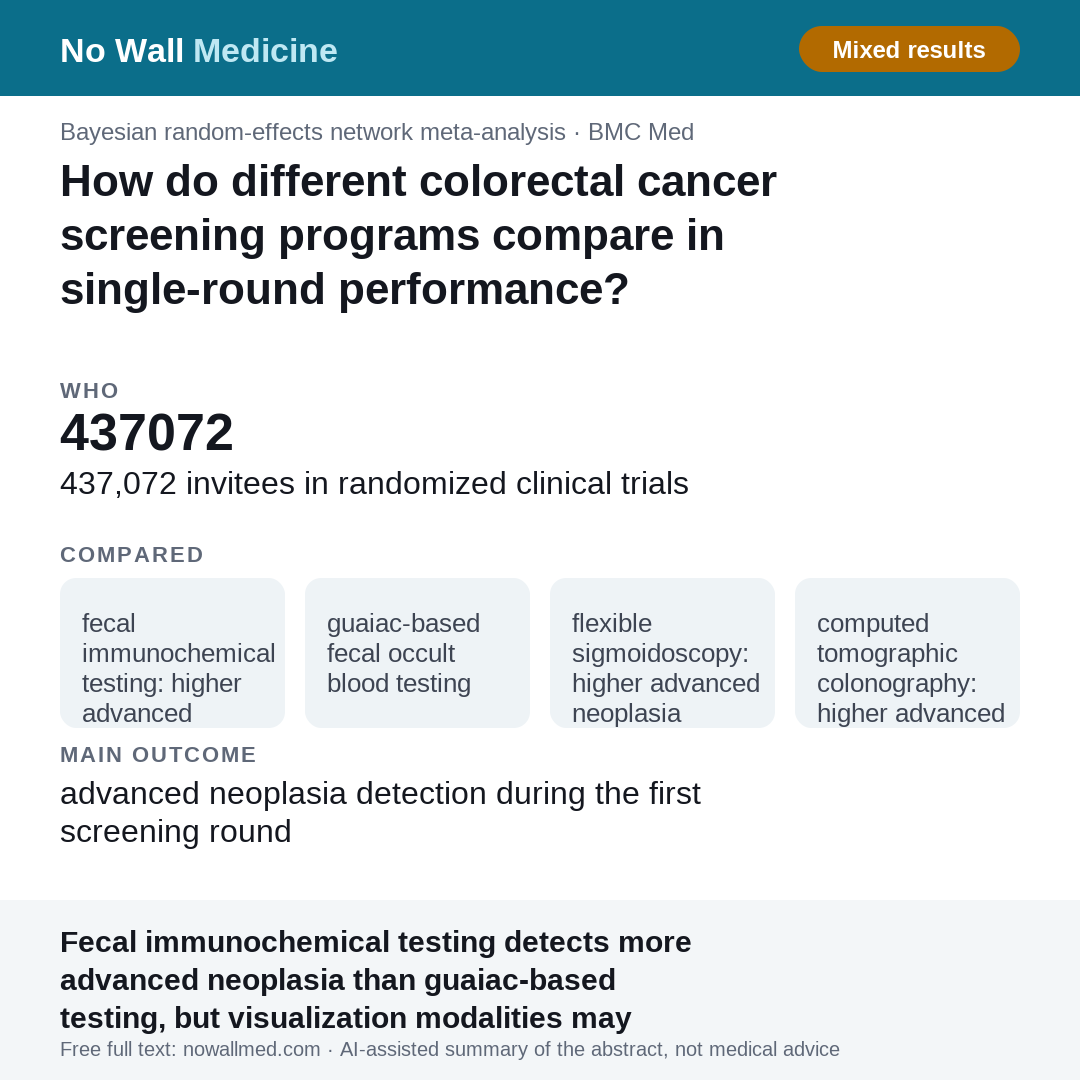
How do different colorectal cancer screening programs compare in single-round performance?
Who
437072
437,072 invitees in randomized clinical trials
Compared
fecal immunochemical testing: higher advanced neoplasia detection than guaiac-based
guaiac-based fecal occult blood testing
flexible sigmoidoscopy: higher advanced neoplasia detection than fecal immunochemical testing
computed tomographic colonography: higher advanced neoplasia detection than fecal immunochemical testing
Main outcome
advanced neoplasia detection during the first screening round
Result: relative risk 2.48 (95% credible interval 1.52-4.21)
Bottom line: Fecal immunochemical testing detects more advanced neoplasia than guaiac-based testing, but visualization modalities may outperform fecal immunochemical testing.
Limitation: High risk of bias for detection outcomes and low event rates for colorectal cancer detection.
BMC Med · 2025-02-21Download image
Clinical question: How do different colorectal cancer screening programs compare in single-round performance?
Abstract
Background
Demonstrating mortality reduction in new colorectal cancer (CRC) screening programs through randomized clinical trials (RCTs) is challenging. We systematically reviewed single-round program performance outcomes using a stepwise approach proposed by the World Endoscopy Organization CRC Screening Committee framework. Methods
The MEDLINE, EMBASE, Central, and Ichushi Web databases were searched until October 28, 2024, to find RCTs comparing guaiac-based and immunochemical fecal occult blood testing (gFOBT and FIT), flexible sigmoidoscopy (FS), computed tomographic colonography (CTC), and total colonoscopy (TCS). Paired reviewers screened studies, extracted data, and assessed bias risk. A Bayesian random-effects network meta-analysis was conducted, and the certainty of evidence was evaluated using the Grading of Recommendations Assessment, Development and Evaluation approach. The primary outcome was advanced neoplasia (AN) detection, and the secondary outcomes were participation and colorectal cancer (CRC) detection, all during the first screening round. Results
Eighteen RCTs (437,072 invitees) were included. The risk of bias was low or raised some concerns for screening participation, but it was high for detection outcomes. In the network meta-analysis of 15 RCTs not allowing crossover, the FIT-based program had a higher AN detection rate than the gFOBT-based program (relative risk [RR] 2.48; 95% credible interval [CrI] 1.52-4.21; moderate certainty). AN detection rates were not different in the CTC- (RR 1.01; CrI 0.43-2.23; very low certainty) and TCS-based (RR 1.03; CrI 0.54-1.78; low certainty) programs compared with the FS-based program. All the visualization modality programs had higher AN detection rates than the FIT-based program (FS: RR 2.13 [CrI 1.38-3.77]; CTC 2.16 [1.11-4.51]; and TCS 2.19 [1.43-3.48]; all with low certainty). Low event rates precluded definitive conclusions regarding CRC detection (very low to low certainty). The TCS-based program had the worst participation rate (very low to low certainty). Comparative data allowing crossover were limited. Conclusions
This is the first network meta-analysis that evaluates program-level initial performance indicators. FIT-based programs likely detect more AN cases than gFOBT-based programs, while FS-, CTC-, and TCS-based programs may outperform FIT. Due to limitations in first-round results, long-term outcomes should be assessed after 10-15 years.
Topics
Cite this article
Terasawa T, Tadano T, Abe K, Sasaki S, Hosono S, Katayama T. Single-round performance of colorectal cancer screening programs: a network meta-analysis of randomized clinical trials. BMC Med. 2025. doi:10.1186/s12916-025-03948-9
Spotted a mistake? Suggest a correction
Top studies every Monday
The week’s key trials and guidelines in your specialties, plus any topics you follow. By email, free.
Get the weekly digest