Single-session visuospatial task may prevent posttraumatic stress disorder symptoms after unplanned caesarean sections
Single-session visuospatial task procedure to prevent childbirth-related posttraumatic stress disorder: a multicentre double-blind randomised controlled trial
Multicentre double-blind randomised controlled trialBenefit found
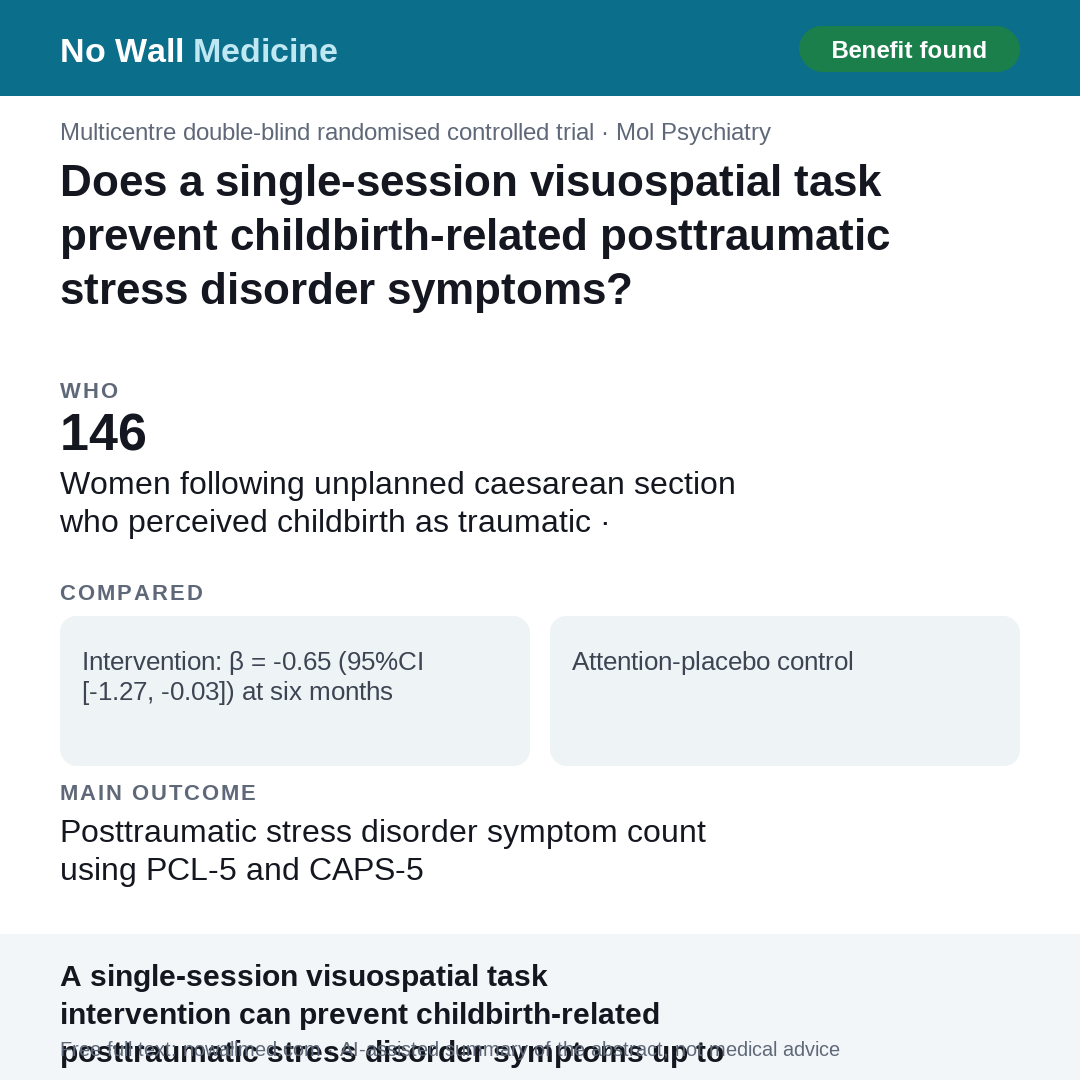
Does a single-session visuospatial task prevent childbirth-related posttraumatic stress disorder symptoms?
Who
146
Women following unplanned caesarean section who perceived childbirth as traumatic · Multicentre
Compared
Intervention: β = -0.65 (95%CI [-1.27, -0.03]) at six months
Attention-placebo control
Main outcome
Posttraumatic stress disorder symptom count using PCL-5 and CAPS-5
Result: β = -0.65 (95%CI [-1.27, -0.03])
Bottom line: A single-session visuospatial task intervention can prevent childbirth-related posttraumatic stress disorder symptoms up to six months postpartum.
Mol Psychiatry · 2023-09-27Download image
Clinical question: Does a single-session visuospatial task prevent childbirth-related posttraumatic stress disorder symptoms?
Why it matters: Preventive evidence-based interventions are currently lacking for the 18.5% of women who develop childbirth-related posttraumatic stress disorder symptoms following an unplanned caesarean section.
Key points
- Researchers randomized 146 women who perceived their unplanned caesarean section as traumatic to either a single-session visuospatial task intervention or an attention-placebo group.
- At six months postpartum, the intervention was associated with a significant reduction in total PTSD symptom count (p = 0.041) and alterations in cognition and mood (p = 0.0016).
- The intervention showed no significant differences between groups when measured by the clinician-administered PTSD scale (CAPS-5).
Headline and key points written with AI from the paper’s abstract, with every number checked against it. Read the paper before relying on them.
Was this summary helpful?
Subject terms
Cite this article
Deforges C, Sandoz V, Noël Y, Avignon V, Desseauve D, Bourdin J. Single-session visuospatial task procedure to prevent childbirth-related posttraumatic stress disorder: a multicentre double-blind randomised controlled trial. Mol Psychiatry. 2023. doi:10.1038/s41380-023-02275-w
Spotted a mistake? Suggest a correction
Top studies every Monday
The week’s key trials and guidelines in your specialties, plus any topics you follow. By email, free.
Get the weekly digest