Single-use optical tracking navigation showed accurate placement in 3D-printed and cadaveric head models
Single-use optical tracking navigation for external ventricular drain placement: Preclinical 3D-Printed and cadaveric evaluation with a systematic review
Preclinical 3D-printed and cadaveric evaluationBenefit found
Is a single-use optical tracking navigation system feasible and accurate for external ventricular drain placement?
Who
11
3D-printed head models and cadaveric head models
Compared
3D-printed models: 9/9 (100%) Kakarla grade 1
Cadaveric head: 2/2 (100%) Kakarla grade 1
Main outcome
Kakarla grading
Bottom line: The single-use optical tracking navigation device enables accurate, real-time image-guided external ventricular drain placement in preclinical models.
Limitation: Small sample size, ex vivo design, and reliance on 2D fluoroscopy for verification.
Brain Spine · 2026-03-03Download image
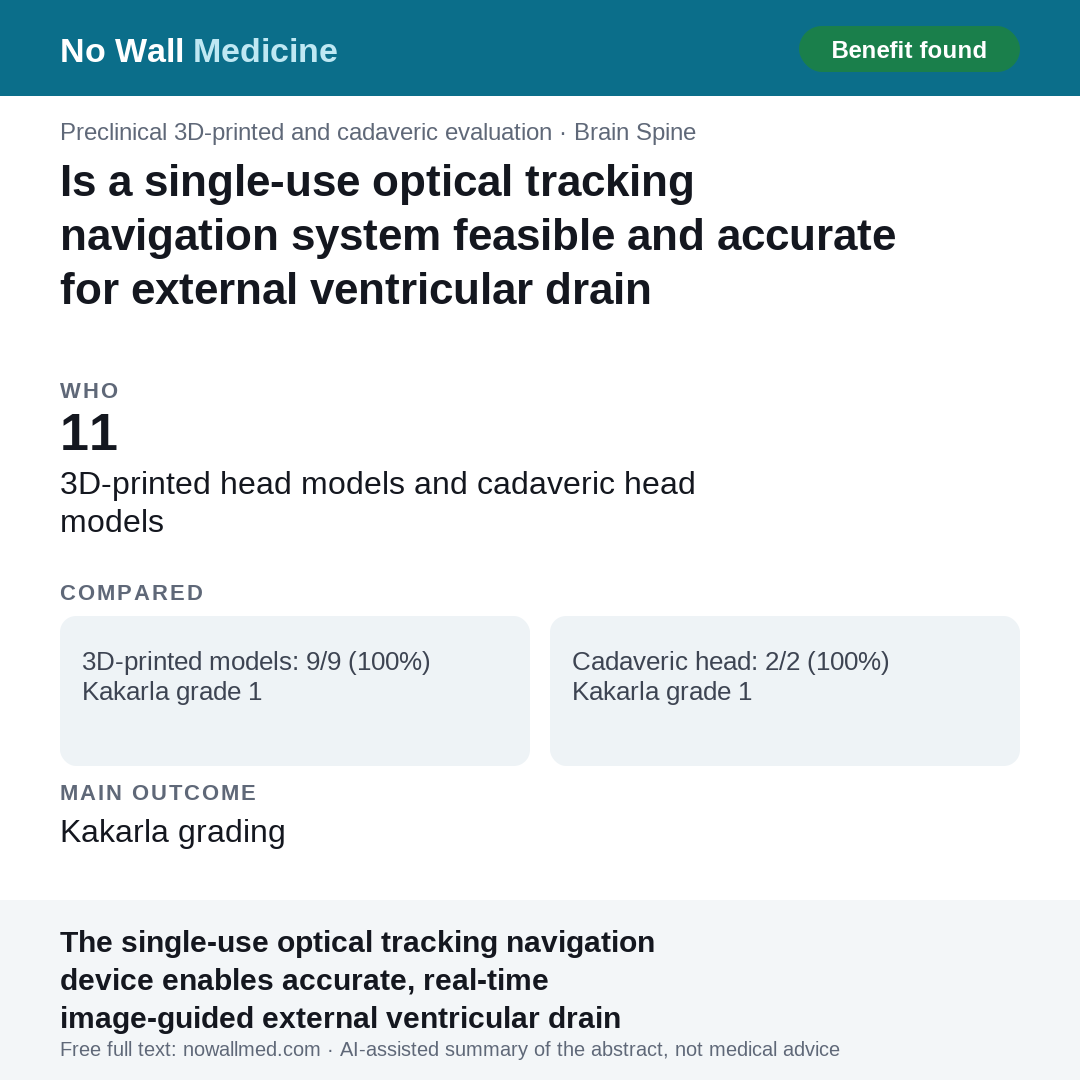
Clinical question: Is a single-use optical tracking navigation system feasible and accurate for external ventricular drain placement?
Why it matters: External ventricular drain malposition occurs in up to 38% of cases, creating a need for simpler and more user-friendly technical adjuncts.
Key points
- Researchers tested a single-use optical tracking navigation device for external ventricular drain placement using 9 3D-printed model procedures and 2 cadaveric head procedures.
- All 11 placements achieved a Kakarla grade 1, with mean tip-to-target distances of 13.3 ± 6.4 mm in 3D-printed models and 22.2 ± 3.2 mm in cadaveric heads.
- The mean procedure time was 12.1 ± 2.1 min and the mean likelihood to recommend the device was 7/10.
Limitation the authors note: The study was limited by a small sample size, an ex vivo design, and reliance on 2D fluoroscopy for verification.
Headline and key points written with AI from the paper’s abstract, with every number checked against it. Read the paper before relying on them.
Cite this article
De Wilde D, Saemann A, Ramseyer R, Stifter J, Guzman R. Single-use optical tracking navigation for external ventricular drain placement: Preclinical 3D-Printed and cadaveric evaluation with a systematic review. Brain Spine. 2026. doi:10.1016/j.bas.2026.106000
Spotted a mistake? Suggest a correction