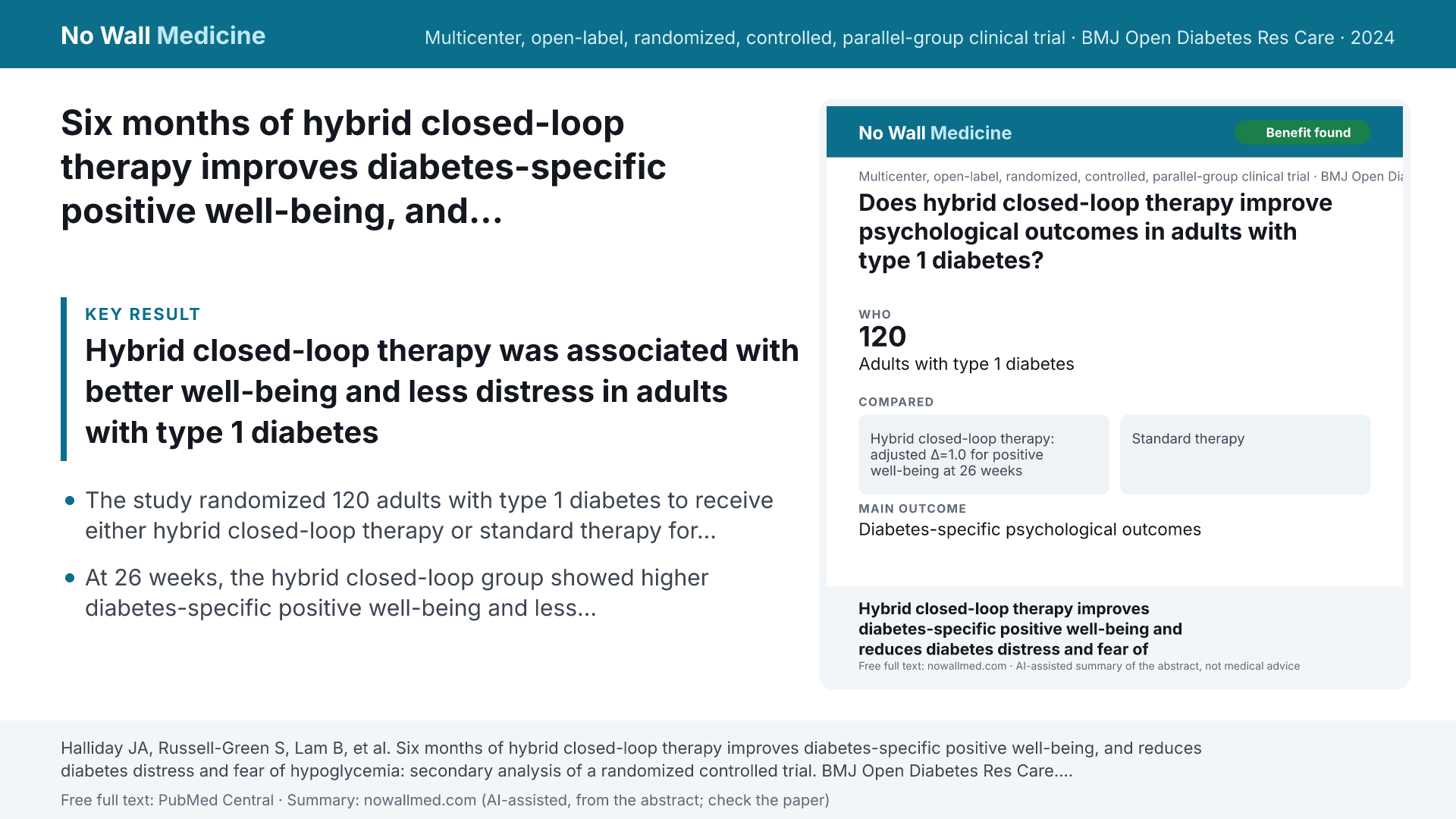
Hybrid closed-loop therapy was associated with better well-being and less distress in adults with type 1 diabetes
Six months of hybrid closed-loop therapy improves diabetes-specific positive well-being, and reduces diabetes distress and fear of hypoglycemia: secondary analysis of a randomized controlled trial
Secondary analysis of a trialBenefit found
Does hybrid closed-loop therapy improve psychological outcomes in adults with type 1 diabetes?
Who
120
Adults with type 1 diabetes
Compared
Hybrid closed-loop therapy: adjusted Δ=1.0 for positive well-being at 26 weeks
Standard therapy
Main outcome
Diabetes-specific psychological outcomes
Bottom line: Hybrid closed-loop therapy improves diabetes-specific positive well-being and reduces diabetes distress and fear of hypoglycemia.
BMJ Open Diabetes Res Care · 2024-12-22Download image
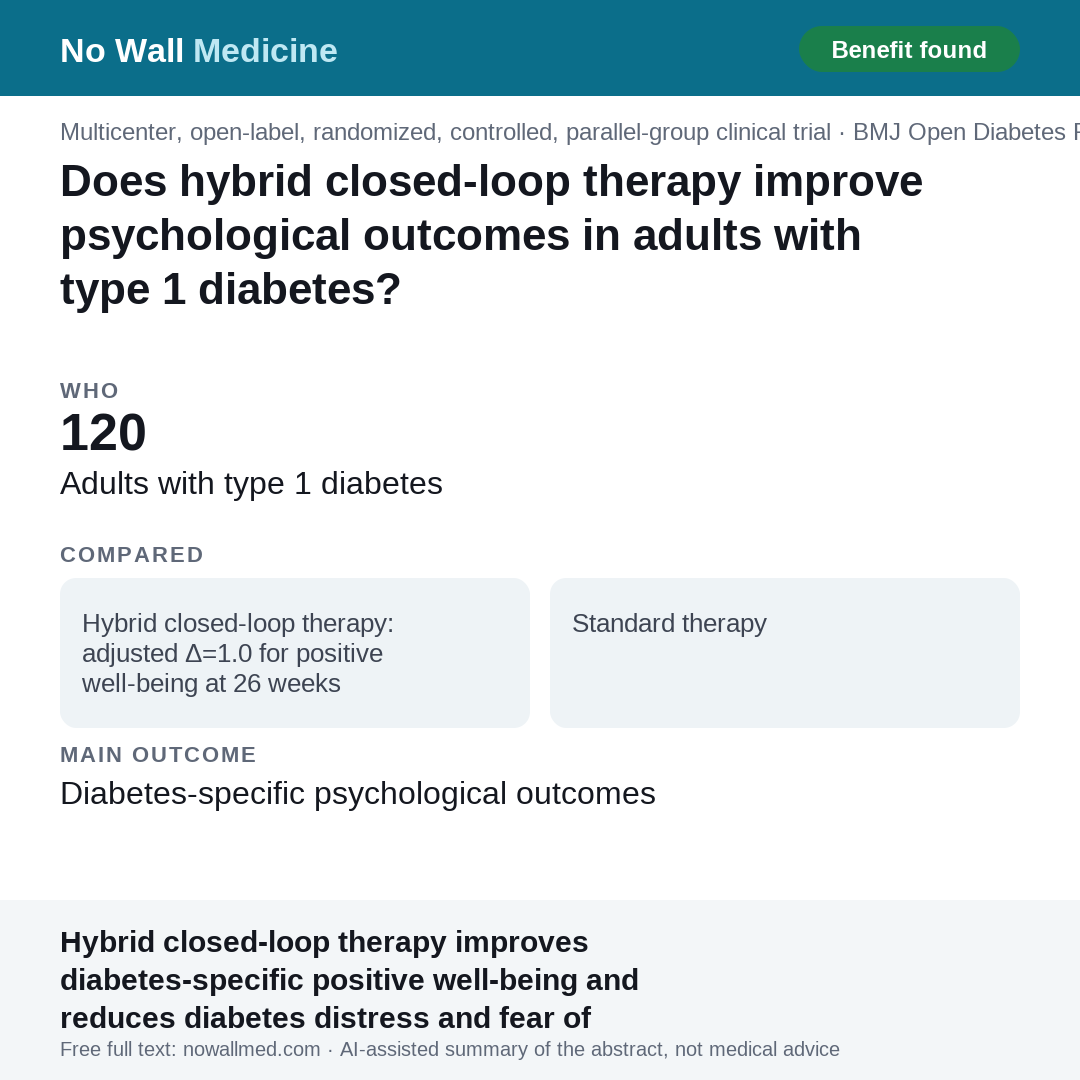
Clinical question: Does hybrid closed-loop therapy improve psychological outcomes in adults with type 1 diabetes?
Why it matters: It was unknown how hybrid closed-loop systems, which automatically adjust insulin delivery, affect psychological outcomes like diabetes distress and fear of low blood sugar.
Key points
- The study randomized 120 adults with type 1 diabetes to receive either hybrid closed-loop therapy or standard therapy for 26 weeks.
- At 26 weeks, the hybrid closed-loop group showed higher diabetes-specific positive well-being and less diabetes distress and fear of hypoglycemia.
- Hybrid closed-loop therapy did not change diabetes treatment satisfaction, diabetes-specific quality of life, hypoglycemia awareness, or perceived frequency of low glucose levels.
Headline and key points written with AI from the paper’s abstract, with every number checked against it. Read the paper before relying on them.
Was this summary helpful?
Abstract
Introduction
This analysis aimed to investigate diabetes-specific psychological outcomes among adults with type 1 diabetes (T1D) using hybrid closed-loop (HCL) versus standard therapy. Research design and methods
In this multicenter, open-label, randomized, controlled, parallel-group clinical trial, adults with T1D were allocated to 26 weeks of HCL (MiniMed™ 670G) or standard therapy (insulin pump or multiple daily injections without real-time continuous glucose monitoring). Psychological outcomes (awareness and fear of hypoglycemia; and diabetes-specific positive well-being, diabetes distress, diabetes treatment satisfaction, and diabetes-specific quality of life (QoL)) were measured at enrollment, mid-trial and end-trial. Linear mixed models were conducted, using restricted maximum likelihood estimation, unadjusted and adjusted (for covariates: age, sex, diabetes duration, glycated hemoglobin, recent severe hypoglycemia, pre-trial insulin delivery modality, enrollment and mid-study scores). Results
120 participants (mean age 44±12 years) were randomized to intervention (n=61) or standard therapy (n=59). At 13 weeks, the HCL group had better diabetes-specific positive well-being than the standard therapy group (unadjusted: Δ=1.0, p=0.025; adjusted: Δ=1.1, p=0.01), which was maintained at 26 weeks (unadjusted: Δ=0.9, p=0.042; adjusted: Δ=1.0, p=0.023). At 26 weeks, the HCL group also had less diabetes distress (adjusted: Δ=-6.4, p=0.039), fear of hypoglycemia ("maintain high": adjusted: Δ=-0.8, p=0.034; and "worry": adjusted: Δ=-1.8, p=0.048), and perceived "unacceptably high glucose levels" (unadjusted: Δ=-1.1, p<0.001; adjusted: Δ=-1.1, p<0.001). HCL did not improve diabetes treatment satisfaction, diabetes-specific QoL, hypoglycemia awareness, or perceived frequency of unacceptably low glucose levels. Conclusions
These findings imply that HCL offers important psychological benefits. In particular, improvement in diabetes-specific positive well-being was observed 13 weeks after HCL initiation and maintained at 26 weeks. Reduction in the perceived frequency of hyperglycemia was also apparent by 26 weeks. Adjusted analyses showed significant reductions in diabetes distress and fear of hypoglycemia at 26 weeks, suggesting these benefits were apparent for people with particular characteristics. Trial registration number
Australian New Zealand Clinical Trials Registry: ACTRN12617000520336.
Abstract reproduced under the article’s CC BY NC licence.
Subject terms
Cite this article
Halliday JA, Russell-Green S, Lam B, et al. Six months of hybrid closed-loop therapy improves diabetes-specific positive well-being, and reduces diabetes distress and fear of hypoglycemia: secondary analysis of a randomized controlled trial. BMJ Open Diabetes Res Care. 2024. doi:10.1136/bmjdrc-2024-004428
Spotted a mistake? Suggest a correction