Six-year outcomes for transcatheter versus surgical aortic valve replacement show no significant difference in mortality or stroke
Six-Year Outcomes After Transcatheter vs Surgical Aortic Valve Replacement in Low-Risk Patients With Aortic Stenosis
Randomized trialNo clear difference
What are the 6-year outcomes of transcatheter vs surgical aortic valve replacement in low-risk patients?
Who
1414
Low-risk patients with severe symptomatic aortic stenosis
Compared
23.3%Transcatheter aortic valve replacement
20.4%Surgery
Main outcome
All-cause mortality or disabling stroke
Result: difference: 2.8% (95% CI: -1.9% to 7.6%)
Bottom line: At 6 years, transcatheter aortic valve replacement showed no significant difference in mortality or disabling stroke compared to surgery.
JACC · 2026-02-16Download image
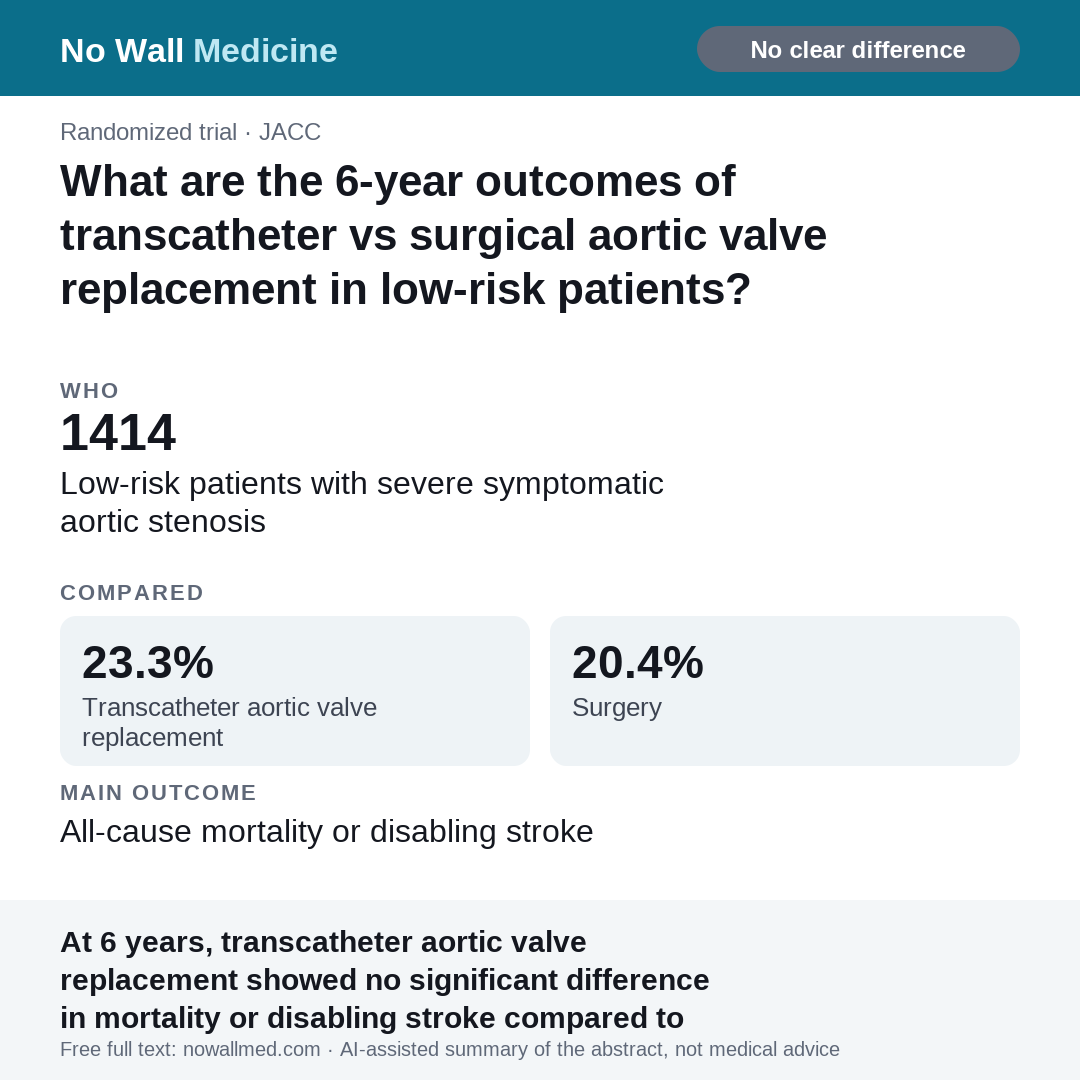
Clinical question: What are the 6-year outcomes of transcatheter vs surgical aortic valve replacement in low-risk patients?
Why it matters: Doctors needed long-term data to compare the safety and effectiveness of transcatheter versus surgical valve replacement in patients at low surgical risk.
Key points
- Researchers studied 1,414 patients with severe aortic stenosis, comparing transcatheter aortic valve replacement (a minimally invasive procedure) to surgical aortic valve replacement.
- At 6 years, the composite of all-cause mortality or disabling stroke was 23.3% for transcatheter replacement and 20.4% for surgery, which was not a statistically significant difference.
- The rate of reintervention for aortic regurgitation, or leaking valve, was 5.6% for transcatheter replacement compared to 1.6% for surgery at 6 years.
Headline and key points written with AI from the paper’s abstract, with every number checked against it. Read the paper before relying on them.
Topics
Cite this article
Forrest JK, Yakubov SJ, Deeb GM, Reardon MJ, Evolut Low Risk Trial Investigators. Six-Year Outcomes After Transcatheter vs Surgical Aortic Valve Replacement in Low-Risk Patients With Aortic Stenosis. JACC. 2026. doi:10.1016/j.jacc.2026.02.5063
Spotted a mistake? Suggest a correction