Delivering short-chain fatty acids to the small intestine increases blood levels but lowers hormone release
Small intestinal compared with colonic short-chain fatty acid delivery drives distinct systemic concentrations and endocrine responses in humans: a randomized, crossover trial
Randomized, single-blinded, crossover trialMixed results
Does small intestinal versus colonic short-chain fatty acid delivery affect systemic concentrations and endocrine responses?
Who
28
28 healthy adults
Compared
Small intestinal delivery
Colonic delivery
Placebo
Main outcome
Total release of glucagon-like peptide 1 and peptide YY
Result: PYY release difference: β = 111.46 (95% confidence interval: 4.33, 218.59) pg/mL.h
Bottom line: Small intestinal delivery yields higher circulating short-chain fatty acids, but colonic delivery produces greater peptide YY release.
Am J Clin Nutr · 2026-08-10Download image
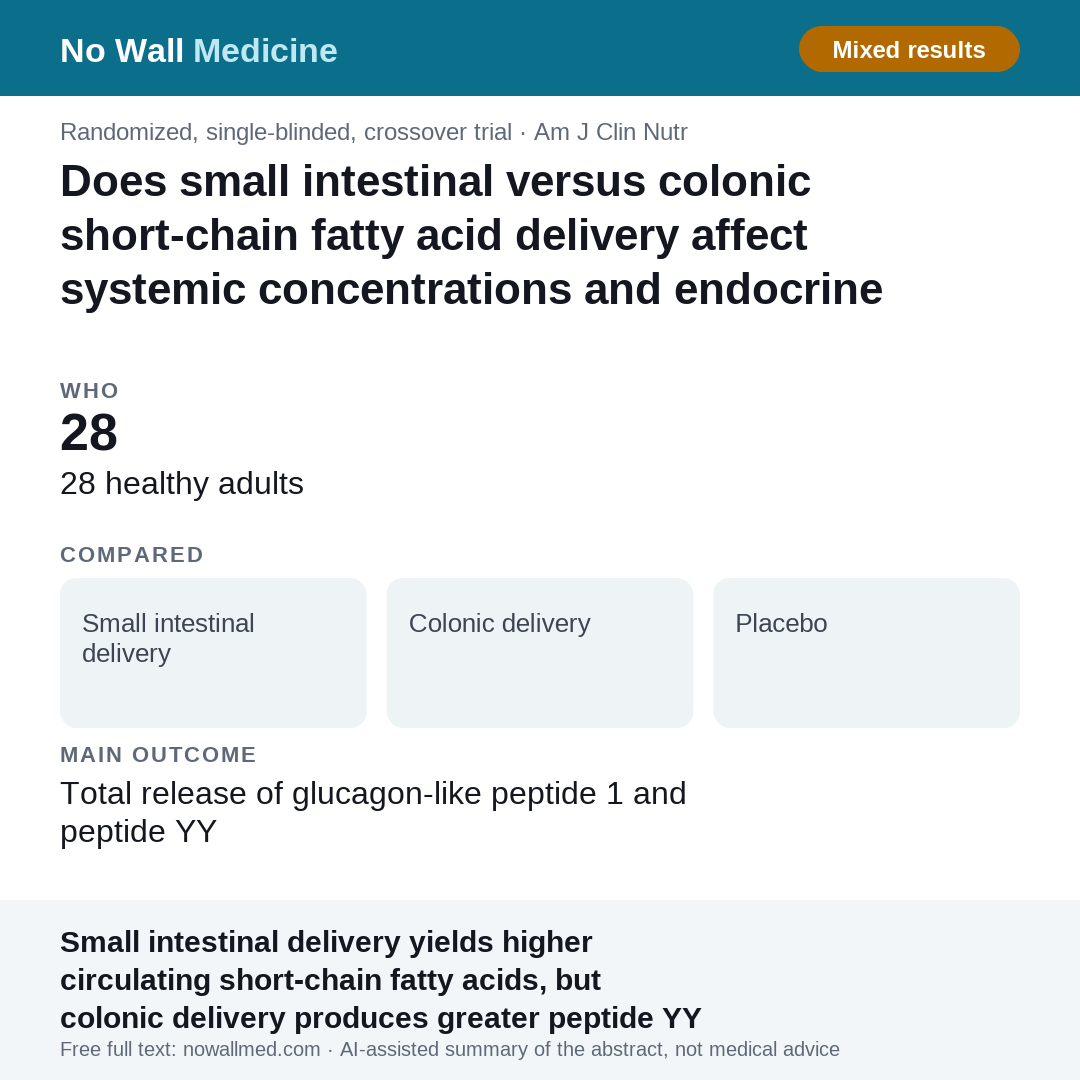
Clinical question: Does small intestinal versus colonic short-chain fatty acid delivery affect systemic concentrations and endocrine responses?
Why it matters: It is unclear how delivering short-chain fatty acids to the small intestine versus the colon affects systemic concentrations and hormone responses.
Key points
- Researchers conducted a crossover trial with 28 healthy adults comparing the delivery of a 230 mmol dose of short-chain fatty acids to the small intestine, the colon, or a placebo.
- Small intestinal delivery resulted in higher circulating short-chain fatty acid concentrations, while colonic delivery led to greater release of the hormone peptide YY.
- The study found that the delivery site changed both the systemic concentrations of short-chain fatty acids and the endocrine responses in humans.
Headline and key points written with AI from the paper’s abstract, with every number checked against it. Read the paper before relying on them.
Topics
Spotted a mistake? Suggest a correction