Small mobile cash transfers increased full childhood immunization coverage in a Pakistani trial
Small mobile conditional cash transfers (mCCTs) of different amounts, schedules and design to improve routine childhood immunization coverage and timeliness of children aged 0-23 months in Pakistan: An open label multi-arm randomized controlled trial
Seven arm, factorial open label randomized controlled trialBenefit found
How do different small mobile conditional cash transfers affect childhood immunization coverage and timeliness in Pakistan?
Who
11197
Caregiver-child pairs in Karachi, Pakistan · Karachi, Pakistan
Compared
Any mobile conditional cash transfer
SMS reminder only
Control
Main outcome
Full immunization coverage at 12 months
Result: OR:1.18, 95% CI: 1.05-1.33
Bottom line: Small mobile conditional cash transfers increase full immunization coverage compared to SMS reminders alone in Pakistan.
Funded by: Global Innovation Fund, GiveWell
eClinicalMedicine · 2022-06-25Download image
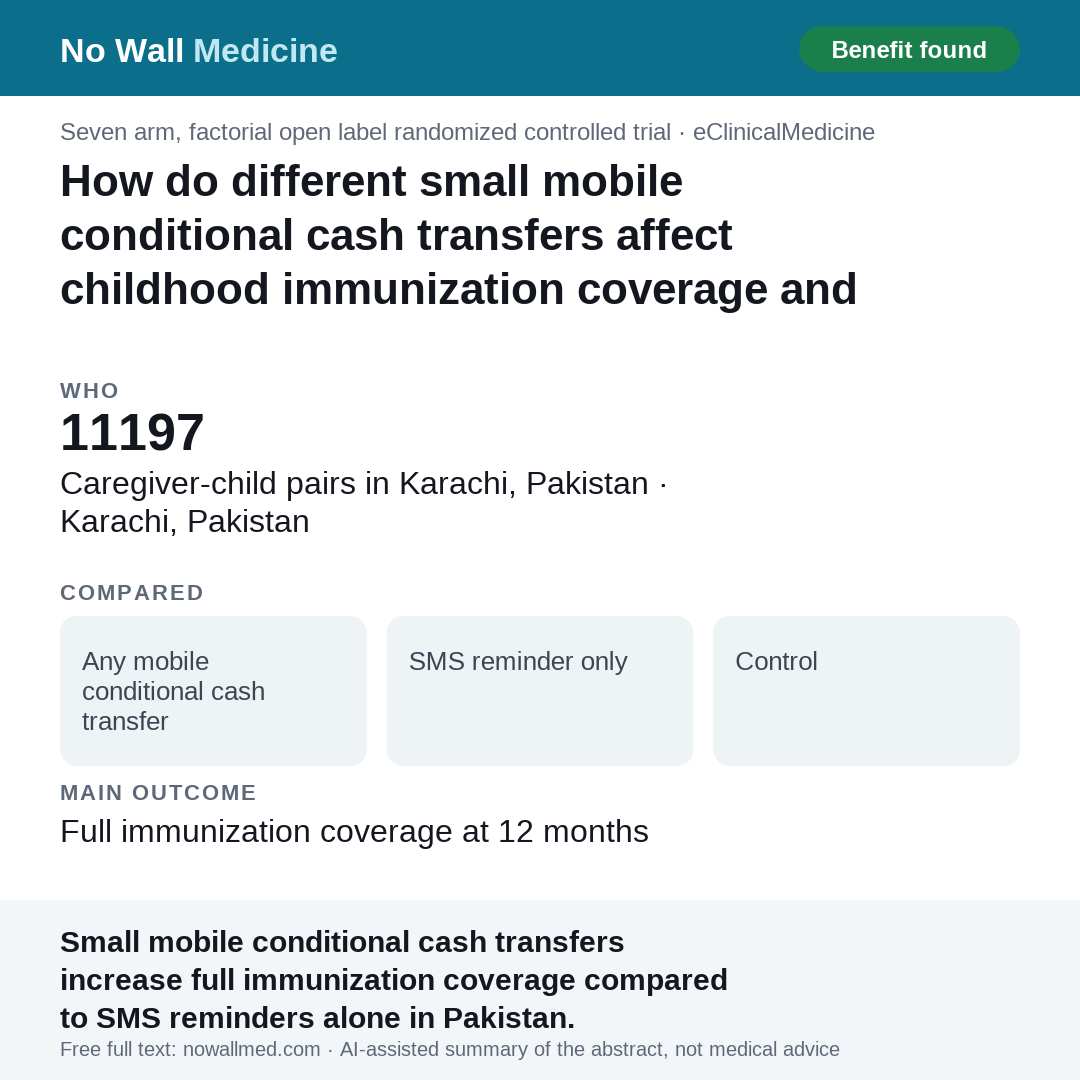
Clinical question: How do different small mobile conditional cash transfers affect childhood immunization coverage and timeliness in Pakistan?
Why it matters: It is unknown how the amount, schedule, and design of small mobile-based conditional cash transfers impact childhood immunization coverage in lower-income settings.
Key points
- Researchers randomized 11,197 caregiver-child pairs in Karachi, Pakistan, to compare different mobile cash transfer amounts, schedules, and delivery methods against text message reminders and a control group.
- Full immunization coverage at 12 months was higher for any mobile cash transfer compared to text messages (OR: 1.18, 95% CI: 1.05-1.33; p = 0.005).
- Higher cash amounts, certain rather than lottery payments, and airtime instead of mobile money were associated with higher immunization coverage.
Headline and key points written with AI from the paper’s abstract, with every number checked against it. Read the paper before relying on them.
Was this summary helpful?
Cite this article
Chandir S, Siddiqi DA, Abdullah S, Duflo E, Khan AJ, Glennerster R. Small mobile conditional cash transfers (mCCTs) of different amounts, schedules and design to improve routine childhood immunization coverage and timeliness of children aged 0-23 months in Pakistan: An open label multi-arm randomized controlled trial. eClinicalMedicine. 2022. doi:10.1016/j.eclinm.2022.101500
Spotted a mistake? Suggest a correction
Top studies every Monday
The week’s key trials and guidelines in your specialties, plus any topics you follow. By email, free.
Get the weekly digest