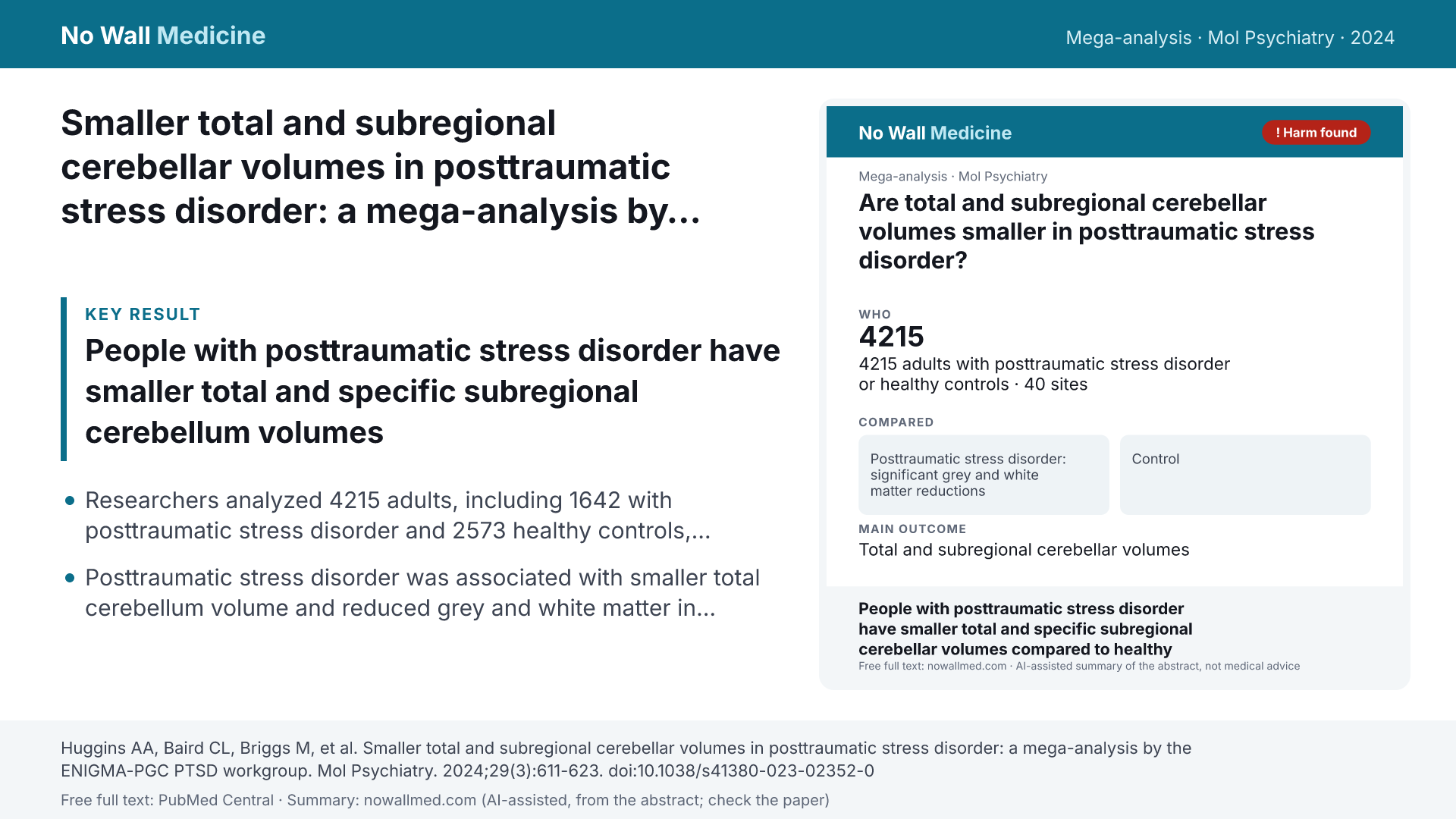
Smaller total and subregional cerebellar volumes in posttraumatic stress disorder: a mega-analysis by the ENIGMA-PGC PTSD workgroup
Key result: People with posttraumatic stress disorder have smaller total and specific subregional cerebellum volumes
Mega-analysisHarm found
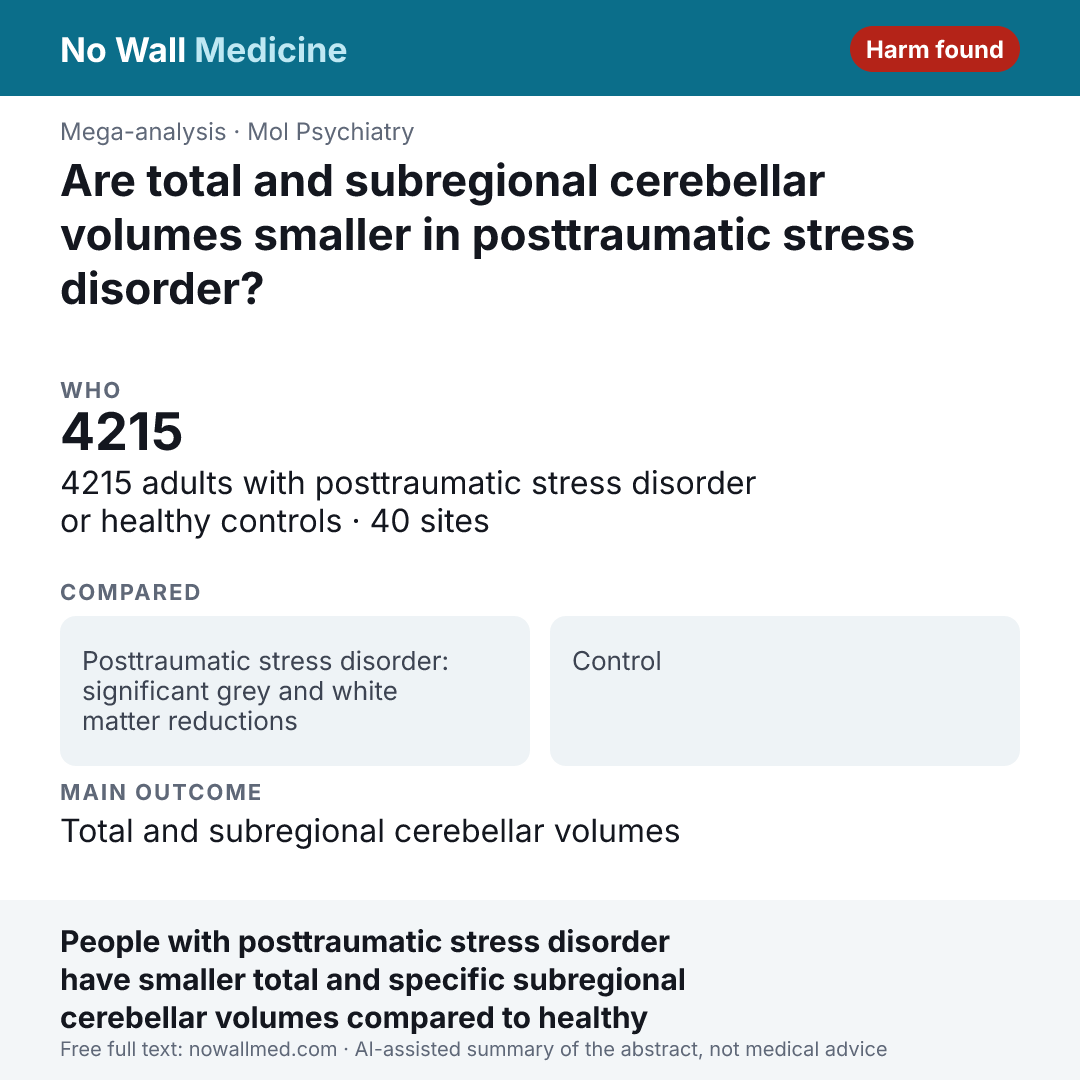
Are total and subregional cerebellar volumes smaller in posttraumatic stress disorder?
Who
4215
4215 adults with posttraumatic stress disorder or healthy controls · 40 sites
Compared
Posttraumatic stress disorder: significant grey and white matter reductions
Control
Main outcome
Total and subregional cerebellar volumes
Bottom line: People with posttraumatic stress disorder have smaller total and specific subregional cerebellar volumes compared to healthy controls.
Mol Psychiatry · 2024-01-10 · Save PNG
Key points
- Researchers analyzed 4215 adults, including 1642 with posttraumatic stress disorder and 2573 healthy controls, across 40 different sites.
- Posttraumatic stress disorder was associated with smaller total cerebellum volume and reduced grey and white matter in several subregions.
- Smaller volumes were linked to higher symptom severity and were found in the posterior lobe, vermis, flocculonodular lobe, and corpus medullare.
Discussion prompts
- Would these patients look like yours? Who was left out?
- Is the main outcome one that matters to patients?
- Is the difference large enough to change what you do?
Cite: Huggins AA, Baird CL, Briggs M, et al. Smaller total and subregional cerebellar volumes in posttraumatic stress disorder: a mega-analysis by the ENIGMA-PGC PTSD workgroup. Mol Psychiatry. 2024;29(3):611-623. doi:10.1038/s41380-023-02352-0
Free full text: PubMed Central · Summary and visual abstract: nowallmed.com/a/smaller-total-and-subregional-cerebellar-volumes-in-posttraumatic-1b5egok/ (AI-assisted from the abstract; check the paper before relying on it).