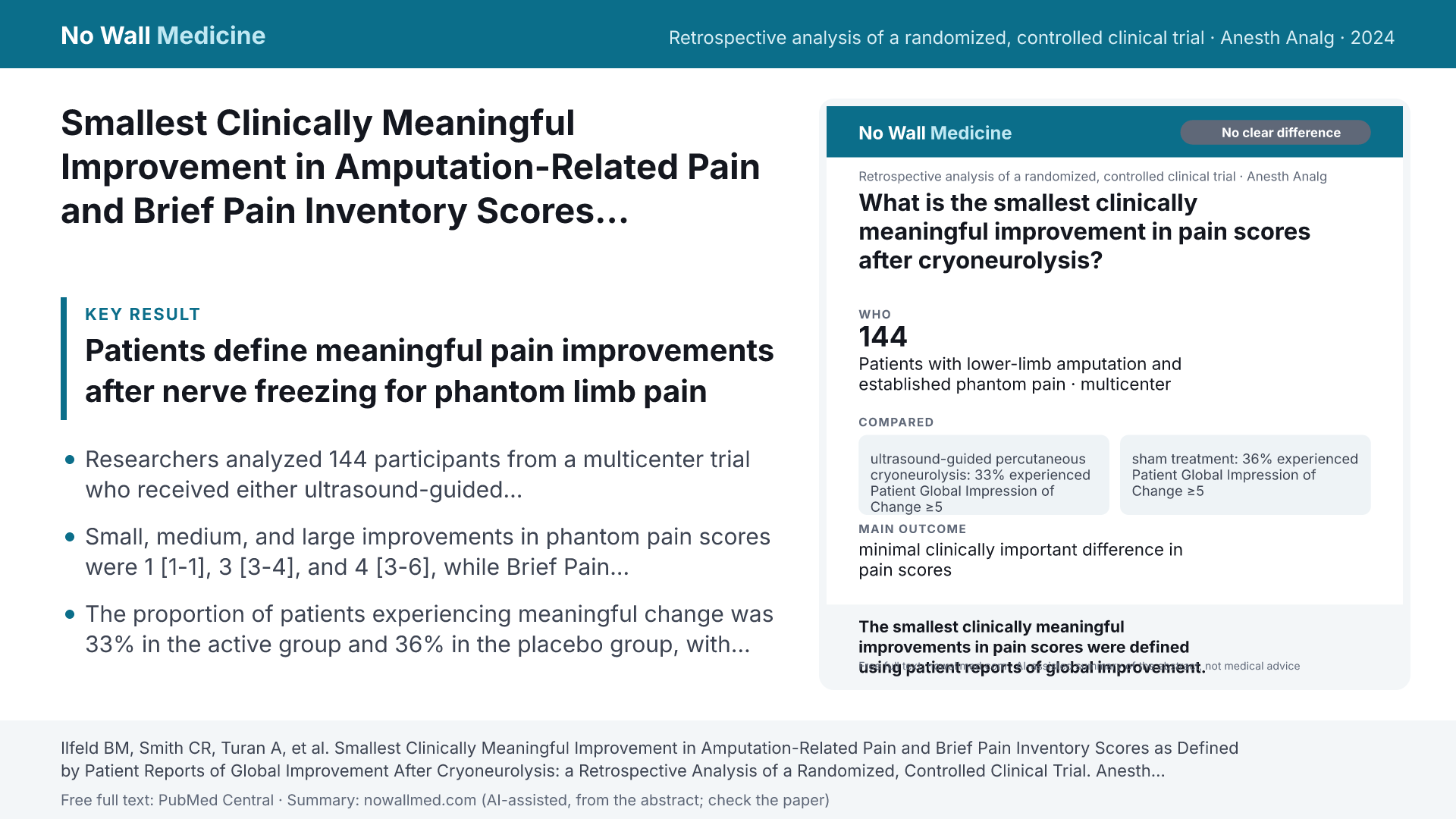
Smallest Clinically Meaningful Improvement in Amputation-Related Pain and Brief Pain Inventory Scores as Defined by Patient Reports of Global Improvement After Cryoneurolysis: a Retrospective Analysis of a Randomized, Controlled Clinical Trial
Key result: Patients define meaningful pain improvements after nerve freezing for phantom limb pain
Key points
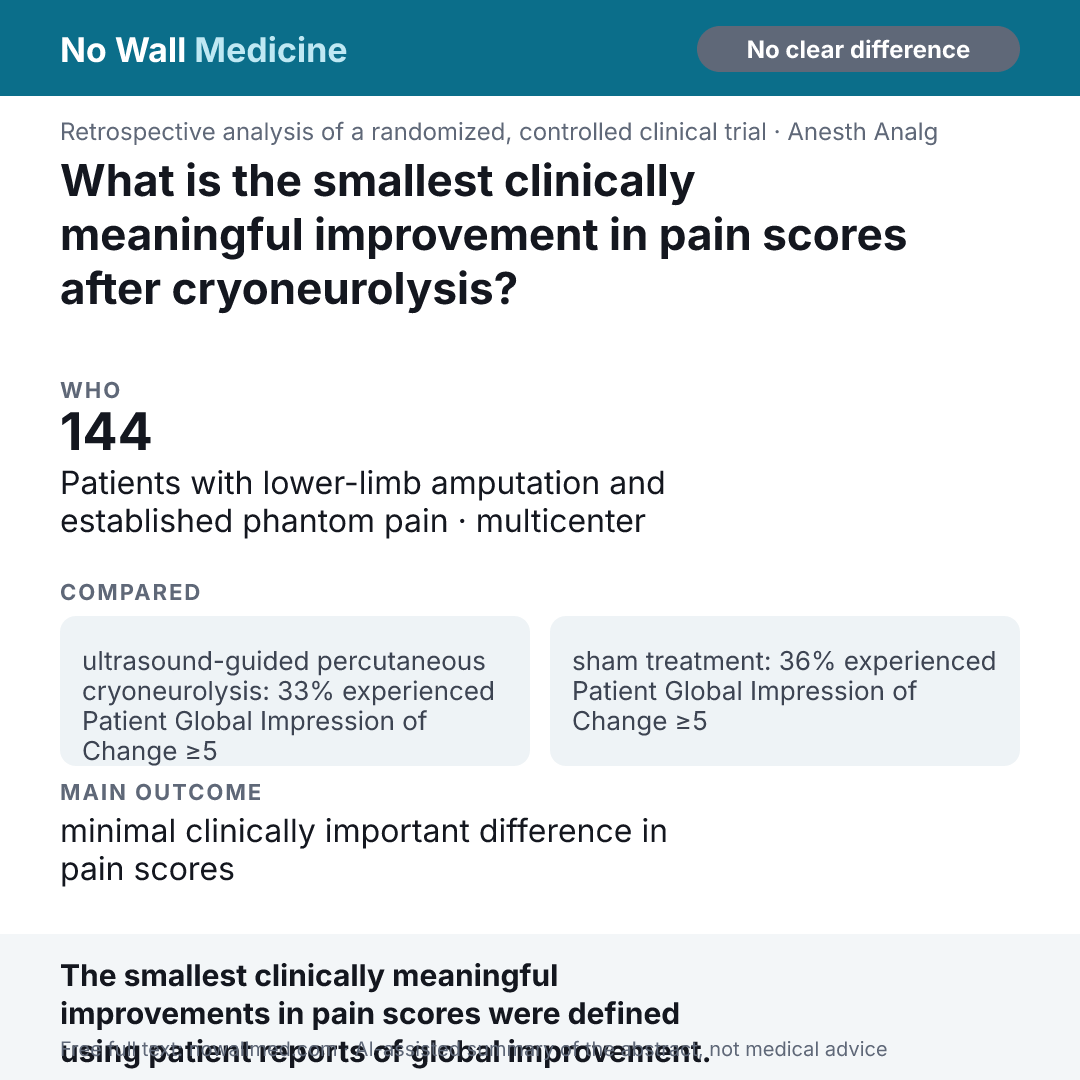
- Researchers analyzed 144 participants from a multicenter trial who received either ultrasound-guided percutaneous cryoneurolysis, or nerve freezing, or a sham treatment for phantom limb pain.
- Small, medium, and large improvements in phantom pain scores were 1 [1-1], 3 [3-4], and 4 [3-6], while Brief Pain Inventory interference scores were 16 [6-18], 24 [22-31], and 34 [22-46].
- The proportion of patients experiencing meaningful change was 33% in the active group and 36% in the placebo group, with a relative risk of 0.9 (0.6-1.4).
Why it matters: The smallest clinically meaningful improvement in pain scores is unknown for patients with chronic pain conditions treated with nerve freezing.
Discussion prompts
- Would these patients look like yours? Who was left out?
- Is the main outcome one that matters to patients?
- Is the difference large enough to change what you do?
Cite: Ilfeld BM, Smith CR, Turan A, et al. Smallest Clinically Meaningful Improvement in Amputation-Related Pain and Brief Pain Inventory Scores as Defined by Patient Reports of Global Improvement After Cryoneurolysis: a Retrospective Analysis of a Randomized, Controlled Clinical Trial. Anesth Analg. 2024;139(6):1325-1331. doi:10.1213/ANE.0000000000006833
Free full text: PubMed Central · Summary and visual abstract: nowallmed.com/a/smallest-clinically-meaningful-improvement-in-amputation-related-pain-opbs5q/ (AI-assisted from the abstract; check the paper before relying on it).