Sending smaller batches of surveys every two weeks maintained higher response rates in a smartphone study
Smartphone App-Based Survey Deployment Patterns and Longitudinal Response Rate: Randomized Controlled Trial
Randomized controlled trialBenefit found
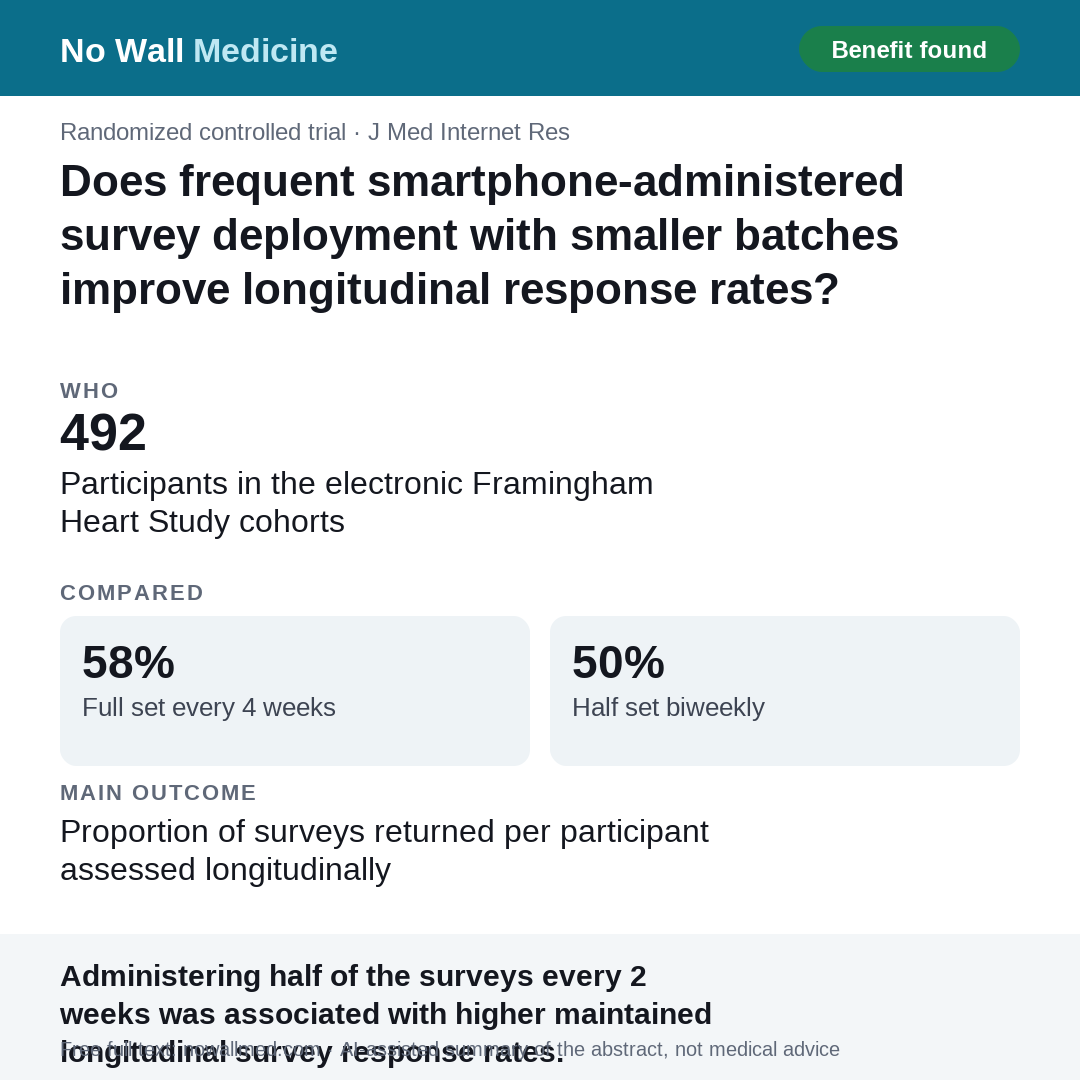
Does frequent smartphone-administered survey deployment with smaller batches improve longitudinal response rates?
Who
492
Participants in the electronic Framingham Heart Study cohorts
Compared
58%Full set every 4 weeks (wk 24-32)
50%Half set biweekly (wk 24-32)
Main outcome
Proportion of surveys returned per participant assessed longitudinally
Bottom line: Administering half of the surveys every 2 weeks was associated with higher maintained longitudinal survey response rates.
J Med Internet Res · 2025-10-10Download image
Clinical question: Does frequent smartphone-administered survey deployment with smaller batches improve longitudinal response rates?
Why it matters: Survey fatigue is a common challenge in longitudinal studies that use smartphone apps to collect data over time.
Key points
- Researchers studied 492 participants in the Framingham Heart Study, comparing a group receiving all surveys every 4 weeks to a group receiving half the surveys every 2 weeks.
- The experimental group had higher response rates in later periods, such as 58% compared to 50% between week 24 and week 32.
- The proportion of participants who did not return any surveys rose from 3% to 38% in the control group, compared to 1% to 28% in the experimental group.
Headline and key points written with AI from the paper’s abstract, with every number checked against it. Read the paper before relying on them.
Topics
Cite this article
Zhang Y, Rong J, Wang X, Schramm E, Pathiravasan CH, Borrelli B. Smartphone App-Based Survey Deployment Patterns and Longitudinal Response Rate: Randomized Controlled Trial. J Med Internet Res. 2025. doi:10.2196/73972
Spotted a mistake? Suggest a correction