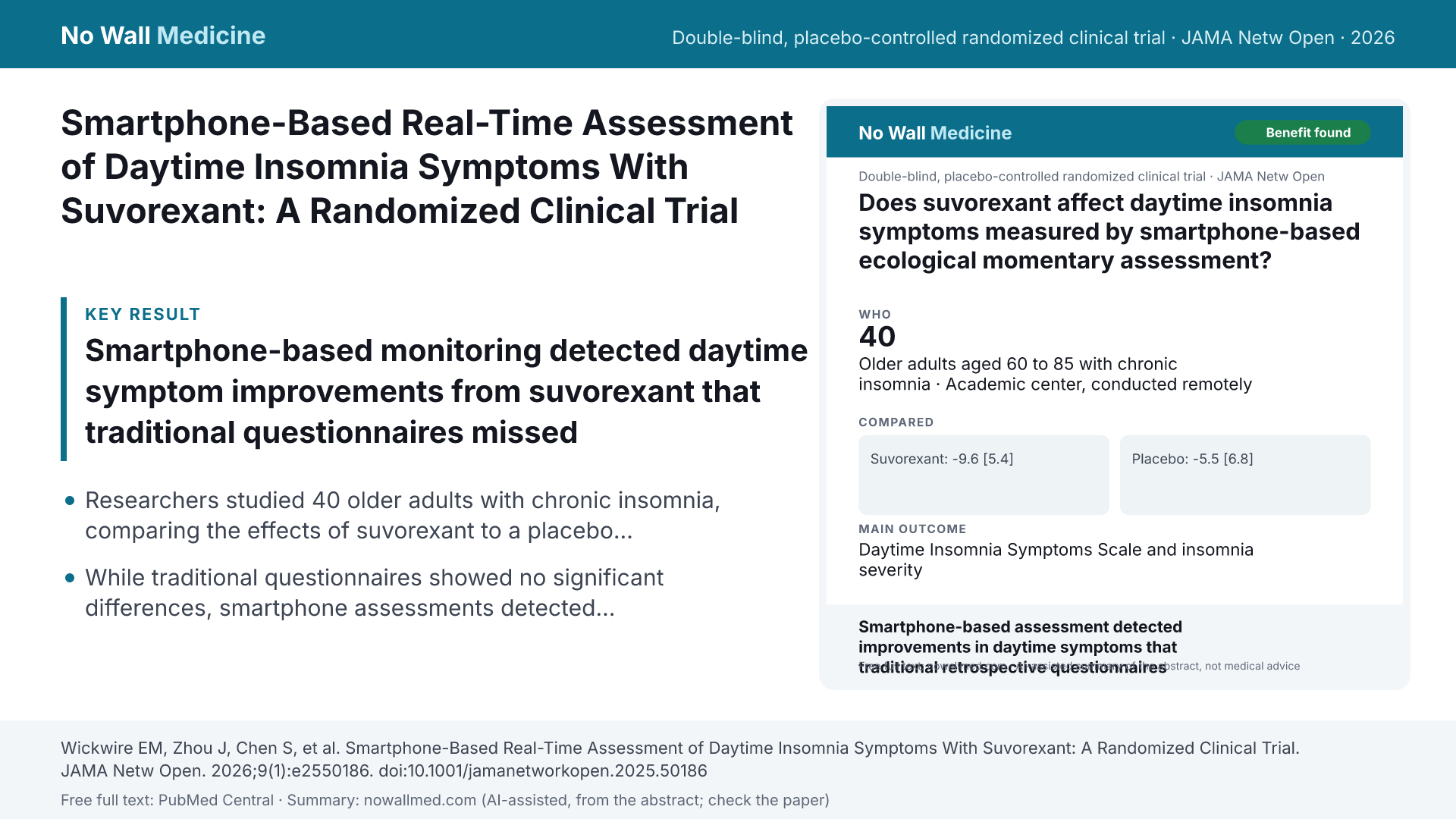
Smartphone-based monitoring detected daytime symptom improvements from suvorexant that traditional questionnaires missed
Smartphone-Based Real-Time Assessment of Daytime Insomnia Symptoms With Suvorexant: A Randomized Clinical Trial
Double-blind, placebo-controlled randomized clinical trialBenefit found
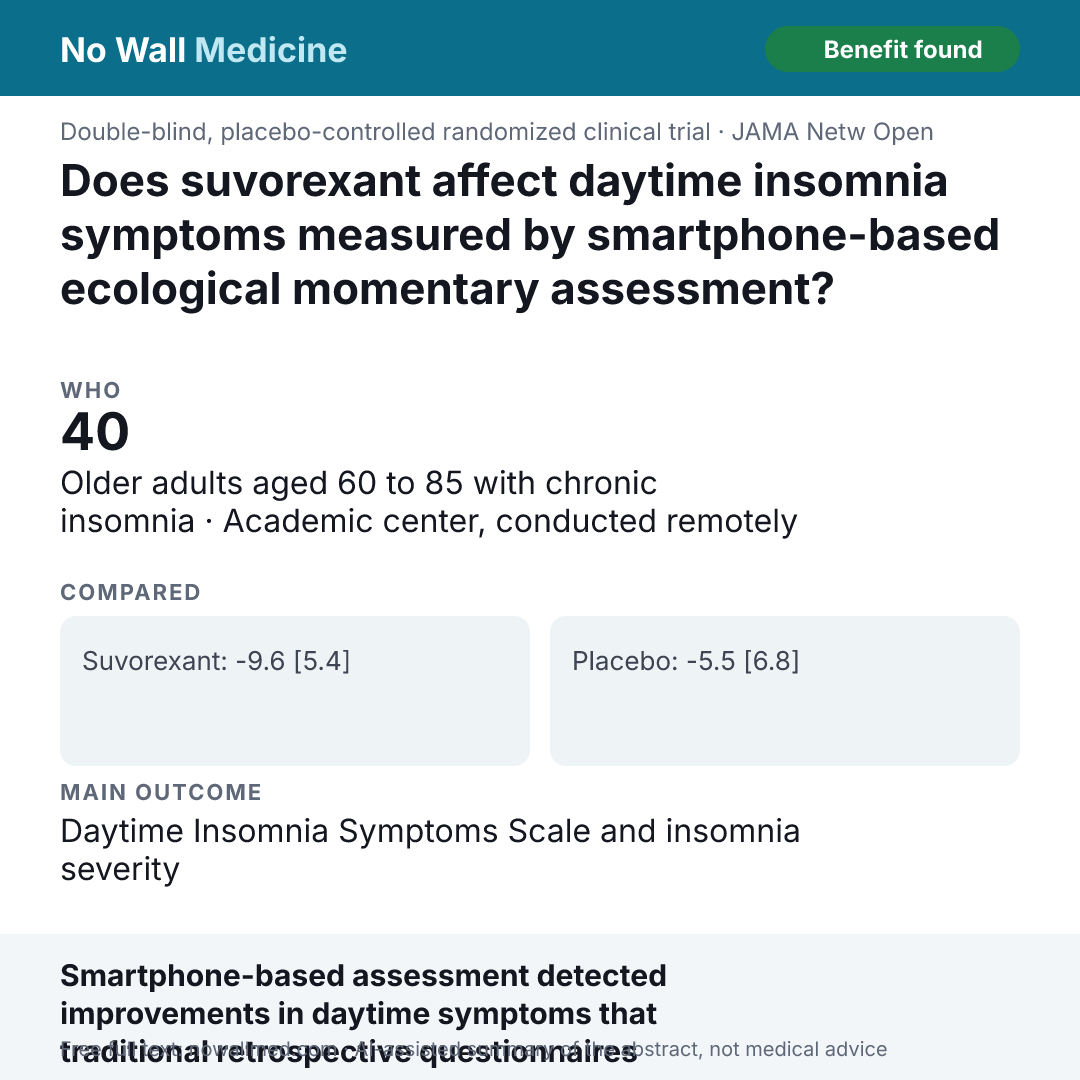
Does suvorexant affect daytime insomnia symptoms measured by smartphone-based ecological momentary assessment?
Who
40
Older adults aged 60 to 85 with chronic insomnia · Academic center, conducted remotely
Compared
Suvorexant: -9.6 [5.4]
Placebo: -5.5 [6.8]
Main outcome
Daytime Insomnia Symptoms Scale and insomnia severity
Result: effect size, 0.66 [95% CI, 0.02 to 1.30]
Bottom line: Smartphone-based assessment detected improvements in daytime symptoms that traditional retrospective questionnaires failed to detect.
JAMA Netw Open · 2026-01-02 · Save PNG
Clinical question: Does suvorexant affect daytime insomnia symptoms measured by smartphone-based ecological momentary assessment?
Why it matters: Traditional assessments of daytime insomnia symptoms often rely on retrospective questionnaires that may lack the sensitivity to detect subtle changes from treatment.
Key points
- Researchers studied 40 older adults with chronic insomnia, comparing the effects of suvorexant to a placebo using smartphone-based real-time assessments.
- While traditional questionnaires showed no significant differences, smartphone assessments detected significant improvements in subjective cognition and fatigue at one or more times of day.
- Suvorexant reduced insomnia severity with a mean change in the Insomnia Severity Index of -9.6 [5.4] compared to -5.5 [6.8] for placebo.
Headline and key points written with AI from the paper’s abstract, with every number checked against it. Read the paper before relying on them.
Was this summary helpful?
Subject terms
Headline, design, result, key points, caveat and citation as plain text.
Cite this article
Wickwire EM, Zhou J, Chen S, et al. Smartphone-Based Real-Time Assessment of Daytime Insomnia Symptoms With Suvorexant: A Randomized Clinical Trial. JAMA Netw Open. 2026;9(1):e2550186. doi:10.1001/jamanetworkopen.2025.50186
Spotted a mistake? Suggest a correction