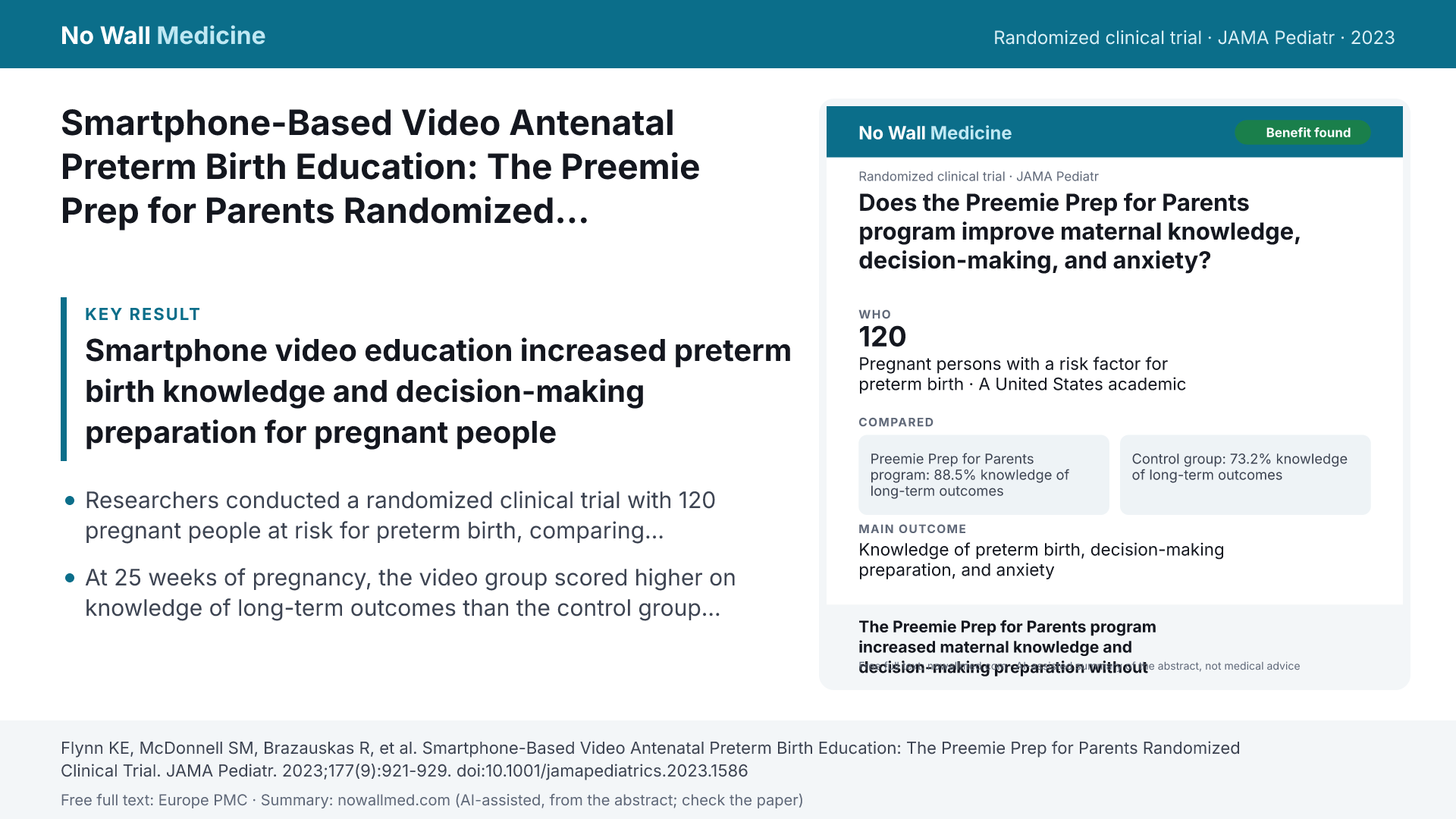
Smartphone video education increased preterm birth knowledge and decision-making preparation for pregnant people
Smartphone-Based Video Antenatal Preterm Birth Education: The Preemie Prep for Parents Randomized Clinical Trial
Randomized clinical trialBenefit found
Does the Preemie Prep for Parents program improve maternal knowledge, decision-making, and anxiety?
Who
120
Pregnant persons with a risk factor for preterm birth · A United States academic medical center
Compared
Preemie Prep for Parents program: 88.5% knowledge of long-term outcomes
Control group: 73.2% knowledge of long-term outcomes
Main outcome
Knowledge of preterm birth, decision-making preparation, and anxiety
Result: estimated difference, 15.3 percentage points; 95% CI, 8.3-22.5 percentage points
Bottom line: The Preemie Prep for Parents program increased maternal knowledge and decision-making preparation without increasing anxiety.
JAMA Pediatr · 2023-07-31Download image
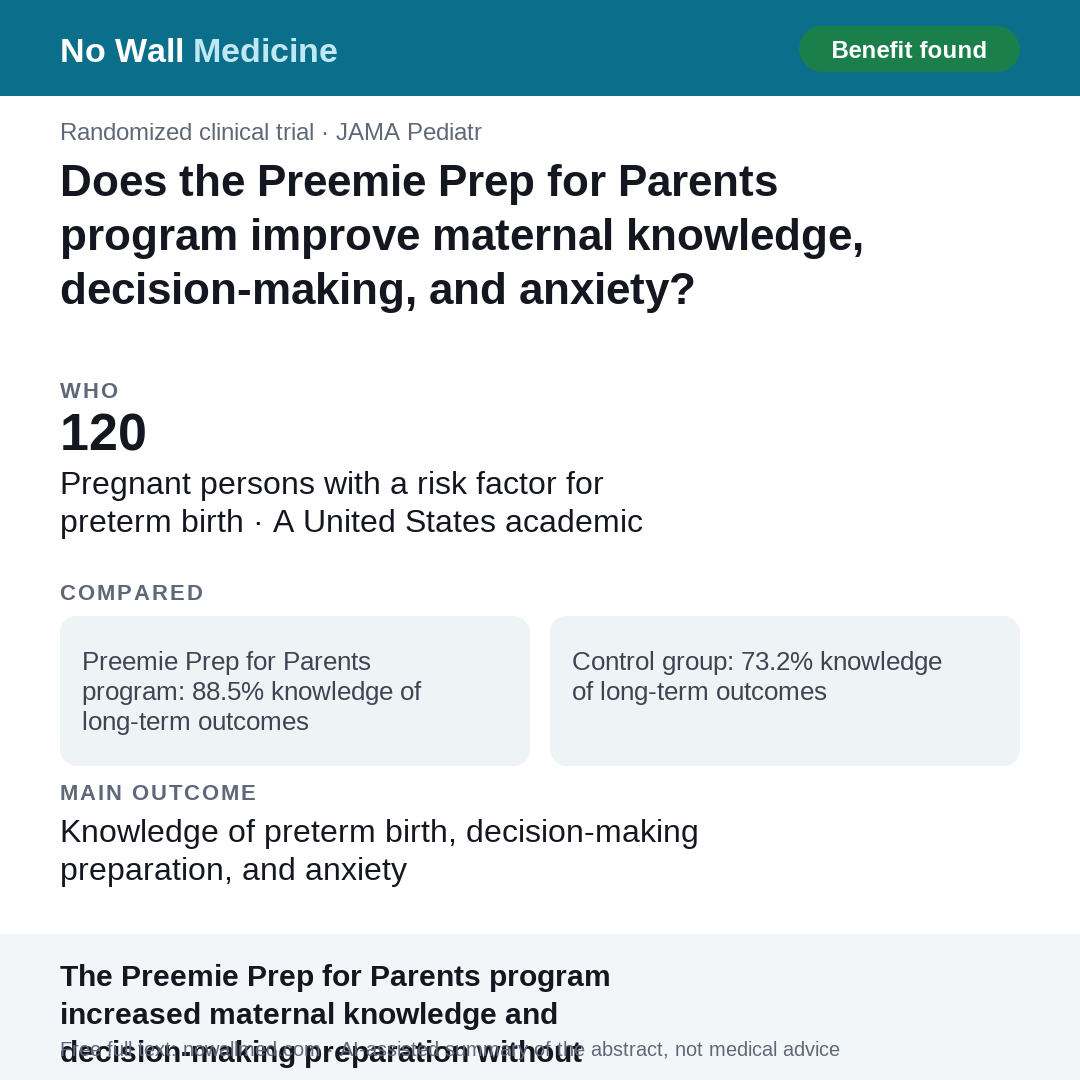
Clinical question: Does the Preemie Prep for Parents program improve maternal knowledge, decision-making, and anxiety?
Why it matters: Standard prenatal care does not always offer anticipatory education to parents at risk of preterm birth, leaving them unprepared for healthcare choices.
In absolute numbers
Preemie Prep for Parents program: 88.5% · Control group: 73.2% → a difference of 15.3 percentage points, so about 7 people would need the treatment for 1 more to benefit (number needed to treat) over the trial’s follow-up.
Worked out by us from the two group results above, not reported by the authors. Check the paper for the exact outcome and timing.
Key points
- Researchers conducted a randomized clinical trial with 120 pregnant people at risk for preterm birth, comparing a smartphone video program to standard educational webpages.
- At 25 weeks of pregnancy, the video group scored higher on knowledge of long-term outcomes than the control group (88.5% vs 73.2%).
- The video program was associated with being more prepared to make decisions without increasing anxiety levels.
Headline and key points written with AI from the paper’s abstract, with every number checked against it. Read the paper before relying on them.
Was this summary helpful?
Abstract
Importance
Preterm birth is a leading cause of infant mortality and child morbidity. Preterm birth is not always unexpected, yet standard prenatal care does not offer anticipatory education to parents at risk of delivering preterm, which leaves parents unprepared to make health care choices during the pregnancy that can improve survival and decrease morbidity in case of preterm birth.Objective
To evaluate the effect of the Preemie Prep for Parents (P3) program on maternal knowledge of preterm birth, preparation for decision-making, and anxiety.Design, setting, and participants
Recruitment for this randomized clinical trial conducted at a US academic medical center took place from February 3, 2020, to April 12, 2021. A total of 120 pregnant persons with a risk factor for preterm birth were enrolled between 16 and 21 weeks' gestational age and followed up through pregnancy completion.Intervention
Starting at 18 weeks' gestational age, P3 program participants received links delivered via text message to 51 gestational age-specific short animated videos. Control participants received links to patient education webpages from the American College of Obstetricians and Gynecologists.Main outcomes and measures
At 25 weeks' gestation, scores on the Parent Prematurity Knowledge Questionnaire (scored as percent correct), Preparation for Decision Making Scale (scored 0-100), and Patient-Reported Outcomes Measurement Information System (PROMIS) Anxiety computerized adaptive test. Analysis was based on an intention to treat.Results
A total of 120 pregnant participants (mean [SD] age, 32.5 [4.9] years) were included in the study; 60 participants were randomized to each group. Participants in the P3 group scored higher than those in the control group on knowledge of long-term outcomes at 25 weeks (88.5% vs 73.2%; estimated difference, 15.3 percentage points; 95% CI, 8.3-22.5 percentage points; P Conclusions and relevance
In this randomized clinical trial, pregnant persons randomly assigned to the P3 program had more knowledge of core competencies and were more prepared to make decisions that affect maternal and infant health, without experiencing worse anxiety. Mobile antenatal preterm birth education may provide a unique benefit to parents with preterm birth risk factors.Trial registration
ClinicalTrials.gov Identifier: NCT04093492.
Abstract reproduced under the article’s CC BY licence.
Cite this article
Flynn KE, McDonnell SM, Brazauskas R, et al. Smartphone-Based Video Antenatal Preterm Birth Education: The Preemie Prep for Parents Randomized Clinical Trial. JAMA Pediatr. 2023. doi:10.1001/jamapediatrics.2023.1586
Spotted a mistake? Suggest a correction