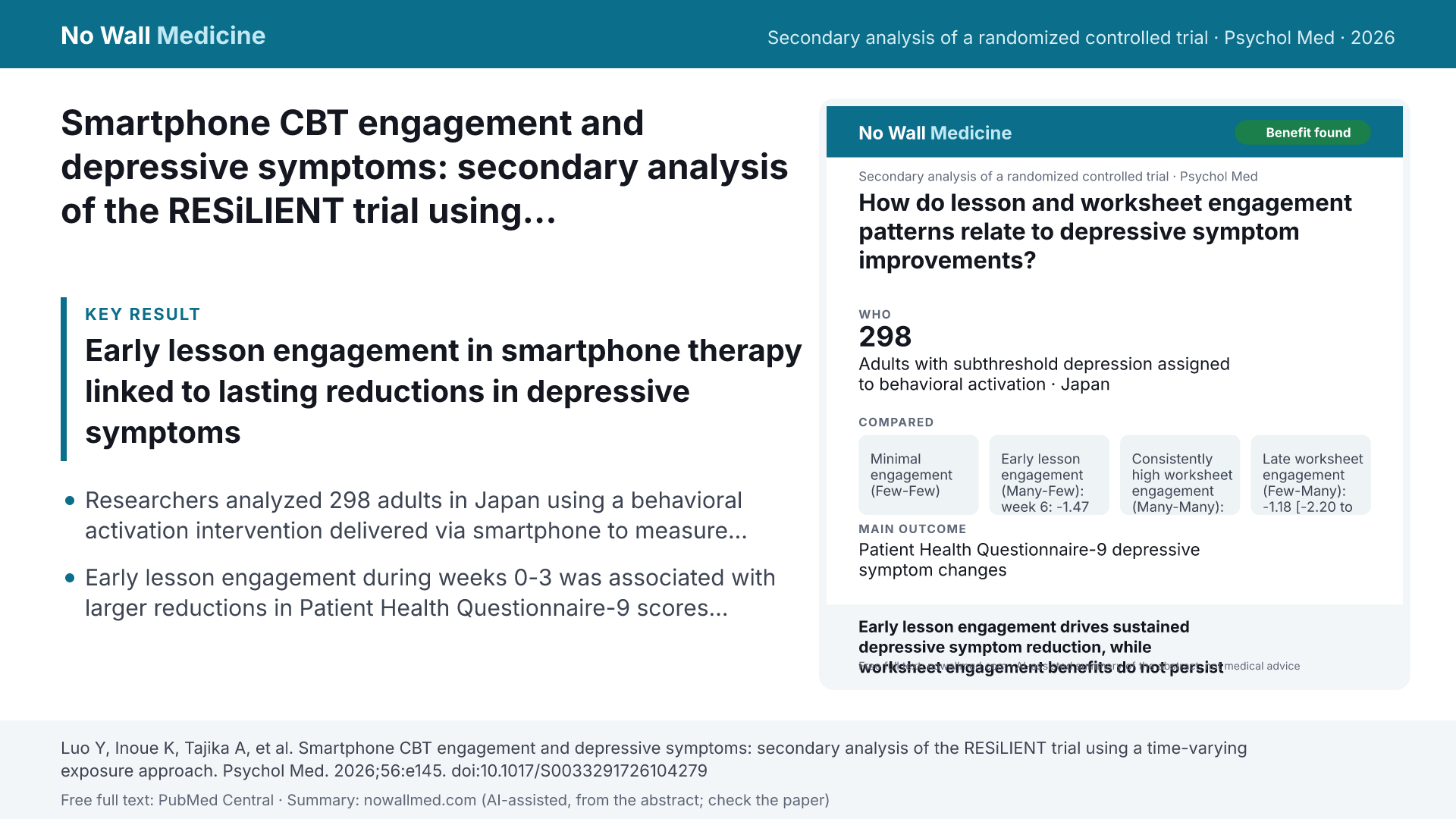
Early lesson engagement in smartphone therapy linked to lasting reductions in depressive symptoms
Smartphone CBT engagement and depressive symptoms: secondary analysis of the RESiLIENT trial using a time-varying exposure approach
Secondary analysis of a randomized controlled trialBenefit found
How do lesson and worksheet engagement patterns relate to depressive symptom improvements?
Who
298
Adults with subthreshold depression assigned to behavioral activation · Japan
Compared
Minimal engagement (Few-Few)
Early lesson engagement (Many-Few): week 6: -1.47 [95% CI -2.52 to -0.53]; week 26: -1.27 [-2.53 to -0.17]
Consistently high worksheet engagement (Many-Many): -1.25 [-2.17 to -0.44]
Late worksheet engagement (Few-Many): -1.18 [-2.20 to -0.08]
Main outcome
Patient Health Questionnaire-9 depressive symptom changes
Bottom line: Early lesson engagement drives sustained depressive symptom reduction, while worksheet engagement benefits do not persist to week 26.
Psychol Med · 2026-05-13Download image
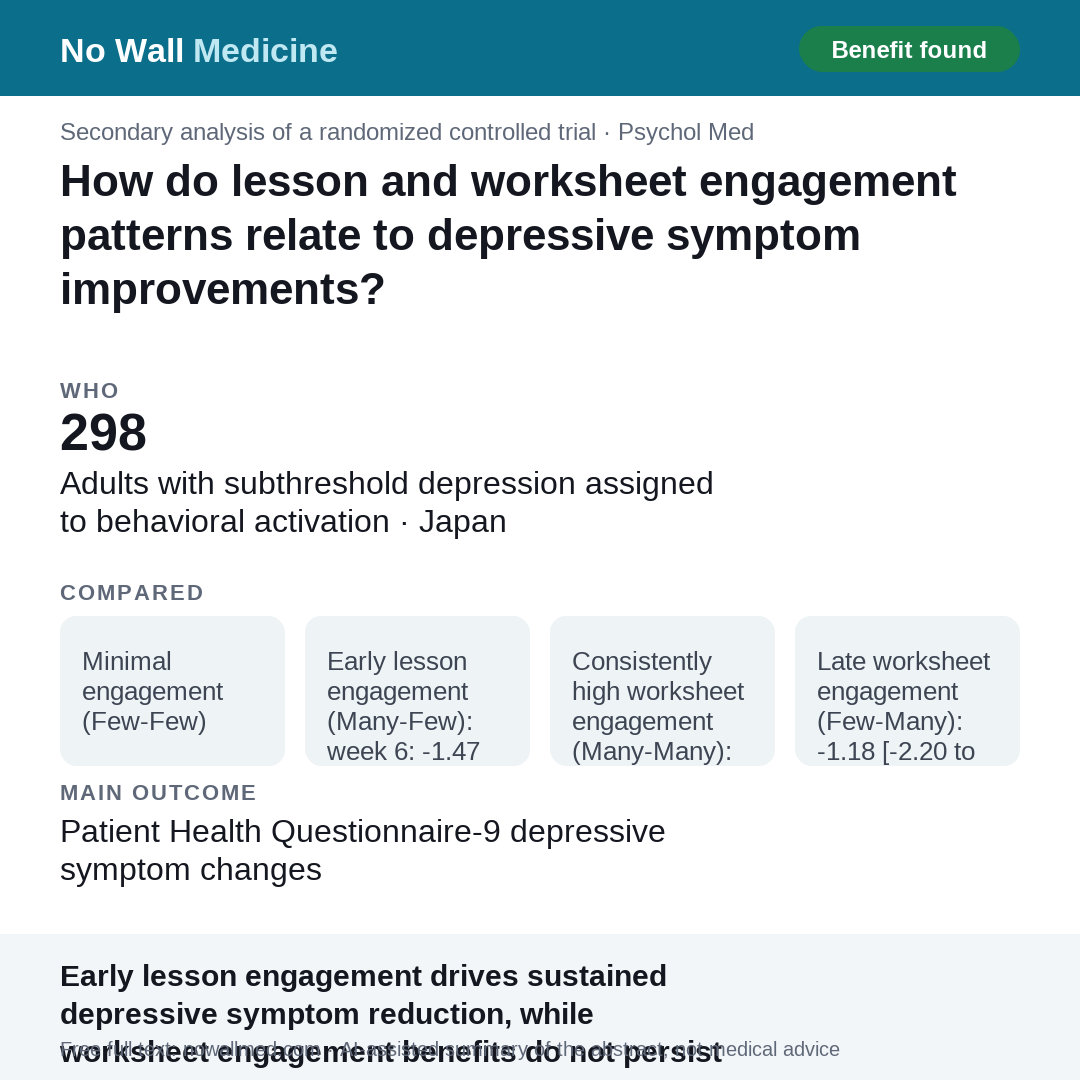
Clinical question: How do lesson and worksheet engagement patterns relate to depressive symptom improvements?
Why it matters: It remains unclear how different levels of engagement with smartphone-based cognitive behavioral therapy programs affect improvements in depressive symptoms.
Key points
- Researchers analyzed 298 adults in Japan using a behavioral activation intervention delivered via smartphone to measure how engagement patterns affected depressive symptoms.
- Early lesson engagement during weeks 0-3 was associated with larger reductions in Patient Health Questionnaire-9 scores at week 6 (-1.47) and week 26 (-1.27).
- Higher worksheet engagement improved symptoms at week 6, with the greatest benefit seen in consistently high engagers (-1.25), but these effects did not persist to week 26.
Headline and key points written with AI from the paper’s abstract, with every number checked against it. Read the paper before relying on them.
Was this summary helpful?
Subject terms
Cite this article
Luo Y, Inoue K, Tajika A, et al. Smartphone CBT engagement and depressive symptoms: secondary analysis of the RESiLIENT trial using a time-varying exposure approach. Psychol Med. 2026. doi:10.1017/S0033291726104279
Spotted a mistake? Suggest a correction