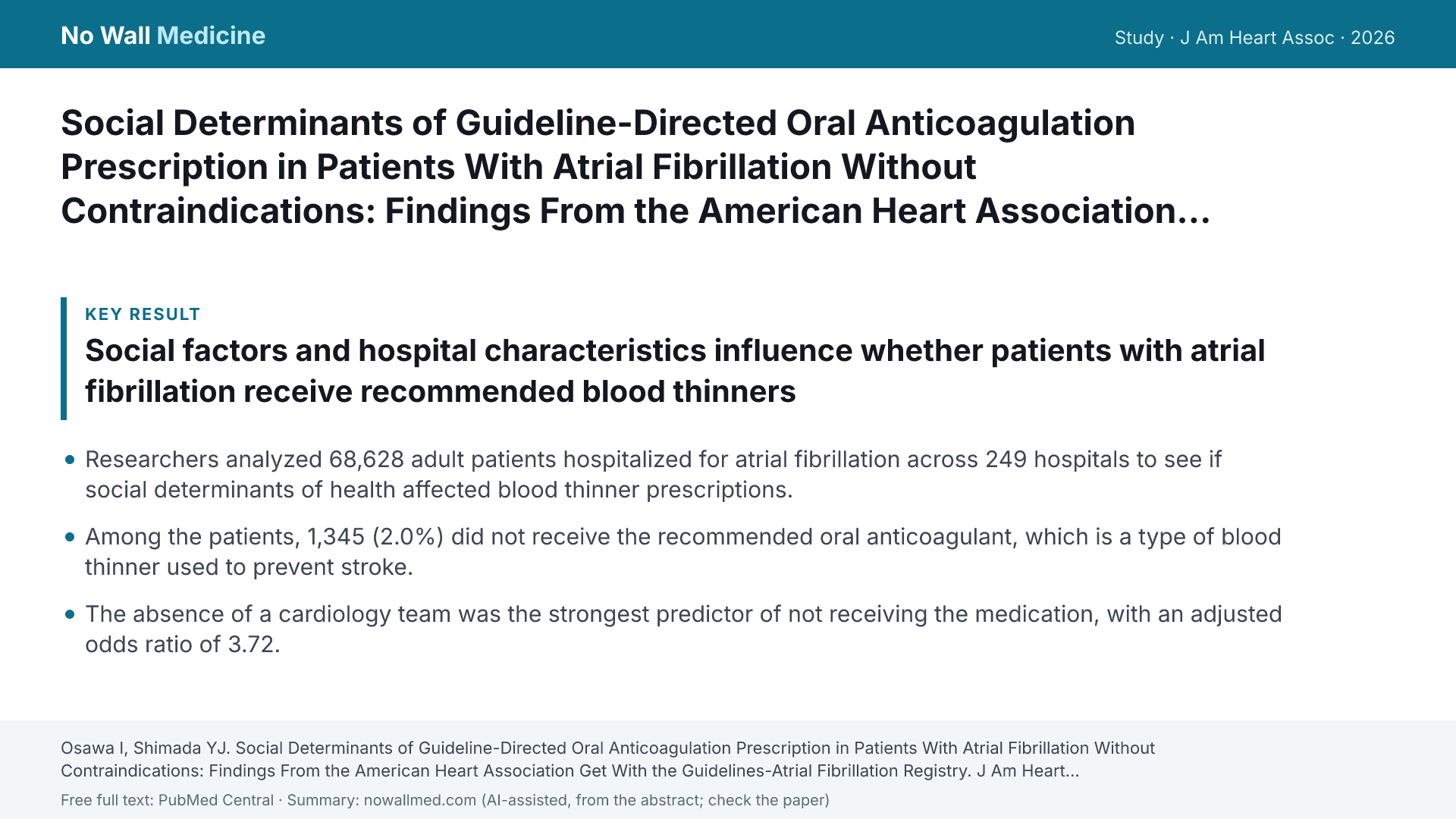
Social Determinants of Guideline-Directed Oral Anticoagulation Prescription in Patients With Atrial Fibrillation Without Contraindications: Findings From the American Heart Association Get With the Guidelines-Atrial Fibrillation Registry
Key result: Social factors and hospital characteristics influence whether patients with atrial fibrillation receive recommended blood thinners
Key points
- Researchers analyzed 68,628 adult patients hospitalized for atrial fibrillation across 249 hospitals to see if social determinants of health affected blood thinner prescriptions.
- Among the patients, 1,345 (2.0%) did not receive the recommended oral anticoagulant, which is a type of blood thinner used to prevent stroke.
- The absence of a cardiology team was the strongest predictor of not receiving the medication, with an adjusted odds ratio of 3.72.
Discussion prompts
- Would these patients look like yours? Who was left out?
- Is the main outcome one that matters to patients?
- Is the difference large enough to change what you do?
Cite: Osawa I, Shimada YJ. Social Determinants of Guideline-Directed Oral Anticoagulation Prescription in Patients With Atrial Fibrillation Without Contraindications: Findings From the American Heart Association Get With the Guidelines-Atrial Fibrillation Registry. J Am Heart Assoc. 2026;15(19):e050448. doi:10.1161/JAHA.126.050448
Free full text: PubMed Central · Summary and visual abstract: nowallmed.com/a/social-determinants-of-guideline-directed-oral-anticoagulation-utm52m/ (AI-assisted from the abstract; check the paper before relying on it).