Bone marrow plasma cells and light chain levels were linked to shorter disease-free survival
Solitary plasmacytoma: single-institution experience, and systematic review and meta-analysis of clinical outcomes
Single-institution experience and meta-analysisMixed results
What are the clinical outcomes and risk factors for solitary plasmacytoma?
Who
3487
Patients with solitary plasmacytomas · Mayo Clinic and 62 studies
Compared
79 monthsTrue solitary plasmacytoma
15.7 monthsPlasmacytoma with up to 10% clonal plasma cells
Main outcome
median disease-free survival
Bottom line: Clonal plasma cells in bone marrow and tumor location significantly impact disease-free survival in solitary plasmacytoma.
Blood Adv · 2025-01-30Download image
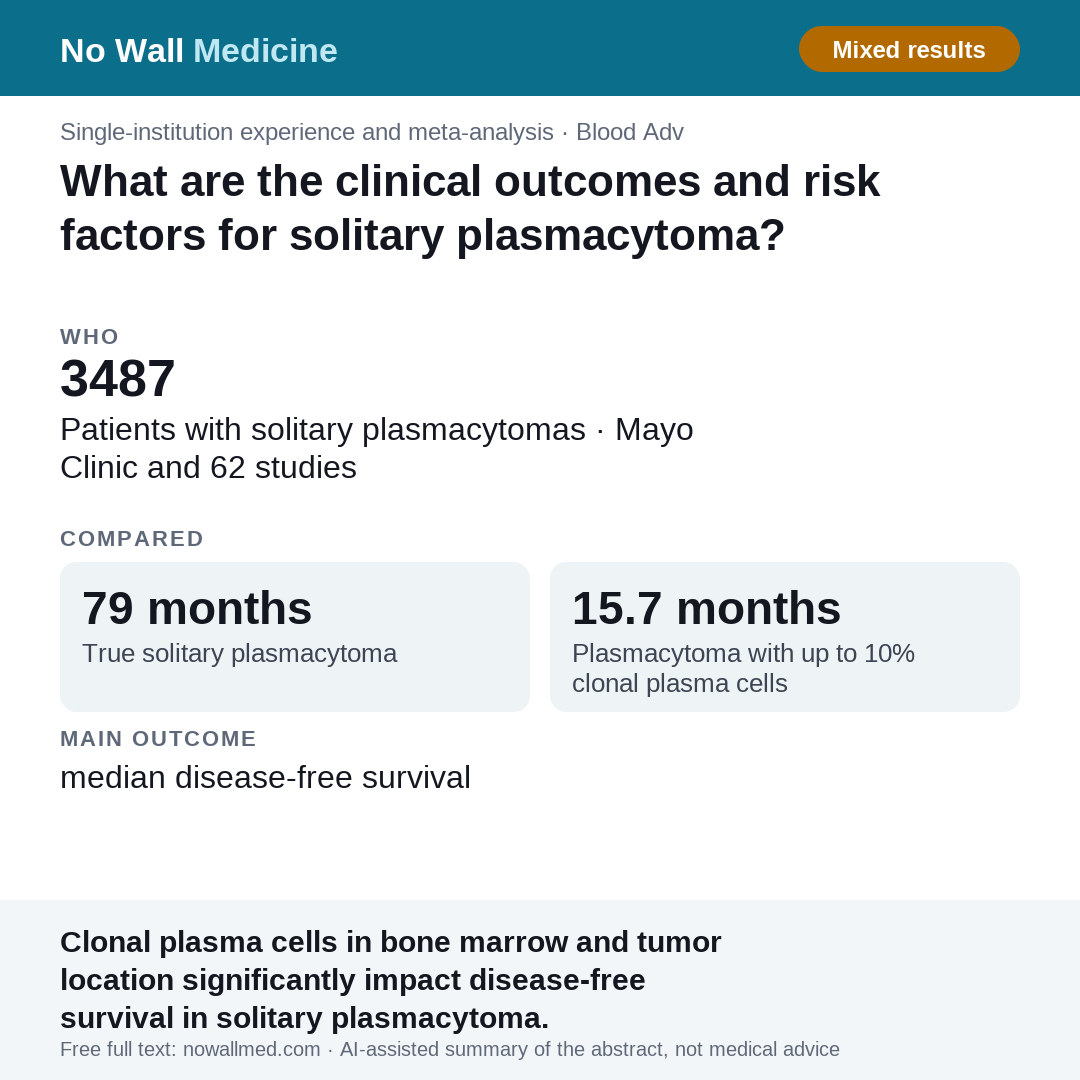
Clinical question: What are the clinical outcomes and risk factors for solitary plasmacytoma?
Why it matters: The specific risk factors and survival differences based on bone marrow involvement and tumor location for solitary plasmacytoma were not fully established.
Key points
- Researchers analyzed 147 patients from one clinic and 3487 patients from 62 studies to evaluate solitary plasmacytoma outcomes.
- Patients with up to 10% clonal plasma cells in the bone marrow had a median disease-free survival of 15.7 months compared to 79 months for those with no clonal cells.
- Disease-free survival rates at 3, 5, and 10 years were 66.9%, 55%, and 42.1% respectively.
Headline and key points written with AI from the paper’s abstract, with every number checked against it. Read the paper before relying on them.
Was this summary helpful?
Abstract
In this study, we first analyzed data from 147 patients with solitary plasmacytomas treated at the Mayo Clinic between 2005 and 2022 and then expanded our investigation through a systematic review and meta-analysis of 62 studies, encompassing 3487 patients from the years 1960 to 2022. Our findings reveal that patients with up to 10% clonal plasma cells in their bone marrow (BM), denoted as plasmacytoma +, had a significantly reduced median disease-free survival (DFS) of 15.7 months vs 79 months, P < .05, observed in patients with true solitary plasmacytomas, with no clonal cells in the BM. Risk factors identified for shorter DFS included the presence of clonal plasma cells in the marrow and a difference between involved and uninvolved free light chains of >5 mg/dL. The meta-analysis portion of our study highlighted a male predominance among patients, with a median age of 58 years, and confirmed radiation therapy as the predominant treatment modality. We also found that DFS rates at 3, 5, and 10 years were 66.9%, 55%, and 42.1%, respectively, and noted a significant difference in outcomes between patients with bone and extramedullary plasmacytomas, with the latter group exhibiting better survival rates. This dual-faceted approach provides a thorough overview of survival rates and critical risk factors for patients with plasmacytoma, underscoring the vital role of accurate disease staging at diagnosis and the impact of tumor location on patient prognosis.
Abstract reproduced under the article’s CC BY NC ND licence.
Subject terms
Cite this article
Charalampous C, Claveau JS, Kapoor P, Binder M, Buadi FK, Cook J. Solitary plasmacytoma: single-institution experience, and systematic review and meta-analysis of clinical outcomes. Blood Adv. 2025. doi:10.1182/bloodadvances.2024013355
Spotted a mistake? Suggest a correction
Top studies every Monday
The week’s key trials and guidelines in your specialties, plus any topics you follow. By email, free.
Get the weekly digest