Stimulating an enzyme in the body was associated with cranial blood vessel widening and headache
Soluble guanylate cyclase induces cranial vasodilation and headache in adults: a randomized trial
Randomized, double-blind, placebo-controlled, two-way crossover studyHarm found
Does oral riociguat induce cranial vasodilation and headache in healthy adults?
Who
12
12 healthy adults · Single site in Denmark
Compared
riociguat 2.5 mg: 10 (83%) reported headache
placebo: three (25%) reported headache
Main outcome
cranial vasodilation and headache occurrence
Bottom line: Oral riociguat ingestion induces cranial vasodilation and increases headache occurrence in healthy adults.
Limitation: Further research is warranted to delineate nitric oxide-dependent versus nitric oxide-independent activation.
Brain Commun · 2025-11-05Download image
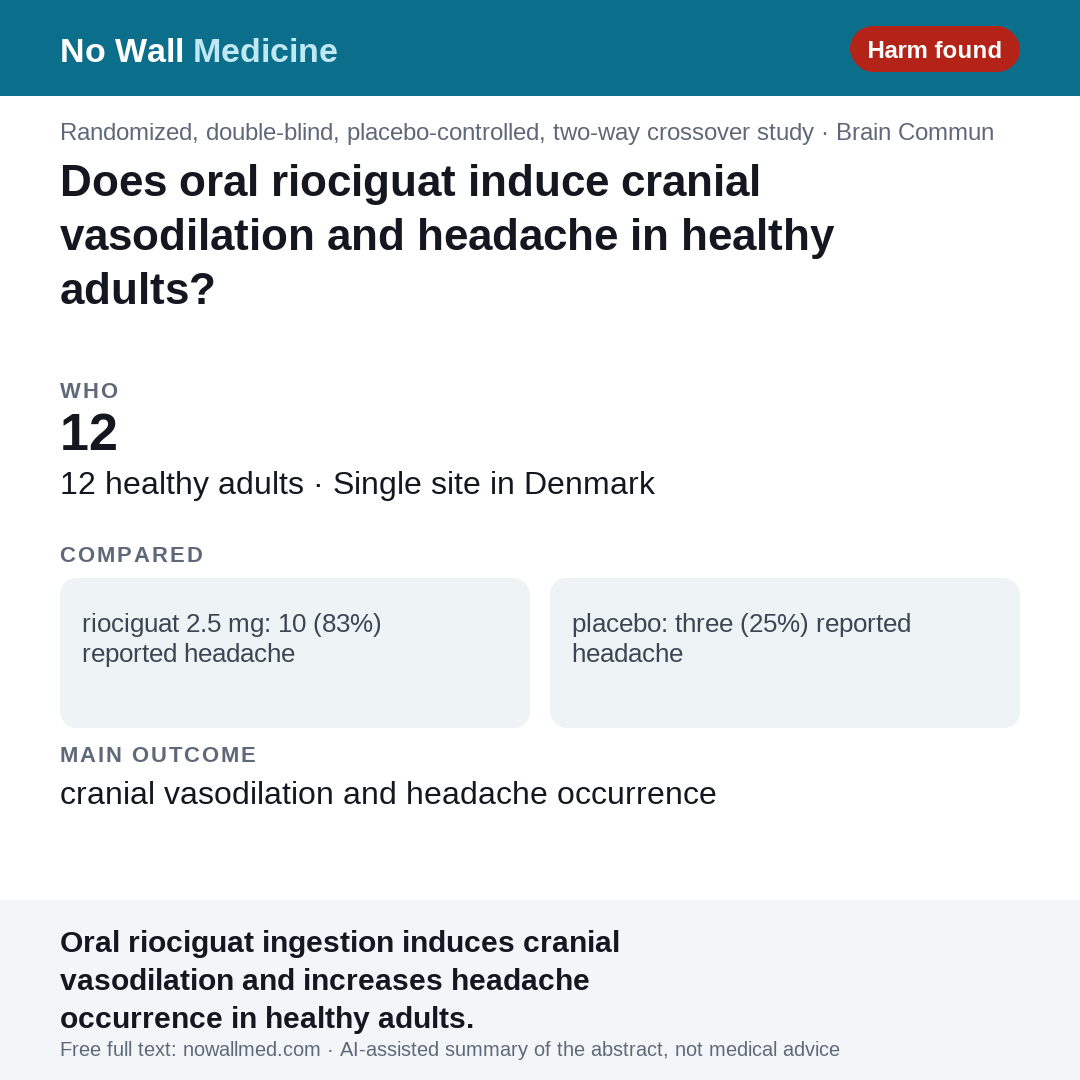
Clinical question: Does oral riociguat induce cranial vasodilation and headache in healthy adults?
Why it matters: The role of cranial vasodilation, or the widening of blood vessels in the head, in the development of headaches is a subject of ongoing debate.
Key points
- Twelve healthy adults with a mean age of 27.3 years were studied in a randomized, double-blind, placebo-controlled crossover trial.
- Riociguat ingestion was associated with significant increases in superficial temporal artery diameter at 120 min (P = 0.02) and 240 min (P < 0.01) compared to placebo.
- Headache was reported by 10 (83%) of 12 participants after riociguat ingestion compared with three (25%) participants after placebo (P = 0.02).
Headline and key points written with AI from the paper’s abstract, with every number checked against it. Read the paper before relying on them.
Cite this article
Rasmussen NB, Christensen CE, Ashina H, Amin FM, Domínguez-Moreno R, Abdulla J. Soluble guanylate cyclase induces cranial vasodilation and headache in adults: a randomized trial. Brain Commun. 2025. doi:10.1093/braincomms/fcaf436
Spotted a mistake? Suggest a correction