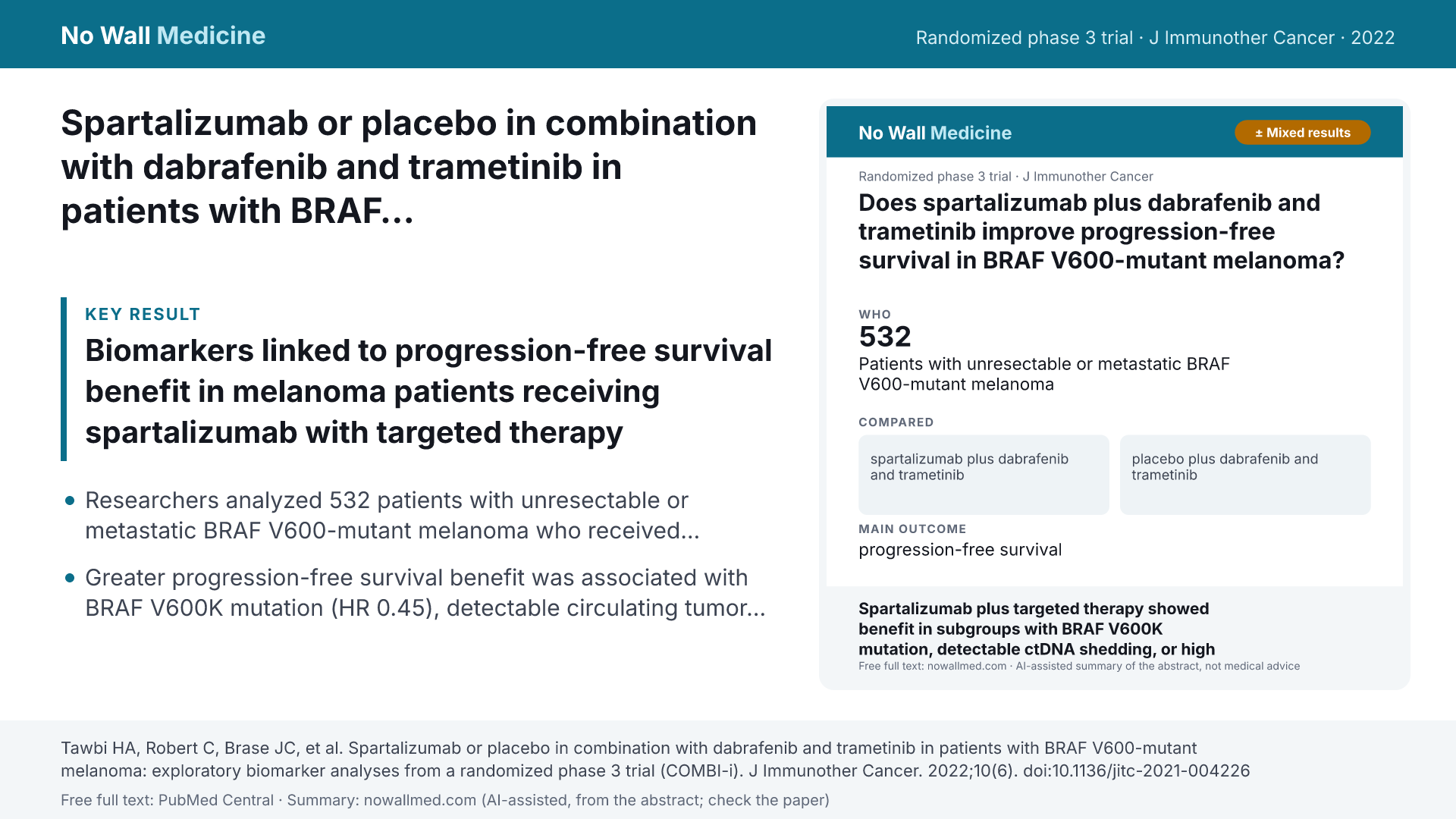
Biomarkers linked to progression-free survival benefit in melanoma patients receiving spartalizumab with targeted therapy
Spartalizumab or placebo in combination with dabrafenib and trametinib in patients with BRAF V600-mutant melanoma: exploratory biomarker analyses from a randomized phase 3 trial (COMBI-i)
Randomized phase 3 trialMixed results
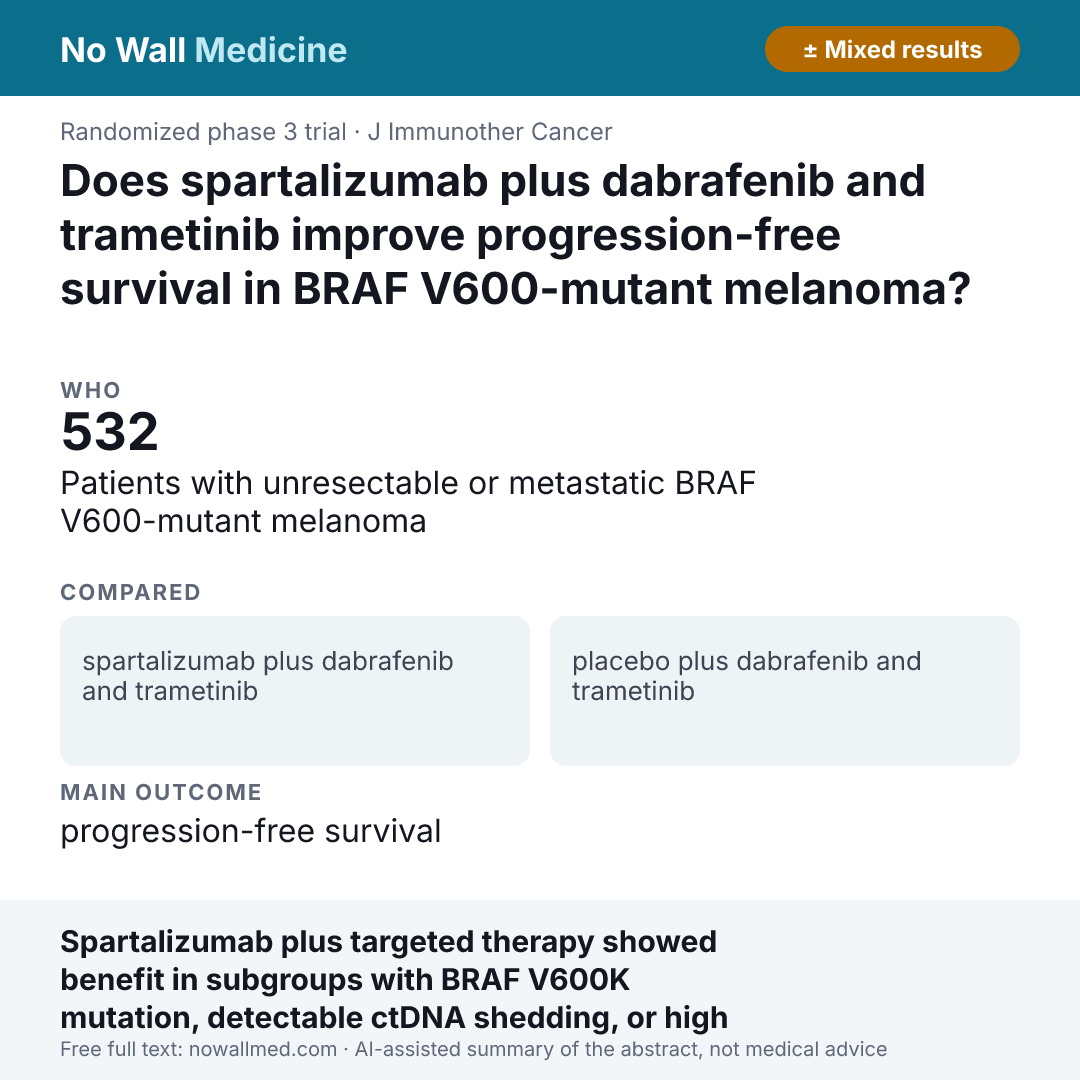
Does spartalizumab plus dabrafenib and trametinib improve progression-free survival in BRAF V600-mutant melanoma?
Who
532
Patients with unresectable or metastatic BRAF V600-mutant melanoma
Compared
spartalizumab plus dabrafenib and trametinib
placebo plus dabrafenib and trametinib
Main outcome
progression-free survival
Bottom line: Spartalizumab plus targeted therapy showed benefit in subgroups with BRAF V600K mutation, detectable ctDNA shedding, or high CD4+/CD8+ ratio.
J Immunother Cancer · 2022-06-21 · NCT02967692
Same trial (NCT02967692)
Papers we list that report this registered trial, oldest first. Read a secondary analysis alongside the main results.
- Main results No clear difference
Spartalizumab plus dabrafenib and trametinib did not clearly improve progression-free survival J Clin Oncol 2022-01 - Secondary analysis Mixed results
This paper J Immunother Cancer 2022-06 - Related analysis
Spartalizumab plus dabrafenib and trametinib was associated with longer overall survival in advanced melanoma J Clin Oncol 2026-08
Headline and visual abstract written with AI from the paper’s abstract, with every number checked against it. Read the paper before relying on them.
Was this summary helpful?
Abstract
Background
The randomized phase 3 COMBI-i trial did not meet its primary endpoint of improved progression-free survival (PFS) with spartalizumab plus dabrafenib and trametinib (sparta-DabTram) vs placebo plus dabrafenib and trametinib (placebo-DabTram) in the overall population of patients with unresectable/metastatic BRAF V600-mutant melanoma. This prespecified exploratory biomarker analysis was performed to identify subgroups that may derive greater treatment benefit from sparta-DabTram. Methods
In COMBI-i (ClinicalTrials.gov, NCT02967692), 532 patients received spartalizumab 400 mg intravenously every 4 weeks plus dabrafenib 150 mg orally two times daily and trametinib 2 mg orally one time daily or placebo-DabTram. Baseline/on-treatment pharmacodynamic markers were assessed via flow cytometry-based immunophenotyping and plasma cytokine profiling. Baseline programmed death ligand 1 (PD-L1) status and T-cell phenotype were assessed via immunohistochemistry; BRAF V600 mutation type, tumor mutational burden (TMB), and circulating tumor DNA (ctDNA) via DNA sequencing; gene expression signatures via RNA sequencing; and CD4+/CD8+ T-cell ratio via immunophenotyping. Results
Extensive biomarker analyses were possible in approximately 64% to 90% of the intention-to-treat population, depending on sample availability and assay. Subgroups based on PD-L1 status/TMB or T-cell inflammation did not show significant differences in PFS benefit with sparta-DabTram vs placebo-DabTram, although T-cell inflammation was prognostic across treatment arms. Subgroups defined by BRAF V600K mutation (HR 0.45 (95% CI 0.21 to 0.99)), detectable ctDNA shedding (HR 0.75 (95% CI 0.58 to 0.96)), or CD4+/CD8+ ratio above median (HR 0.58 (95% CI 0.40 to 0.84)) derived greater PFS benefit with sparta-DabTram vs placebo-DabTram. In a multivariate analysis, ctDNA emerged as strongly prognostic (p=0.007), while its predictive trend did not reach significance; in contrast, CD4+/CD8+ ratio was strongly predictive (interaction p=0.0131). Conclusions
These results support the feasibility of large-scale comprehensive biomarker analyses in the context of a global phase 3 study. T-cell inflammation was prognostic but not predictive of sparta-DabTram benefit, as patients with high T-cell inflammation already benefit from targeted therapy alone. Baseline ctDNA shedding also emerged as a strong independent prognostic variable, with predictive trends consistent with established measures of disease burden such as lactate dehydrogenase levels. CD4+/CD8+ T-cell ratio was significantly predictive of PFS benefit with sparta-DabTram but requires further validation as a biomarker in melanoma. Taken together with previous observations, further study of checkpoint inhibitor plus targeted therapy combination in patients with higher disease burden may be warranted. Trial registration number
NCT02967692.
Abstract reproduced under the article’s CC BY licence.
Subject terms
Cite this article
Tawbi HA, Robert C, Brase JC, et al. Spartalizumab or placebo in combination with dabrafenib and trametinib in patients with BRAF V600-mutant melanoma: exploratory biomarker analyses from a randomized phase 3 trial (COMBI-i). J Immunother Cancer. 2022;10(6). doi:10.1136/jitc-2021-004226
Spotted a mistake? Suggest a correction