Spatial organisation of EEG-derived functional brain networks across physiological, sedated, and disordered states of consciousness: a cross-sectional study
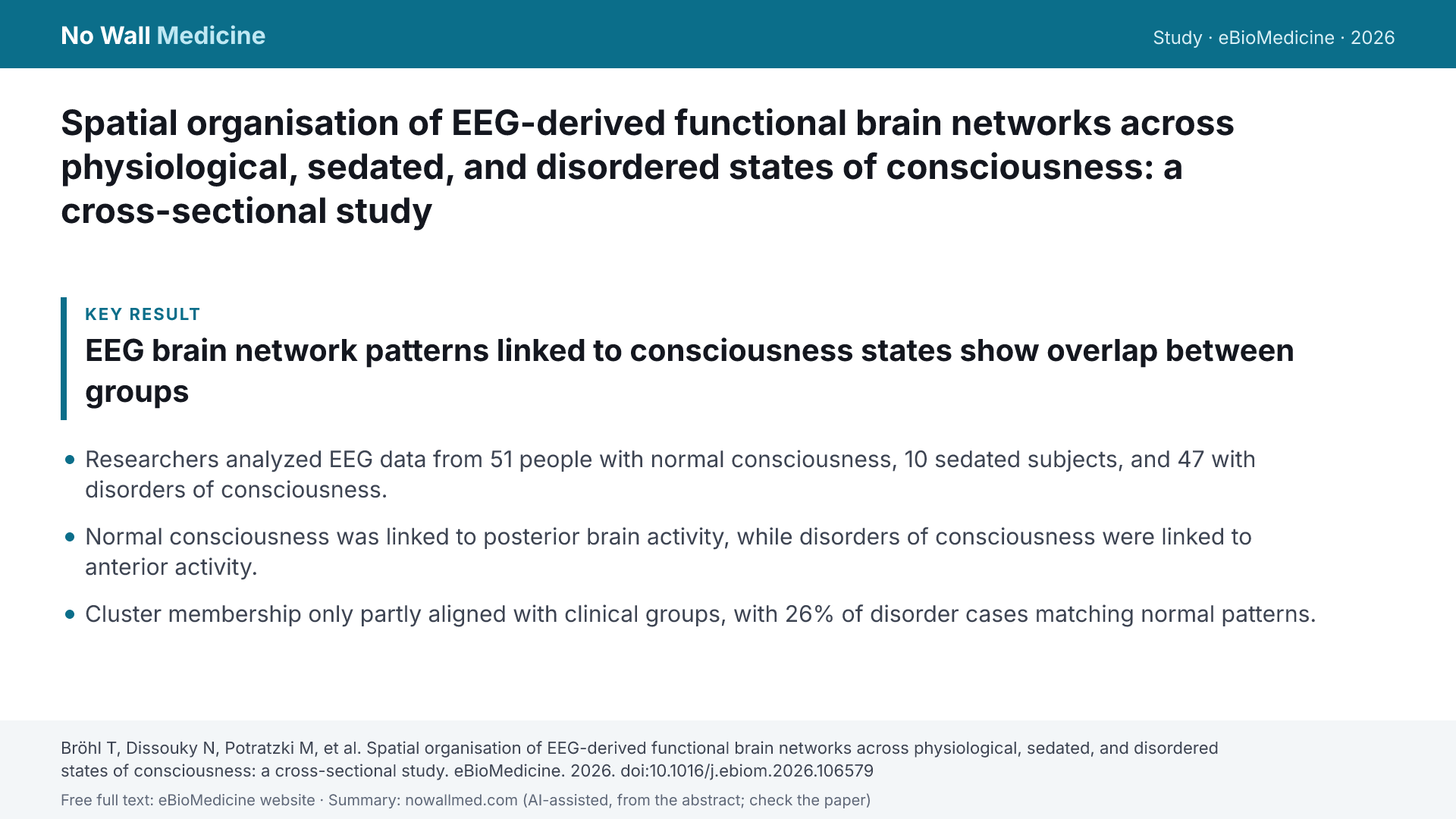
Key result: EEG brain network patterns linked to consciousness states show overlap between groups
Key points
- Researchers analyzed EEG data from 51 people with normal consciousness, 10 sedated subjects, and 47 with disorders of consciousness.
- Normal consciousness was linked to posterior brain activity, while disorders of consciousness were linked to anterior activity.
- Cluster membership only partly aligned with clinical groups, with 26% of disorder cases matching normal patterns.
Why it matters: Differentiating clinical states of altered consciousness is challenging when behavioral responsiveness is limited, requiring complementary measures.
Limitation the authors note: The authors describe the findings as exploratory and observational, noting they require prospective testing before diagnostic application.
Discussion prompts
- Would these patients look like yours? Who was left out?
- Is the main outcome one that matters to patients?
- Is the difference large enough to change what you do?
Cite: Bröhl T, Dissouky N, Potratzki M, et al. Spatial organisation of EEG-derived functional brain networks across physiological, sedated, and disordered states of consciousness: a cross-sectional study. eBioMedicine. 2026. doi:10.1016/j.ebiom.2026.106579
Free full text: eBioMedicine website · Summary and visual abstract: nowallmed.com/a/spatial-organisation-of-eeg-derived-functional-brain-networks-across-vb1rxn/ (AI-assisted from the abstract; check the paper before relying on it).