Highly aspherical spectacle lenses slowed myopia progression in US children over 24 months
Spectacle Lenses With Highly Aspherical Lenslets for Myopia Control: A Randomized Clinical Trial
Double-masked randomized clinical trialBenefit found
Are highly aspherical lenslet spectacle lenses effective for myopia control in US children?
Who
159
Children aged 6 to 12 years with myopia · 9 investigational sites in the US
Compared
Highly aspherical lenslets: -0.25 (0.05) D
Single-vision spectacle lenses: -0.90 (0.05) D
Main outcome
24-month changes in cycloplegic spherical equivalent refraction and axial length
Result: difference, 0.64 D; 95% CI, 0.50 to 0.79
Bottom line: Highly aspherical lenslet spectacle lenses reduced myopia progression and axial elongation in US children over 24 months.
JAMA Ophthalmol · 2026-08-20Download image
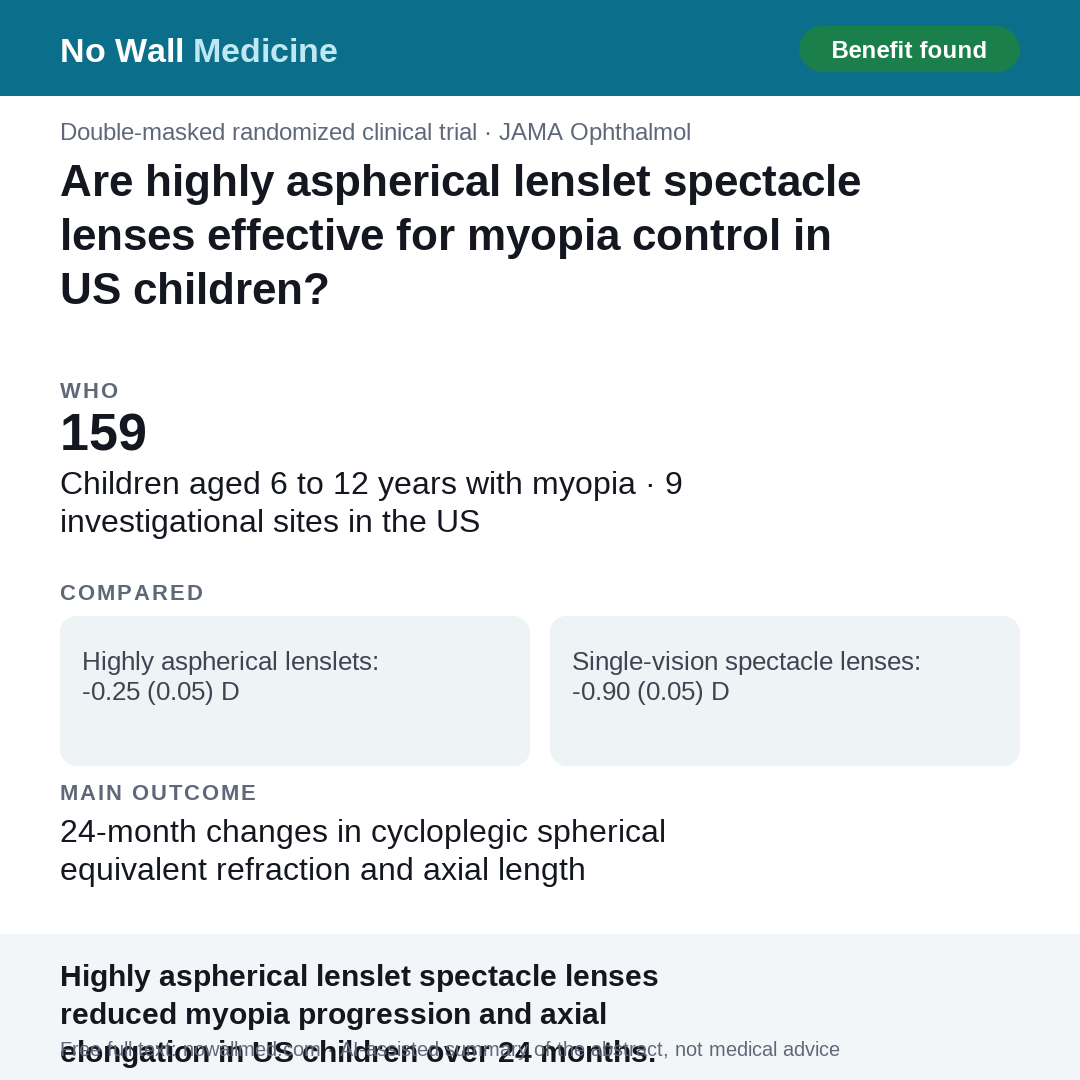
Clinical question: Are highly aspherical lenslet spectacle lenses effective for myopia control in US children?
Why it matters: While highly aspherical lenslets are effective in Asian populations, they have not been proven in children living in the United States.
Key points
- Researchers studied 159 US children aged 6 to 12 years, comparing highly aspherical lenslets to single-vision spectacle lenses.
- The highly aspherical lenslets group had an adjusted mean myopia progression of -0.25 (0.05) D compared to -0.90 (0.05) D in the single-vision group.
- The difference in myopia progression between the two lens types was 0.64 D (95% CI, 0.50 to 0.79; P < 0.05).
Headline and key points written with AI from the paper’s abstract, with every number checked against it. Read the paper before relying on them.
Topics
Spotted a mistake? Suggest a correction