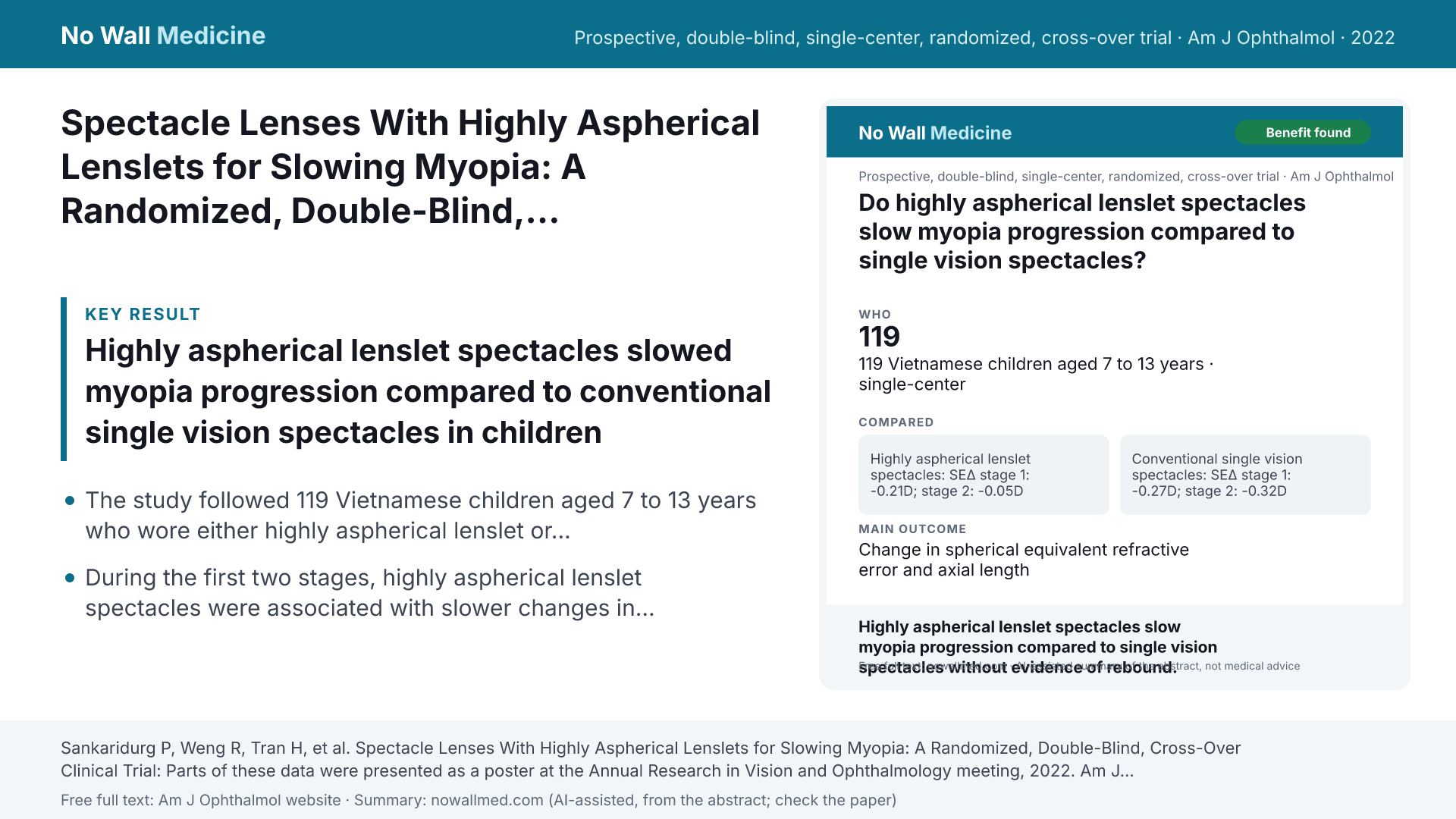
Highly aspherical lenslet spectacles slowed myopia progression compared to conventional single vision spectacles in children
Spectacle Lenses With Highly Aspherical Lenslets for Slowing Myopia: A Randomized, Double-Blind, Cross-Over Clinical Trial: Parts of these data were presented as a poster at the Annual Research in Vision and Ophthalmology meeting, 2022
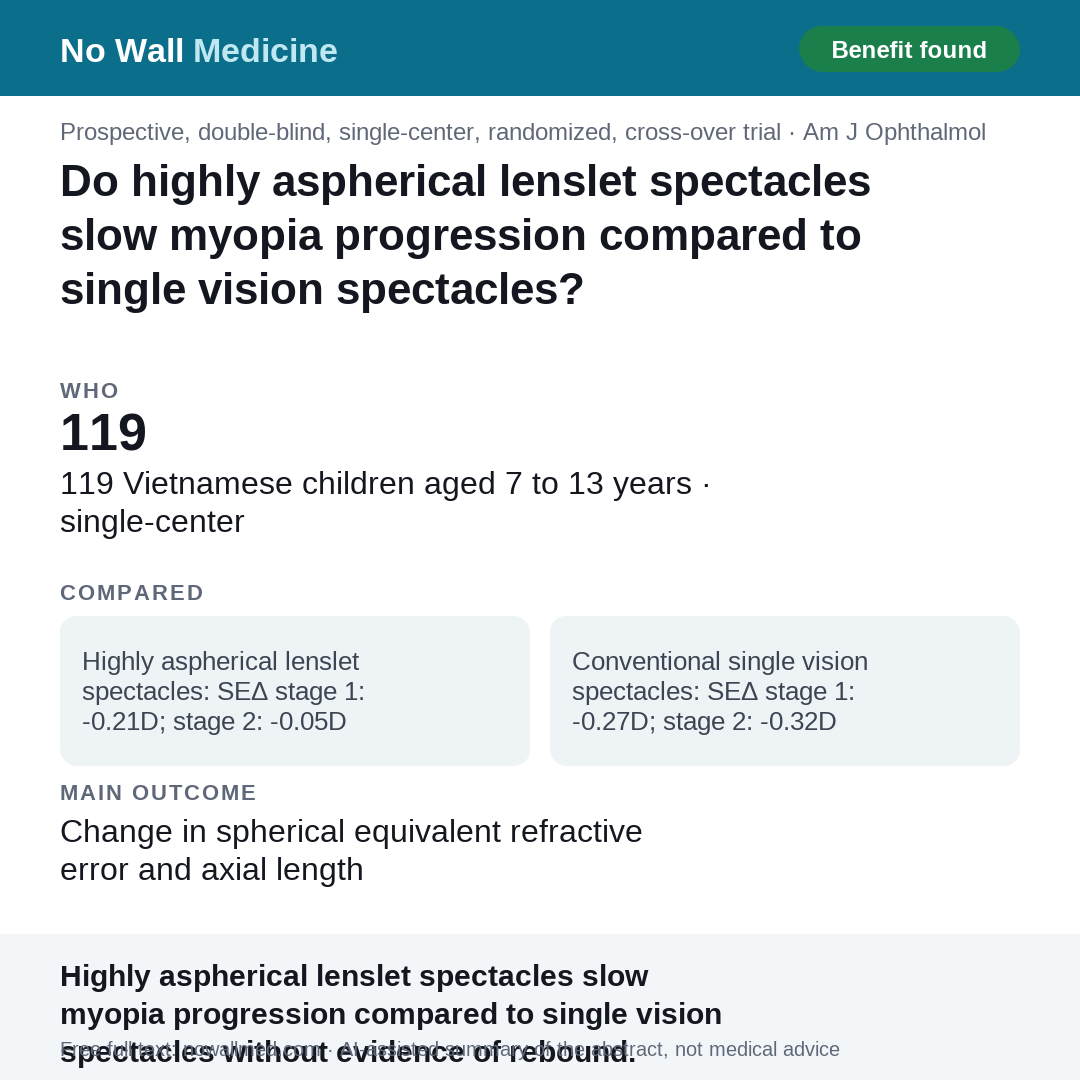
Prospective, double-blind, single-center, randomized, cross-over trialBenefit found
Do highly aspherical lenslet spectacles slow myopia progression compared to single vision spectacles?
Who
119
119 Vietnamese children aged 7 to 13 years · single-center
Compared
Highly aspherical lenslet spectacles: SEΔ stage 1: -0.21D; stage 2: -0.05D
Conventional single vision spectacles: SEΔ stage 1: -0.27D; stage 2: -0.32D
Main outcome
Change in spherical equivalent refractive error and axial length
Bottom line: Highly aspherical lenslet spectacles slow myopia progression compared to single vision spectacles without evidence of rebound.
Am J Ophthalmol · 2022-11-05Download image
Clinical question: Do highly aspherical lenslet spectacles slow myopia progression compared to single vision spectacles?
Why it matters: It was unknown if highly aspherical lenslet spectacles could slow myopia progression or if switching from these lenses to conventional lenses would cause a rebound in myopia.
Key points
- The study followed 119 Vietnamese children aged 7 to 13 years who wore either highly aspherical lenslet or conventional single vision spectacles in a randomized crossover trial.
- During the first two stages, highly aspherical lenslet spectacles were associated with slower changes in spherical equivalent refractive error and axial length, which is the physical length of the eye.
- The change in the ratio of refractive error to eye length when switching from highly aspherical lenslet to single vision spectacles was not different between the two study groups.
Headline and key points written with AI from the paper’s abstract, with every number checked against it. Read the paper before relying on them.
Was this summary helpful?
Subject terms
Cite this article
Sankaridurg P, Weng R, Tran H, Spiegel DP, Drobe B, Ha T. Spectacle Lenses With Highly Aspherical Lenslets for Slowing Myopia: A Randomized, Double-Blind, Cross-Over Clinical Trial: Parts of these data were presented as a poster at the Annual Research in Vision and Ophthalmology meeting, 2022. Am J Ophthalmol. 2022. doi:10.1016/j.ajo.2022.10.021
Spotted a mistake? Suggest a correction
Top studies every Monday
The week’s key trials and guidelines in your specialties, plus any topics you follow. By email, free.
Get the weekly digest