Self-management and spinal manipulation reduced disability but not pain in adults with back pain
Spinal Manipulation and Clinician-Supported Biopsychosocial Self-Management for Acute Back Pain: The PACBACK Randomized Clinical Trial
2 x 2 factorial randomized clinical trialBenefit found
Is spinal manipulation and clinician-supported biopsychosocial self-management effective for acute back pain?
Who
1000
Adults with acute or subacute low back pain at risk of chronicity · 3 research clinics in Minnesota and Pittsburgh
Compared
4.7Supported self-management
5.5Spinal manipulation
4.8Combined self-management and spinal manipulation
5.9Medical care
Main outcome
Monthly low back disability and weekly pain intensity
Result: mean difference -1.2 (95% CI -1.9 to -0.5) for supported self-management
Bottom line: Clinician-supported biopsychosocial self-management reduced low back disability compared to medical care, but spinal manipulation alone did not.
JAMA · 2025-12-29Download image
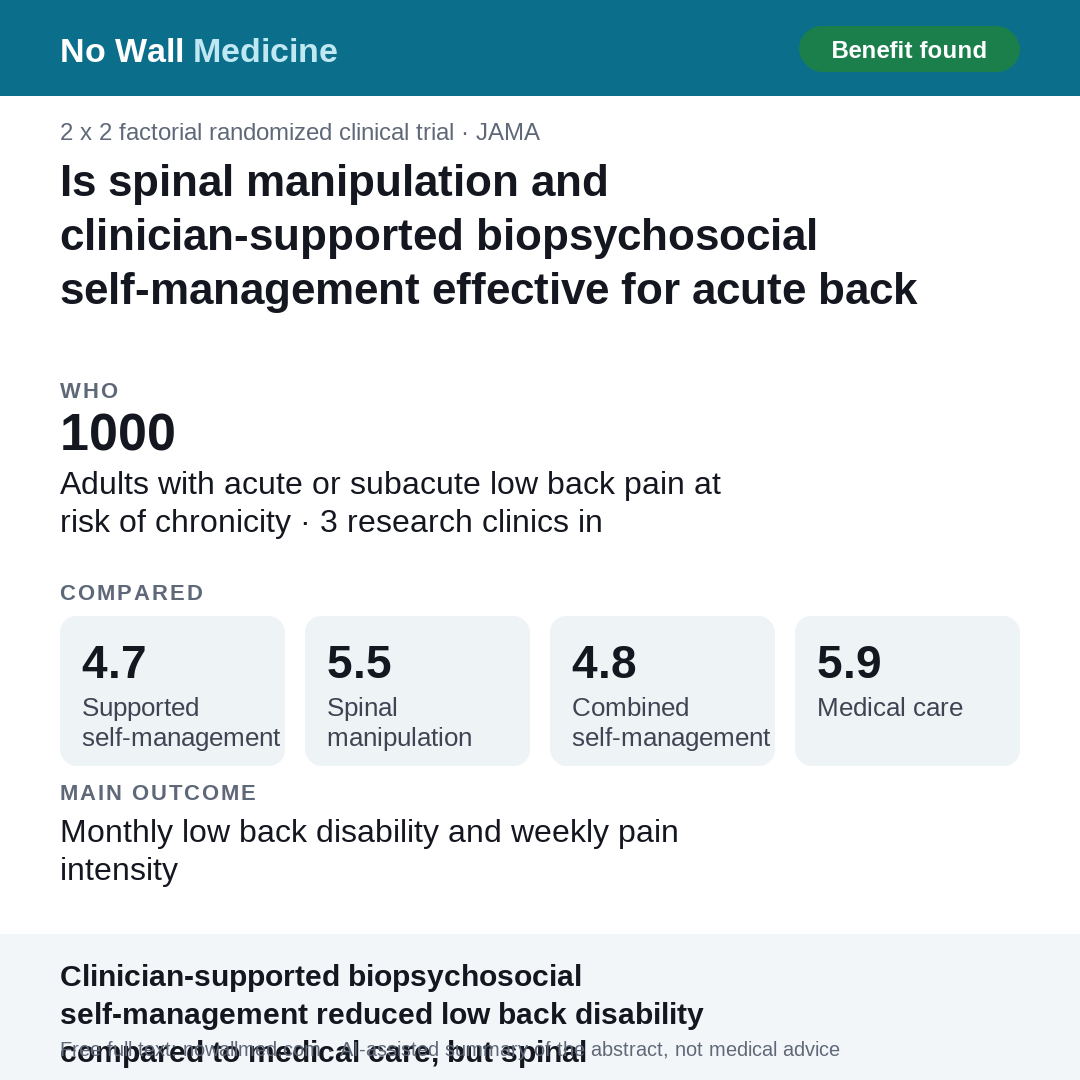
Clinical question: Is spinal manipulation and clinician-supported biopsychosocial self-management effective for acute back pain?
Why it matters: Most treatments for low back pain focus on reducing symptoms without addressing the physical, psychological, and social factors that influence the condition.
Key points
- Researchers studied 1000 adults with acute or subacute low back pain at moderate to high risk of becoming chronic over a 1-year period.
- Supported self-management and combined therapy showed significantly lower disability scores compared to medical care, but spinal manipulation alone did not show a significant difference.
- There were no statistically significant differences in weekly pain intensity across the four treatment groups.
Headline and key points written with AI from the paper’s abstract, with every number checked against it. Read the paper before relying on them.
Topics
Cite this article
Bronfort G, Meier EN, Leininger B, Schneider M, Evans R, Greco C. Spinal Manipulation and Clinician-Supported Biopsychosocial Self-Management for Acute Back Pain: The PACBACK Randomized Clinical Trial. JAMA. 2025. doi:10.1001/jama.2025.21990
Spotted a mistake? Suggest a correction