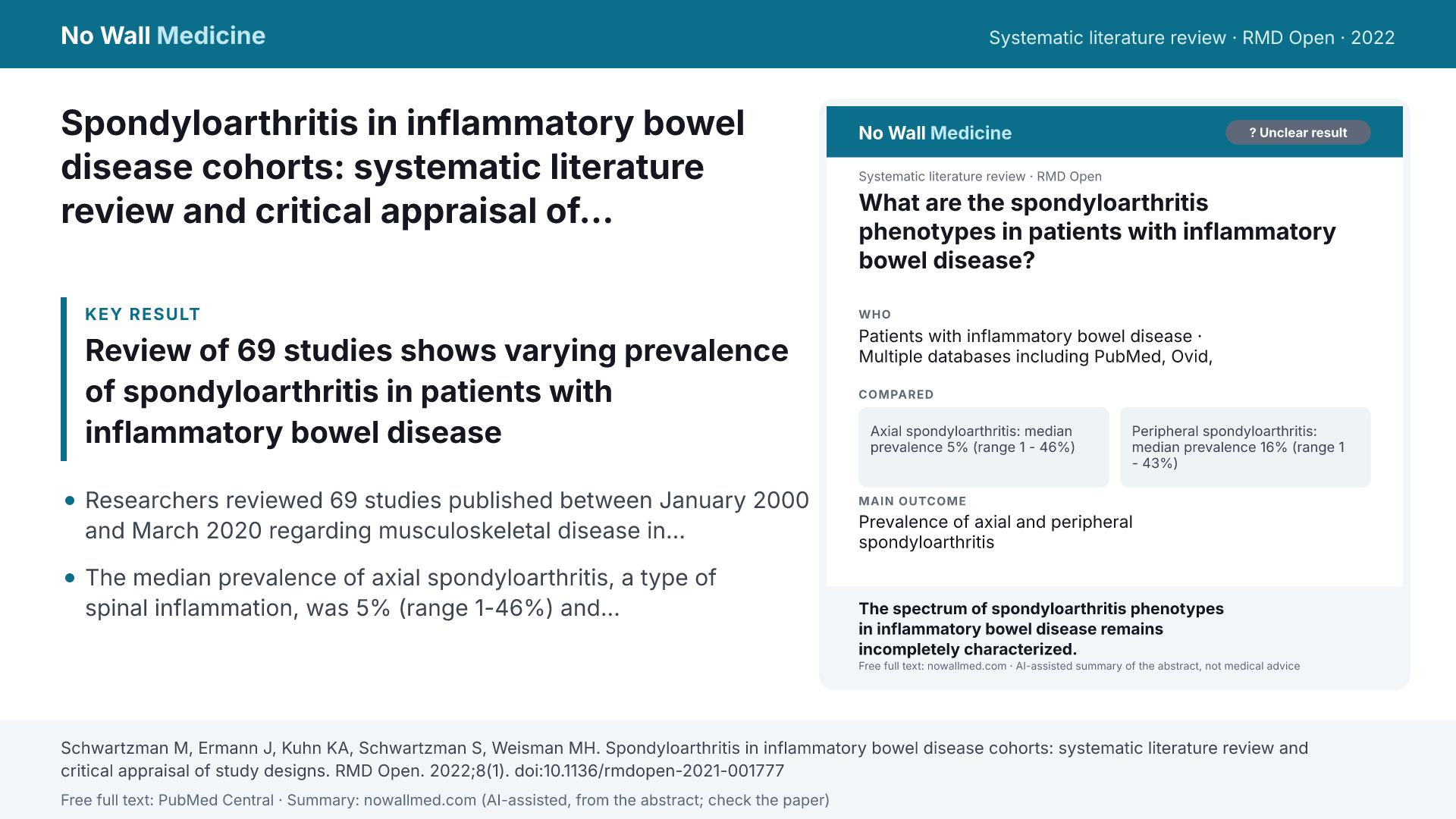
Review of 69 studies shows varying prevalence of spondyloarthritis in patients with inflammatory bowel disease
Spondyloarthritis in inflammatory bowel disease cohorts: systematic literature review and critical appraisal of study designs
Systematic literature reviewUnclear result
What are the spondyloarthritis phenotypes in patients with inflammatory bowel disease?
Who
69
Patients with inflammatory bowel disease · Multiple databases including PubMed, Ovid, Scopus, Cinahl, Medline, Web of Science, and Cochrane
Compared
Axial spondyloarthritis: median prevalence 5% (range 1 - 46%)
Peripheral spondyloarthritis: median prevalence 16% (range 1 - 43%)
Main outcome
Prevalence of axial and peripheral spondyloarthritis
Bottom line: The spectrum of spondyloarthritis phenotypes in inflammatory bowel disease remains incompletely characterized.
RMD Open · 2022-01-20Download image
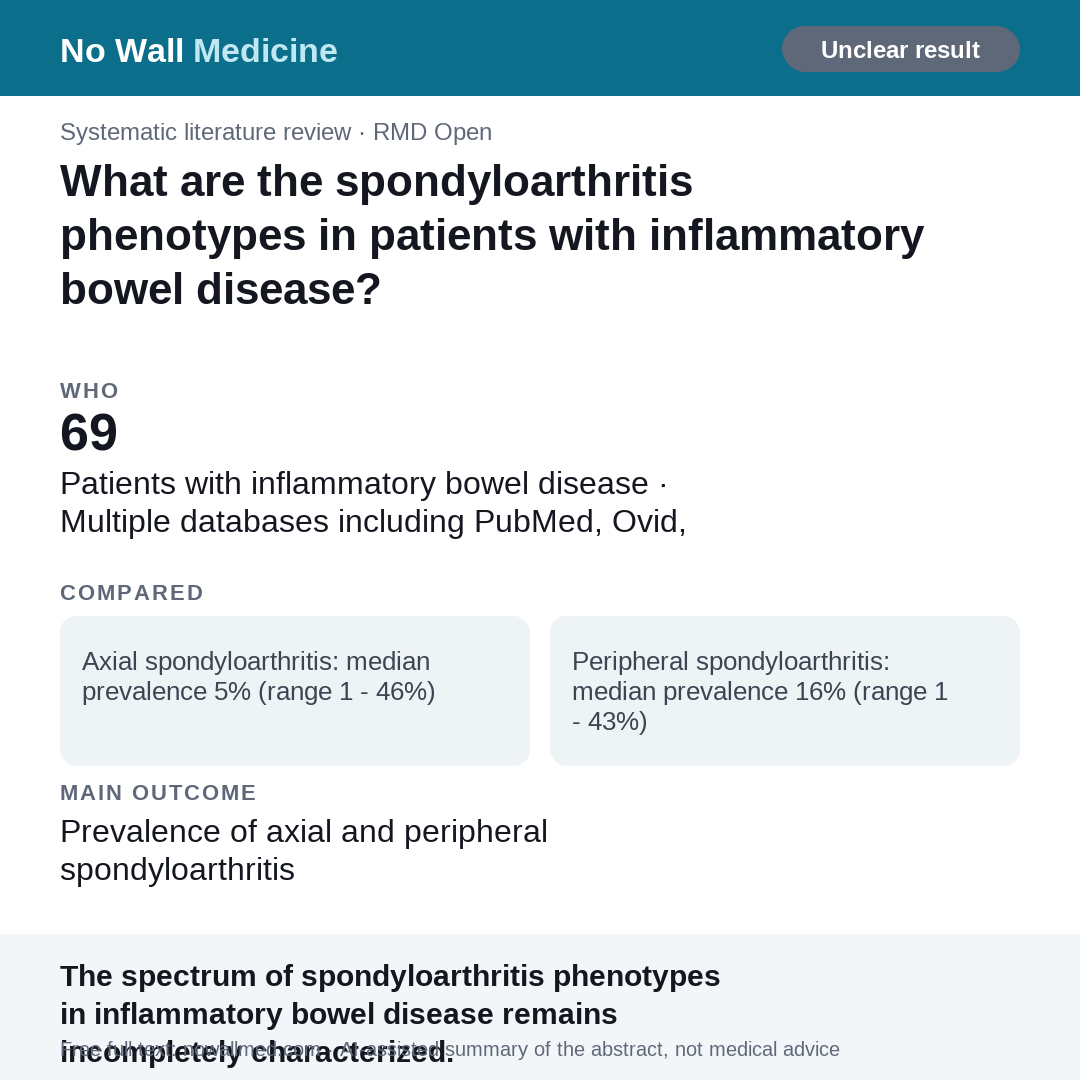
Clinical question: What are the spondyloarthritis phenotypes in patients with inflammatory bowel disease?
Why it matters: The specific spectrum of spondyloarthritis phenotypes in patients with inflammatory bowel disease remains incompletely characterized.
Key points
- Researchers reviewed 69 studies published between January 2000 and March 2020 regarding musculoskeletal disease in patients with inflammatory bowel disease.
- The median prevalence of axial spondyloarthritis, a type of spinal inflammation, was 5% (range 1-46%) and peripheral spondyloarthritis was 16% (range 1-43%).
- In 74% of studies, researchers did not mention if they assessed or excluded osteoarthritis or fibromyalgia.
Limitation the authors note: Most included studies were clinic based (54/69, 78%), single center (47/69, 68%) and cross-sectional (60/69, 87%).
Headline and key points written with AI from the paper’s abstract, with every number checked against it. Read the paper before relying on them.
Was this summary helpful?
Abstract
To critically appraise study designs evaluating spondyloarthritis (SpA) phenotypes in patients with inflammatory bowel disease (IBD). A systematic literature review of PubMed, Ovid, Scopus, Cinahl, Medline, Web of Science, and Cochrane databases was performed. Articles published from January 2000 - March 2020 were included if they evaluated the prevalence/incidence of musculoskeletal disease in cohorts of IBD patients. Most of the 69 included studies were clinic based (54/69, 78%), single center (47/69, 68%) and cross-sectional (60/69, 87%). The median prevalence of axial and peripheral SpA in IBD was 5% (range 1 - 46%) and 16% (range 1 - 43%), respectively. In 38 studies that evaluated axial disease in prospectively enrolled patients, inflammatory back pain was analyzed in 53%. SpA classification criteria were used in 68% and imaging was performed in 76%. In 35 studies that evaluated peripheral disease in prospectively enrolled patients, SpA classification criteria were used in 46%. A physical exam was performed in 74%, and it was performed by a rheumatologist in 54% of studies with a physical exam. Sub-phenotypes of peripheral SpA (mono- or oligo-arthritis, polyarthritis, enthesitis, dactylitis) were variably reported. Seventy-four percent of studies did not mention whether osteoarthritis and fibromyalgia had been assessed or excluded. The spectrum of SpA phenotypes in IBD patients remains incompletely characterized. Future studies should focus on standardizing the variables collected in IBD-SpA cohorts and defining musculoskeletal phenotypes in IBD-SpA in order to better characterize this disease entity and advance the field for clinical and research purposes.
Abstract reproduced under the article’s CC BY NC licence.
Subject terms
Cite this article
Schwartzman M, Ermann J, Kuhn KA, Schwartzman S, Weisman MH. Spondyloarthritis in inflammatory bowel disease cohorts: systematic literature review and critical appraisal of study designs. RMD Open. 2022. doi:10.1136/rmdopen-2021-001777
Spotted a mistake? Suggest a correction