Assisted weaning strategy did not shorten time to successful extubation
Spontaneous breathing trial with pressure support on positive end-expiratory pressure and extensive use of non-invasive ventilation versus T-piece in difficult-to-wean patients from mechanical ventilation: a randomized controlled trial
Single-center prospective open label, randomized controlled superiority trialNo clear difference
Does extensively-assisted weaning shorten time to successful extubation in difficult-to-wean patients?
Who
98
Intubated patients mechanically ventilated for more than 24 hours · Single-center
Compared
Extensively-assisted weaning: median, 172 [50-436] hours
Standard weaning: median, 95 [47-232] hours
Main outcome
Time between inclusion and successful extubation
Result: hazard ratio 0.88 (95% confidence interval: 0.55-1.42)
Bottom line: Extensively-assisted weaning did not shorten the time to successful extubation compared to standard weaning in difficult-to-wean patients.
Ann Intensive Care · 2024-04-17Download image
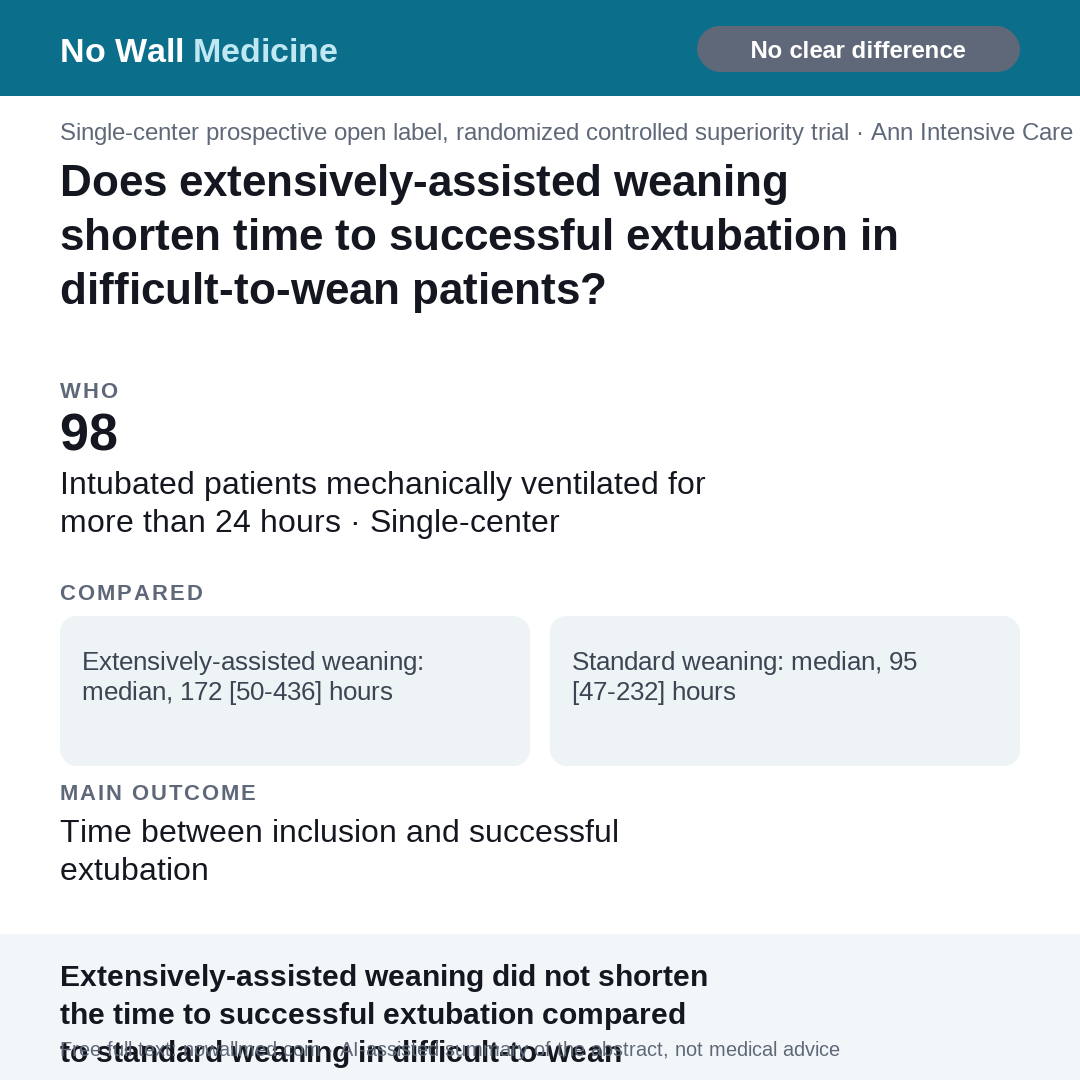
Clinical question: Does extensively-assisted weaning shorten time to successful extubation in difficult-to-wean patients?
Why it matters: Guidelines differ on the best weaning strategy for difficult-to-wean patients from mechanical ventilation
Key points
- 98 patients were randomized into two groups to compare weaning strategies.
- Time to successful extubation was not significantly different between groups, with a hazard ratio of 0.88.
- All secondary outcomes were also not significantly different between groups.
Limitation the authors note: The study was a single-center trial
Headline and key points written with AI from the paper’s abstract, with every number checked against it. Read the paper before relying on them.
Cite this article
Mezidi M, Yonis H, Chauvelot L, Deniel G, Dhelft F, Gaillet M. Spontaneous breathing trial with pressure support on positive end-expiratory pressure and extensive use of non-invasive ventilation versus T-piece in difficult-to-wean patients from mechanical ventilation: a randomized controlled trial. Ann Intensive Care. 2024. doi:10.1186/s13613-024-01290-6
Spotted a mistake? Suggest a correction
Top studies every Monday
The week’s key trials and guidelines in your specialties, plus any topics you follow. By email, free.
Get the weekly digest