Spontaneous blastocyst collapse was associated with lower pregnancy and euploidy rates in IVF
Spontaneous collapse as a prognostic marker for human blastocysts: a systematic review and meta-analysis
Systematic review and meta-analysisHarm found
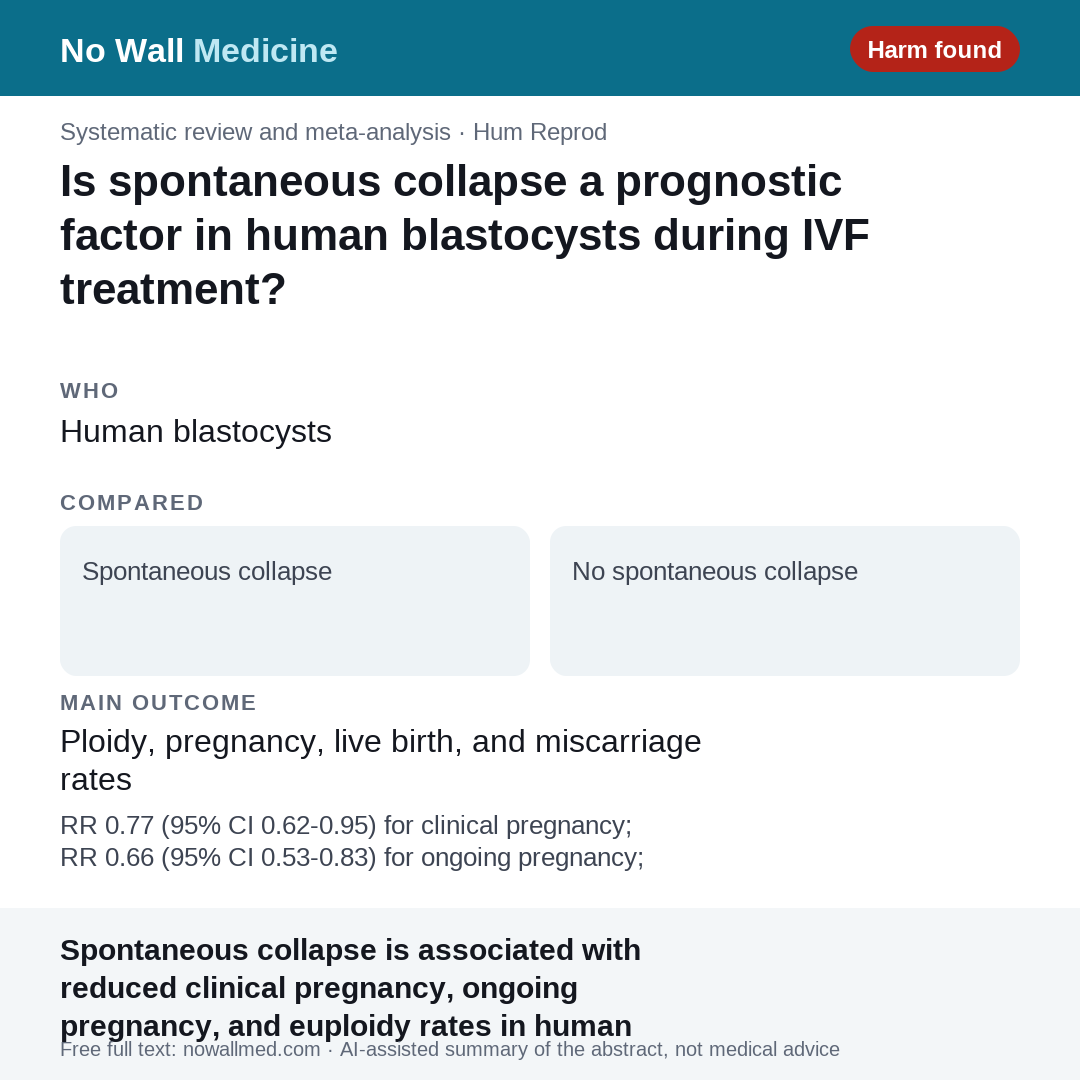
Is spontaneous collapse a prognostic factor in human blastocysts during IVF treatment?
Who
Human blastocysts
Compared
Spontaneous collapse
No spontaneous collapse
Main outcome
Ploidy, pregnancy, live birth, and miscarriage rates
Result: RR 0.77 (95% CI 0.62-0.95) for clinical pregnancy; RR 0.66 (95% CI 0.53-0.83) for ongoing pregnancy; RR 0.70 (95% CI 0.59-0.83) for euploidy
Bottom line: Spontaneous collapse is associated with reduced clinical pregnancy, ongoing pregnancy, and euploidy rates in human blastocysts.
Limitation: All studies were retrospective with varying heterogeneity and potential confounding factors.
Hum Reprod · 2023-08-15Download image
Clinical question: Is spontaneous collapse a prognostic factor in human blastocysts during IVF treatment?
Why it matters: The ploidy and clinical prognosis of human blastocysts that undergo spontaneous collapse are poorly understood due to inconsistent reports.
Key points
- A meta-analysis of seven retrospective cohort studies involving 6,801 blastocysts found a spontaneous collapse incidence of 37.0%.
- Spontaneous collapse was associated with lower clinical pregnancy rates (RR = 0.77, 95% CI = 0.62-0.95), ongoing pregnancy rates (RR = 0.66, 95% CI = 0.53-0.83), and euploidy rates (RR = 0.70, 95% CI = 0.59-0.83).
- Spontaneous collapse was not associated with differences in live birth rates (RR = 0.76, 95% CI = 0.55-1.04) or miscarriage rates (RR = 1.31, 95% CI = 0.95-1.80).
Limitation the authors note: All included studies were retrospective, had varying levels of heterogeneity, and did not account for potential confounding factors.
Headline and key points written with AI from the paper’s abstract, with every number checked against it. Read the paper before relying on them.
Was this summary helpful?
Subject terms
Cite this article
Bickendorf K, Qi F, Peirce K, Natalwala J, Chapple V, Liu Y. Spontaneous collapse as a prognostic marker for human blastocysts: a systematic review and meta-analysis. Hum Reprod. 2023. doi:10.1093/humrep/dead166
Spotted a mistake? Suggest a correction
Top studies every Monday
The week’s key trials and guidelines in your specialties, plus any topics you follow. By email, free.
Get the weekly digest