Stable pulmonary function in Birt-Hogg-Dubé syndrome: a 4-year longitudinal study
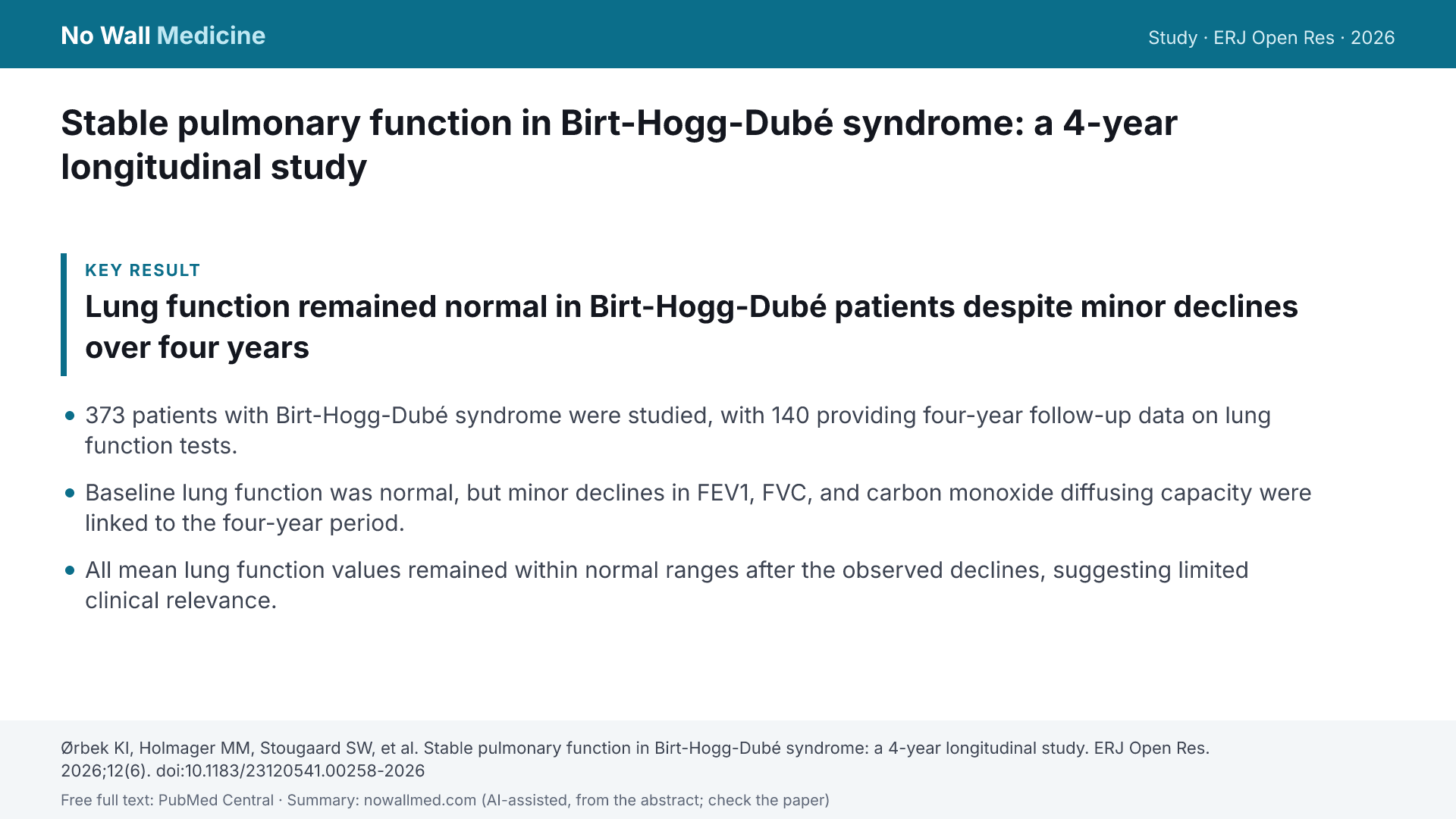
Key result: Lung function remained normal in Birt-Hogg-Dubé patients despite minor declines over four years
Key points
- 373 patients with Birt-Hogg-Dubé syndrome were studied, with 140 providing four-year follow-up data on lung function tests.
- Baseline lung function was normal, but minor declines in FEV1, FVC, and carbon monoxide diffusing capacity were linked to the four-year period.
- All mean lung function values remained within normal ranges after the observed declines, suggesting limited clinical relevance.
Why it matters: Applies to patients with Birt-Hogg-Dubé syndrome; indicates that long-term lung function remains within normal limits despite minor physiological changes.
Limitation the authors note: The study relied on retrospective data from a descriptive cohort design across three regions.
Discussion prompts
- Would these patients look like yours? Who was left out?
- Is the main outcome one that matters to patients?
- Is the difference large enough to change what you do?
Cite: Ørbek KI, Holmager MM, Stougaard SW, et al. Stable pulmonary function in Birt-Hogg-Dubé syndrome: a 4-year longitudinal study. ERJ Open Res. 2026;12(6). doi:10.1183/23120541.00258-2026
Free full text: PubMed Central · Summary and visual abstract: nowallmed.com/a/stable-pulmonary-function-in-birt-hogg-dube-syndrome-a-4-year-1uskj0s/ (AI-assisted from the abstract; check the paper before relying on it).