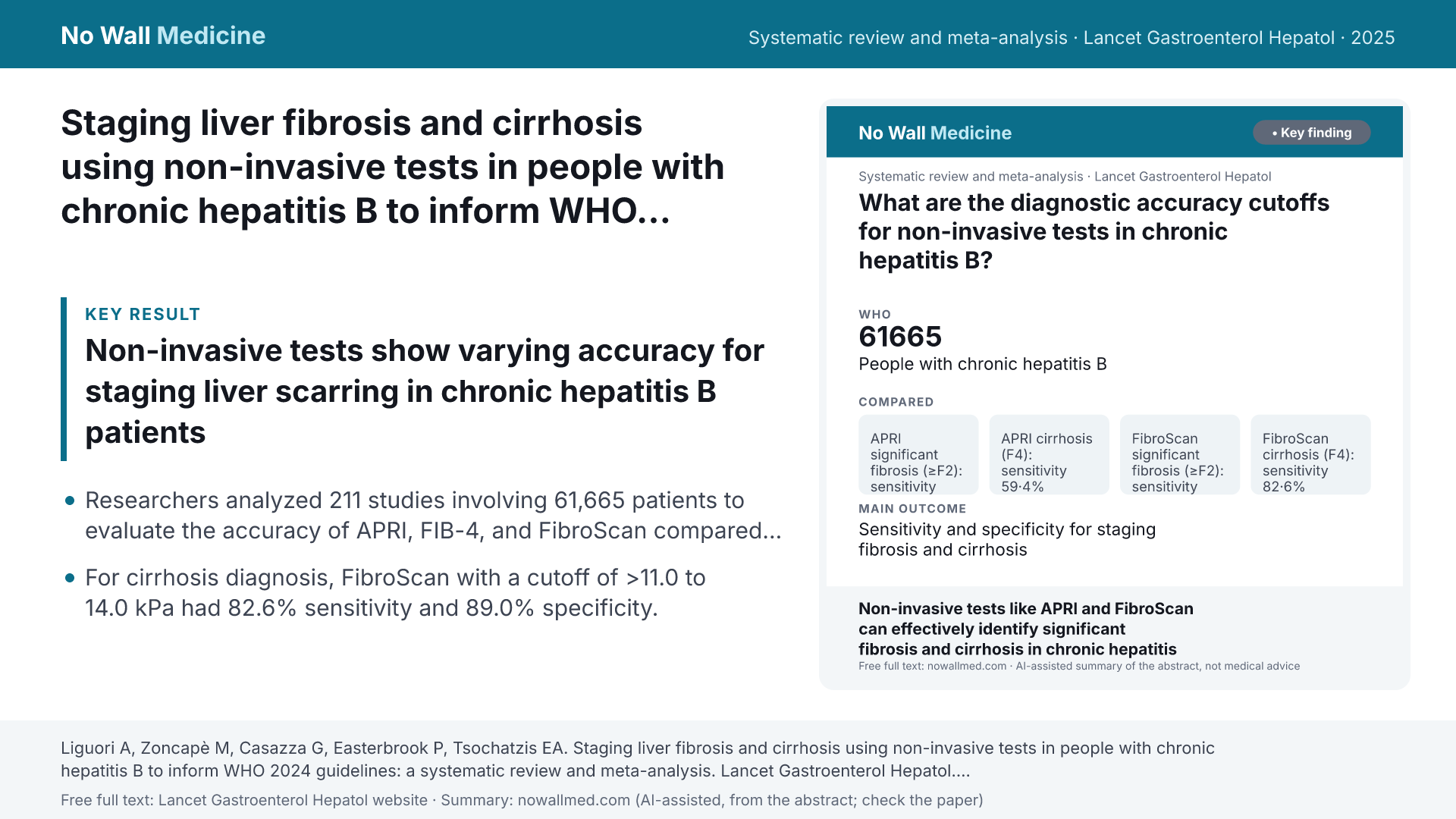
Non-invasive tests show varying accuracy for staging liver scarring in chronic hepatitis B patients
Staging liver fibrosis and cirrhosis using non-invasive tests in people with chronic hepatitis B to inform WHO 2024 guidelines: a systematic review and meta-analysis
Systematic review and meta-analysisKey finding
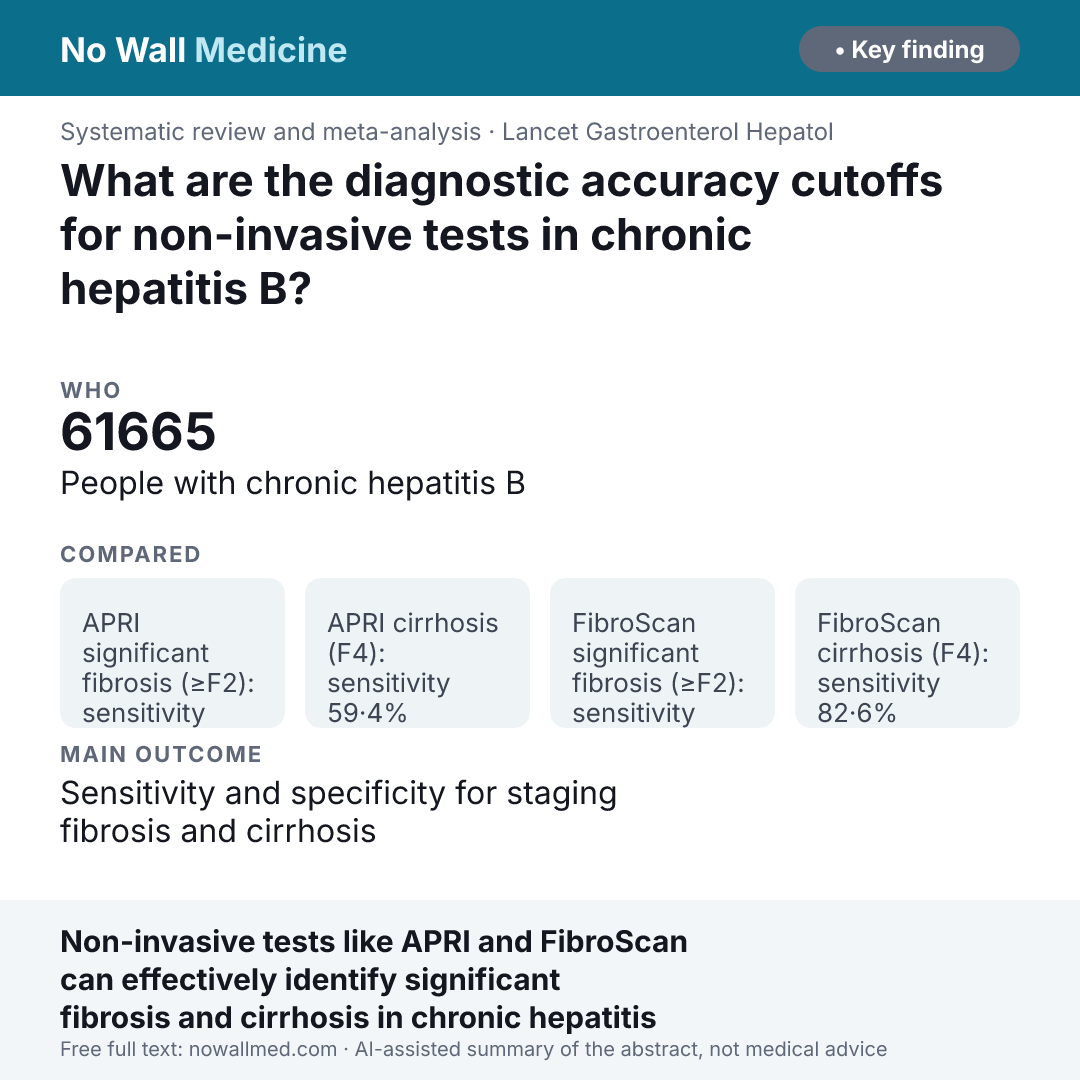
What are the diagnostic accuracy cutoffs for non-invasive tests in chronic hepatitis B?
Who
61665
People with chronic hepatitis B
Compared
APRI significant fibrosis (≥F2): sensitivity 72·9% (95% CI 70·2-75·5)
APRI cirrhosis (F4): sensitivity 59·4% (53·2-65·2)
FibroScan significant fibrosis (≥F2): sensitivity 75·1% (72·2-77·7)
FibroScan cirrhosis (F4): sensitivity 82·6% (77·8-86·5)
Main outcome
Sensitivity and specificity for staging fibrosis and cirrhosis
Bottom line: Non-invasive tests like APRI and FibroScan can effectively identify significant fibrosis and cirrhosis in chronic hepatitis B.
Limitation: 231 studies had a high risk of bias.
Funded by: WHO
Lancet Gastroenterol Hepatol · 2025-02-18 · Save PNG
Clinical question: What are the diagnostic accuracy cutoffs for non-invasive tests in chronic hepatitis B?
Why it matters: The specific cutoffs for non-invasive tests to diagnose significant fibrosis and cirrhosis in people with chronic hepatitis B needed updating for the 2024 WHO guidelines.
Key points
- Researchers analyzed 211 studies involving 61,665 patients to evaluate the accuracy of APRI, FIB-4, and FibroScan compared to liver biopsies.
- For cirrhosis diagnosis, FibroScan with a cutoff of >11.0 to 14.0 kPa had 82.6% sensitivity and 89.0% specificity.
- For significant fibrosis, the APRI low cutoff of >0.3 to 0.7 had 72.9% sensitivity and 64.7% specificity.
Limitation the authors note: A large number of the included studies had a high or unclear risk of bias.
Headline and key points written with AI from the paper’s abstract, with every number checked against it. Read the paper before relying on them.
Was this summary helpful?
Abstract
Background
Non-invasive tests (aspartate aminotransferase-to-platelet ratio index [APRI] and transient elastography [FibroScan]) were recommended in the 2015 WHO guidelines to guide treatment decisions in people with chronic hepatitis B. We updated the systematic review and meta-analysis that informed the 2015 guidelines to inform new cutoffs for non-invasive tests for the diagnosis of significant fibrosis and cirrhosis for the 2024 WHO guidelines for chronic hepatitis B. Methods
We searched PubMed (MEDLINE), Embase, and Science Citation Index Expanded (Web of Science) for studies published in any language between Jan 1, 2014, and Feb 15, 2023. We included all studies that reported cross-sectional data on the staging of fibrosis or cirrhosis with APRI, Fibrosis-4 (FIB-4), and FibroScan compared with liver biopsy as the reference standard in people with chronic hepatitis B. We excluded studies in which the maximum interval between liver biopsy and non-invasive fibrosis test was more than 6 months; that reported on fewer than ten patients with advanced fibrosis or cirrhosis; that were done exclusively in children; and did not report diagnostic accuracy across our prespecified ranges of test cutoffs. The results of this updated search were collated with the meta-analysis that informed the 2015 guidelines. Outcomes of interest were the sensitivity and specificity of non-invasive tests using defined index test cutoffs for detecting significant fibrosis (≥F2), advanced fibrosis (≥F3), and cirrhosis (F4) based on the METAVIR staging system. We performed meta-analyses using a bivariate random-effects model. Findings
Of 19 933 records identified by our search strategy, 195 were eligible for our systematic review and combined with the 69 studies from the previous meta-analysis to total 264. Two studies were at low risk of bias, 31 studies had unclear risk of bias, and 231 studies had a high risk of bias. Of these 264, 211 studies with 61 665 patients were used in the meta-analysis. For the diagnosis of significant fibrosis (≥F2), sensitivity and specificity were 72·9% (95% CI 70·2-75·5) and 64·7% (95% CI 61·0-68·2) for the APRI low cutoff (>0·3 to 0·7), 30·5% (23·7-38·3) and 92·3% (89·3-94·6) for the APRI high cutoff (>1·3 to 1·7), and 75·1% (72·2-77·7) and 79·3% (76·2-82·2) for FibroScan (>6·0 to 8·0 kPa), respectively. For the diagnosis of cirrhosis (F4), sensitivity and specificity were 59·4% (53·2-65·2) and 73·9% (70·1-77·4) for the APRI low cutoff (>0·8 to 1·2), 30·2% (24·2-36·9) and 88·2% (85·4-90·6) for the APRI high cutoff (>1·8 to 2·2), and 82·6% (77·8-86·5) and 89·0% (86·3-91·2) for FibroScan (>11·0 to 14·0 kPa), respectively. Using a hypothetical population of 1000 unselected patients with chronic hepatitis B with a 25% prevalence of significant fibrosis (≥F2), the APRI low cutoff for significant fibrosis (≥F2) would result in 262 (26·2%) false positives but only 68 (6·8%) false negatives. The FibroScan cutoff would result in 158 (15·8%) false positives and 63 (6·3%) false negatives. In a population with a 5% prevalence of cirrhosis (F4), the APRI low cutoff for cirrhosis (F4) would result in 247 (24·7%) false positives and 21 (2·1%) false negatives and the FibroScan cutoff would result in 105 (10·5%) false positives and nine (0·9%) false negatives. Interpretation
These findings have informed new thresholds of APRI and FibroScan for diagnosis of significant fibrosis and cirrhosis in the 2024 WHO guidelines on chronic hepatitis B, with an APRI score greater than 0·5 or a FibroScan value greater than 7·0 kPa considered to identify most adults with significant fibrosis (≥F2) and an APRI score greater than 1·0 or a FibroScan value greater than 12·5 kPa to identify most adults with cirrhosis (F4). These patients are a priority for antiviral treatment. Funding
WHO.
Abstract reproduced under the article’s CC BY licence.
Subject terms
Headline, design, result, key points, caveat and citation as plain text.
Cite this article
Liguori A, Zoncapè M, Casazza G, Easterbrook P, Tsochatzis EA. Staging liver fibrosis and cirrhosis using non-invasive tests in people with chronic hepatitis B to inform WHO 2024 guidelines: a systematic review and meta-analysis. Lancet Gastroenterol Hepatol. 2025;10(4):332-349. doi:10.1016/S2468-1253(24)00437-0
Spotted a mistake? Suggest a correction